Introduction
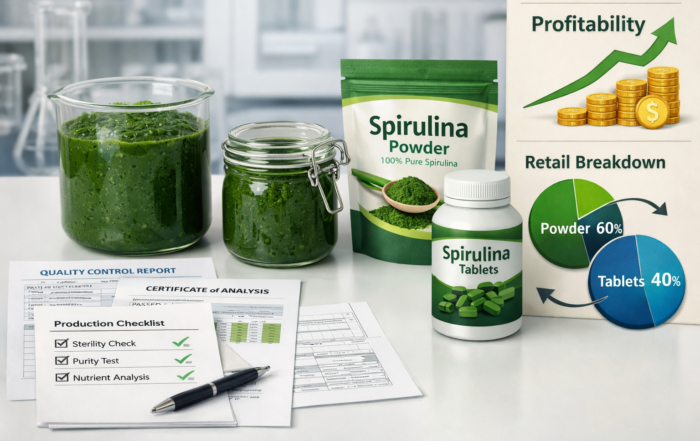
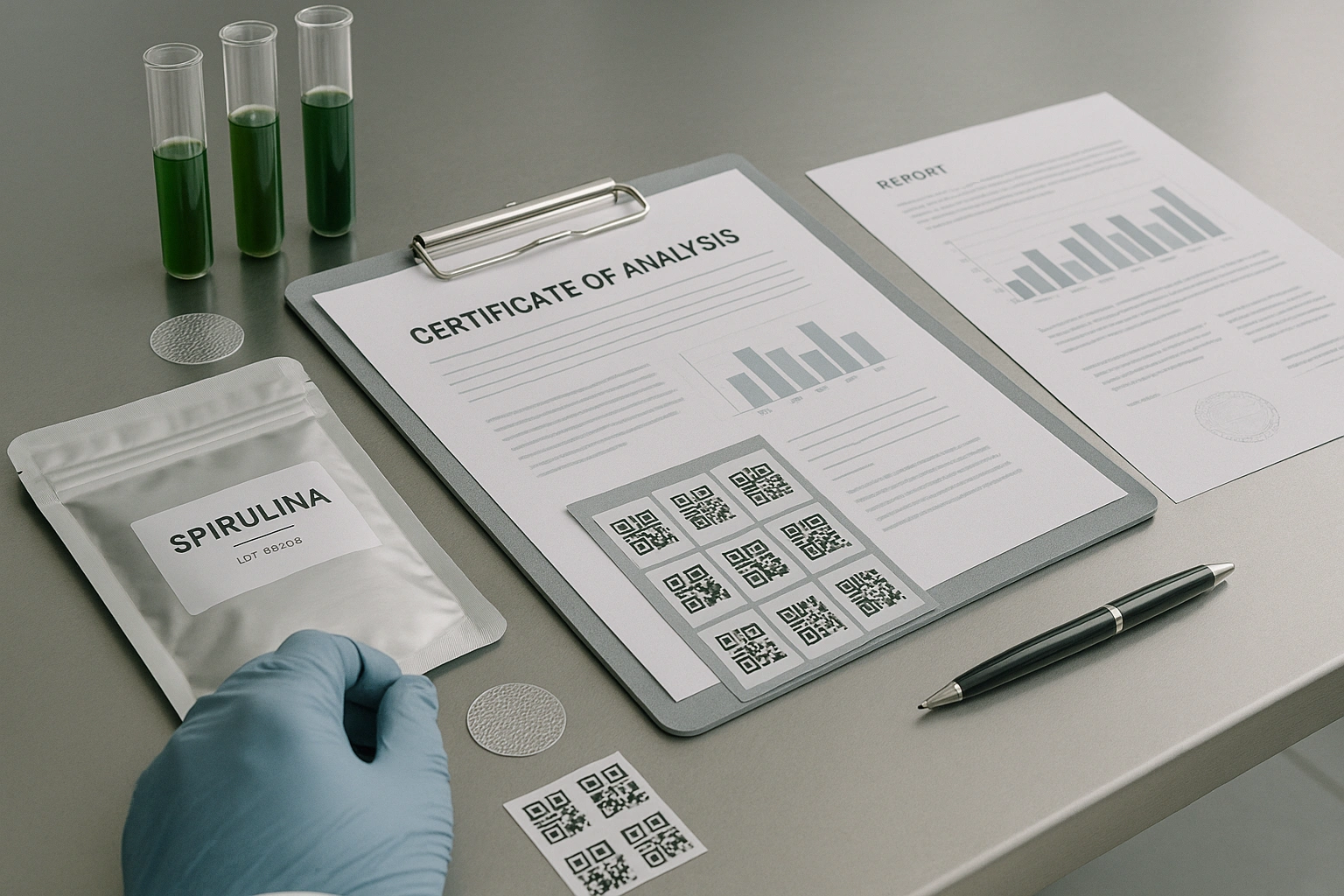
A Certificate of Analysis (COA) is the most crucial quality assurance document in spirulina farming and export operations. It verifies that the final product meets international safety, purity, and nutritional standards. Every batch of spirulina destined for domestic or export markets must be tested for microbial load, heavy metals, moisture, pigment levels, and protein content.
A COA not only assures buyers of product consistency but is also mandatory for HACCP, GMP, ISO 22000, USDA Organic, and EU Organic certification. In this blog, we’ll outline exactly what your COA should display, how to interpret the results, and how to maintain documentation for global compliance.
For an overview of quality testing standards, refer to Spirulina Quality Control in Mass Production: Ensuring Consistency and Safety.
Why the COA Matters in Spirulina Production
- Confirms product safety and purity before export.
- Ensures compliance with food safety authorities (FSSAI, FDA, EFSA).
- Builds credibility with international buyers and nutraceutical brands.
- Protects farms from rejection and financial losses due to contamination or inconsistency.
Every COA acts as a scientific fingerprint of your product — confirming that each lot is safe, nutritionally balanced, and free from harmful contaminants.
Key Parameters Every COA Should Include
A comprehensive spirulina COA covers five major categories: physical, chemical, biological, nutritional, and sensory characteristics.
1. Physical & Chemical Parameters
| Parameter | Acceptable Range | Purpose |
| Moisture | ≤ 6% | Prevents microbial growth & clumping |
| pH (10% Solution) | 9–11 | Confirms product alkalinity |
| Ash Content | ≤ 8% | Indicates mineral concentration |
| Particle Size | 100–200 microns | Ensures uniform drying & flowability |
2. Nutritional Composition
| Parameter | Minimum Standard | Purpose |
| Protein | ≥ 60% | Indicates nutritional value |
| Phycocyanin | ≥ 10% | Reflects pigment concentration & antioxidant strength |
| Beta-Carotene | ≥ 1% | Confirms vitamin A precursor presence |
| Iron | 25–35 mg/100g | Validates mineral content |
| Chlorophyll | ≥ 0.8% | Confirms pigment integrity |
3. Heavy Metal Testing
| Metal | Limit (µg/g) | Testing Method | Remarks |
| Lead (Pb) | ≤ 0.20 | Atomic Absorption Spectroscopy | Neurotoxin; export limit |
| Arsenic (As) | ≤ 0.50 | ICP-MS / AAS | Must be below detection level |
| Cadmium (Cd) | ≤ 0.20 | Graphite Furnace AAS | Carcinogenic; cumulative risk |
| Mercury (Hg) | ≤ 0.025 | Cold Vapour AAS | Harmful even at trace levels |
Regular testing through accredited labs ensures compliance with USP and EU Pharmacopoeia standards. (How to Avoid Heavy Metals and Contamination in Spirulina Farming)
4. Microbiological Testing
| Parameter | Specification | Testing Frequency |
| Total Plate Count | ≤ 50,000 CFU/g | Every Batch |
| Yeast & Mold | ≤ 100 CFU/g | Every Batch |
| E. coli, Salmonella, Staphylococcus | Absent | Every Batch |
These tests ensure food safety and are mandatory for HACCP and ISO 22000 certification.
5. Sensory and Visual Attributes
| Parameter | Specification |
| Color | Deep Green to Blue-Green |
| Odor | Mild & Algae-like, no foul smell |
| Texture | Fine, dry, uniform powder |
Any deviation indicates improper drying, microbial spoilage, or contamination.
Example of a Typical Spirulina COA
A standard export-ready COA includes a full panel of tests confirming nutritional, microbiological, and chemical quality. Below is a typical data set::
Physical & Chemical Analysis
| Parameter | Result | Specification |
| Protein | 65.5% | NLT 60% |
| Loss on Drying | 6% | Max 9.0% |
| Total Ash | 6.2% | Max 9.0% |
| Bulk Density | 0.81 g/ml | 0.70–0.85 g/ml |
| Acid Insoluble Ash | 0.19% | Max 0.50% |
Pigment Profile
| Parameter | Result | Specification |
| β-Carotene | 0.198% | NLT 0.160% |
| Chlorophyll-a | 1.17% | Min 1.0% |
| Phycocyanin | 18.4% | Min 10.0% |
| Total Pheophorbides | 0.109% | NMT 0.12% |
| Existing Pheophorbides | 0.071% | NMT 0.08% |
Fatty Acid Profile
| Parameter | Result | Specification Range |
| Palmitic acid | 46% | 35–60% |
| Palmitoleic acid | 5.2% | 2–8% |
| Stearic acid | 4.4% | 1–5% |
| Oleic acid | 5.5% | 1–7% |
| Linoleic acid | 22% | 13–25% |
| Gamma Linolenic acid | 24.1% | 13–27% |
| Alpha Linolenic acid | 0.18% | <0.5% |
Microbial & Pathogen Analysis
| Parameter | Result | Specification |
| Total Aerobic Count | 8,000 CFU/g | NMT 50,000 CFU/g |
| Mould & Yeast | 70 CFU/g | NMT 100 CFU/g |
| E. coli, Salmonella, Staphylococcus | Absent | Absent |
| Coliforms | Absent | Absent |
Elemental Contaminants & Pesticides
| Parameter | Result | Limit |
| Lead (Pb) | 0.11 µg/g | NMT 0.20 µg/g |
| Arsenic (As) | 0.1 µg/g | NMT 0.50 µg/g |
| Cadmium (Cd) | <0.09 µg/g | NMT 0.20 µg/g |
| Mercury (Hg) | <0.025 µg/g | NMT 0.025 µg/g |
| Pesticides | Absent | Absent |
| PAH, PCB, Aflatoxin | Absent | Absent |
This COA format aligns with USP and EU Pharmacopoeia standards and serves as a benchmark for export documentation.
How a COA Is Generated
- Sample Collection: Random samples from different batches are blended for uniformity.
- Lab Testing: Samples are tested in accredited laboratories using validated methods such as ICP-MS, AAS, and HPLC.
- Data Recording: Results are compared to standard reference ranges.
- Certification: A formal COA document is issued with batch number, manufacturing date, and testing results.
For farms with in-house labs, maintaining calibration logs and retaining samples for at least 6 months ensures traceability and compliance.
COA and Export Compliance
International buyers and authorities like the FDA (USA) and EFSA (Europe) require batch-wise COAs for product approval. Your COA must align with:
- USDA Organic / EU Organic standards
- HACCP and GMP protocols
- ISO 22000 food safety management
Before export, ensure your product passes COA verification along with phytosanitary and organic transaction certificates. (Spirulina Farming for Export to the US and Europe)
Maintaining COA and Quality Records
To ensure transparency and reliability:
- Store all COAs (digital and physical) for a minimum of 5 years.
- Cross-reference every shipment’s COA with its batch number and packaging label.
- Conduct random third-party COA audits twice annually.
- Maintain HACCP-compliant documentation logs and validation checklists.
These practices protect your brand from recalls and strengthen your credibility in international markets.
Common COA Mistakes to Avoid
- Incomplete testing — skipping heavy metal or microbial parameters.
- Non-accredited lab results — unrecognized reports are rejected during export.
- Mismatched batch labeling — COA must correspond exactly to packaging codes.
- Failure to retest during storage — periodic validation ensures stability.
- Outdated methods — always align with current USP/EU Pharmacopoeia standards.
FAQs
Q1: How often should COA testing be done?
Every batch of spirulina should be tested before drying and packaging, and a COA should accompany each shipment.
Q2: Can farms maintain their own testing labs?
Yes. In-house labs reduce turnaround time but must use validated instruments and maintain calibration logs.
Q3: Is COA mandatory for domestic sales?
While not legally required for all markets, a COA significantly improves brand credibility and compliance.
Q4: How can COA help detect contamination?
By analyzing microbial and heavy metal data, COAs can pinpoint early contamination sources, allowing farms to take corrective actions.
Q5: What if a COA shows metal or microbial excess?
The batch must be quarantined, retested, and possibly discarded. Repeated failure may lead to certification suspension.
Conclusion
A Certificate of Analysis (COA) is more than a formality — it’s the proof of spirulina’s purity, nutritional excellence, and compliance with global food safety standards. By consistently testing for heavy metals, microbial safety, pigments, and protein content, spirulina producers can confidently market a product that meets the expectations of both regulators and consumers.
Maintaining transparent COA records, validated lab processes, and HACCP documentation ensures long-term trust, regulatory compliance, and a strong position in the global spirulina industry.
Table Of Contents