Not all spirulina is created equal, and nowhere is that gap wider than at the pharmaceutical-grade tier. While food and bulk spirulina compete largely on price and basic quality, pharma-grade nutraceutical supply is judged on something else entirely: validated purity, reproducibility, and regulatory defensibility. It’s the most demanding, and most valuable, end of the spirulina market. Here’s what actually separates pharma-grade from everything below it, and why so few farms can reach it.
First, what “pharma-grade” does and doesn’t mean
An important clarification up front. “Pharma-grade” refers to the purity, consistency, and manufacturing standard the spirulina is produced to, not a claim that spirulina is an approved drug that treats disease. It means the material is clean, controlled, and documented to a level suitable for pharmaceutical and high-end nutraceutical formulation. The value is in the reliability and safety of the ingredient, exactly what serious buyers pay a premium for.
The tiers of spirulina, and where pharma sits
Spirulina moves through the market in grades, each with different requirements and prices:
| Grade | Judged Mainly On | Typical Use |
|---|---|---|
|
Feed grade |
Basic safety, low cost |
Animal and aqua feed |
|
Food grade |
General food-safety standards |
Supplements, food, beverages |
|
Nutraceutical grade |
Higher purity, pigment content |
Premium supplements |
|
Pharma grade |
Validated purity, GMP, full documentation |
Pharmaceutical and clinical-grade nutraceuticals |
As you climb this ladder, the standards tighten sharply, and pharma-grade sits at the top, evaluated through a far stricter lens than anything below it.
What actually makes spirulina pharma-grade
Pharma buyers don’t purchase spirulina for marketing appeal. They purchase controlled reproducibility, validated purity, and regulatory defensibility. Several things separate this tier:
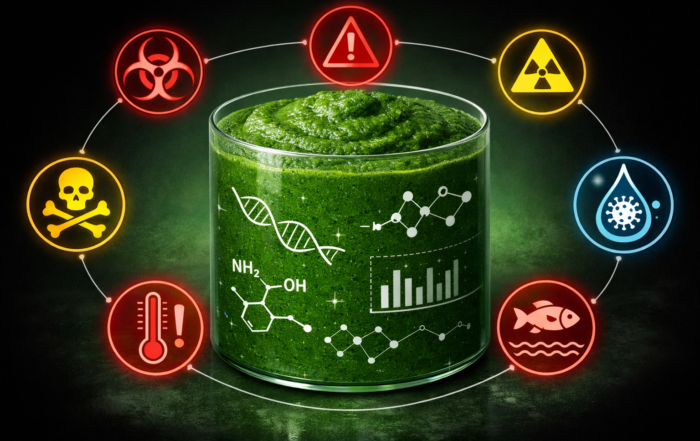
Tighter contaminant limits. Heavy-metal thresholds for pharmaceutical use are typically stricter than general nutraceutical standards, and testing extends to microcystin toxins, microbial load, and agricultural contaminants, all at batch level. The rigorous quality-control regime that food grade treats as a ceiling, pharma grade treats as a floor.
GMP-level manufacturing. Pharma-grade spirulina requires compliance closer to pharmaceutical GMP than food GMP, meaning dedicated zoning, controlled environments, and processes designed to prevent contamination and human contact. This is why reducing human interaction through automation isn’t just efficiency, it’s a compliance necessity at this tier.
Validated reproducibility. Food grade may rely on general shelf-life estimates; pharma grade demands consistent, proven batch-to-batch performance and stability data. Every batch must land within tight specifications, every time.
Documentation precision. Perhaps the defining feature: documentation is often audited more aggressively than the production itself. Pharma buyers frequently conduct third-party verification that goes beyond a supplier’s own Certificate of Analysis, demanding full traceability and regulatory-grade record-keeping.
The role of phycocyanin
A large part of the pharma-grade story centres on phycocyanin, spirulina’s blue pigment-protein complex. It’s both a natural colorant and a studied bioactive compound with antioxidant and anti-inflammatory properties, and purified pharmaceutical-grade phycocyanin commands premium value with its own stringent purity requirements. Preserving phycocyanin intact from pond to product is therefore central to pharma-grade production, and it hinges directly on processing: low-temperature drying that protects phycocyanin and protein structure is what keeps high-value material within pharma specification. High-heat drying that degrades the pigment simply disqualifies the batch.
Why most farms can’t reach this tier
Here’s the commercial reality. A farm can only supply pharma-grade if it invests in laboratory infrastructure, GMP zoning, and compliance systems, and sub-scale farms often struggle to absorb those fixed compliance costs. Several structural requirements stand in the way:
- Water and material integrity. Groundwater must be consistently monitored, and all interaction surfaces must be SS 316 grade to prevent contamination
- Automated, low-contact processing. Automated harvesting equipment reduces human contact and microbial introduction risk
- In-built compliance architecture. GMP zoning is far cheaper to design in from the start than to retrofit later
- Financial scale. Higher compliance costs, audit frequency, and liability exposure must be built into the business model from day one
The farms best positioned for pharmaceutical supply chains are those that engineer laboratory capability, drying stability, and compliance precision from inception, not as an afterthought.
The market opportunity
For farms that can meet the bar, the reward is real. Pharma-grade and pharmaceutical-grade phycocyanin sit in a high-value, growing market, precisely because so few suppliers can deliver validated, regulatory-defensible material consistently. It’s the clearest example of how quality, not volume, drives spirulina profitability: the same biomass that earns commodity prices as feed can command a multiple of that when produced to pharma standard.
Building for the pharmaceutical tier
Reaching pharma-grade isn’t about trying harder at the end of the process; it’s about designing the whole operation for it from the ground up. Laboratory capability, GMP zoning, controlled low-heat drying, automated low-contact handling, and audit-ready documentation all have to be engineered in from the start. This is where infrastructure and expertise are decisive. Facilities built through turnkey spirulina farm solutions can integrate GMP zoning and compliance architecture during planning rather than retrofitting later. Companies like Greenbubble, with 10+ years of experience, operations across 10+ countries, recognition as Best Microalgae Company by the European Algae Biomass Association in Paris, and a customer base accounting for more than 90% of India’s spirulina production, build farms engineered for exactly this level of controlled, compliant, high-value production.
Where this leaves producers
Pharma-grade spirulina is the summit of the market: defined not by marketing or even by nutrition alone, but by validated purity, GMP-level manufacturing, reproducible quality, and documentation robust enough to survive aggressive third-party audit. It’s the tier where spirulina stops being a commodity and becomes a precision ingredient, and where the farms that engineered quality in from the start finally get paid for it. For producers willing to build the lab, the compliance, and the discipline, pharma-grade is where spirulina’s real value lives.
Make us your source on Google
Table Of Contents