Food security has become a national priority across the Gulf. The UAE’s National Food Security Strategy 2051, Saudi Arabia’s Vision 2030 and Qatar’s food security programmes all aim to reduce dependence on imported food and build local production that can withstand supply shocks.
Spirulina fits that goal well. It produces high-quality protein on land unsuitable for conventional crops, needs far less water than livestock or most field crops, and serves markets from supplements to animal feed. It is not a crop that grows itself in the desert, though. The Gulf’s extreme summers, scarce fresh water and dust storms demand serious engineering.
We have built spirulina farms in more than 10 countries over the last decade, including our project in Morocco, and our customers account for more than 90% of India’s spirulina production. This guide explains what it takes to farm spirulina successfully in the UAE and the wider Gulf.
Why the Gulf Has Real Potential
| Gulf advantage | What it means for spirulina |
|---|---|
|
Intense sunlight almost year-round |
Sunlight is spirulina’s most economical energy source |
|
Mild, sunny winters |
Excellent growing conditions from roughly October to April |
|
Very low rainfall |
No monsoon dilution and few cloudy days |
|
Non-arable land |
Spirulina doesn’t need fertile soil |
|
Government food security focus |
Strong policy interest in local protein production |
|
Large solar power capacity |
Potential to lower long-term energy costs |
|
Growing health, fitness and supplement markets |
Local demand for premium, traceable products |
|
Expanding aquaculture and poultry sectors |
Demand for spirulina as a feed ingredient |
For investors focused on local food production, spirulina offers something rare: a high-value protein crop that suits the region’s land instead of fighting it.
The Four Challenges You Must Engineer Around
1. Extreme Summer Heat
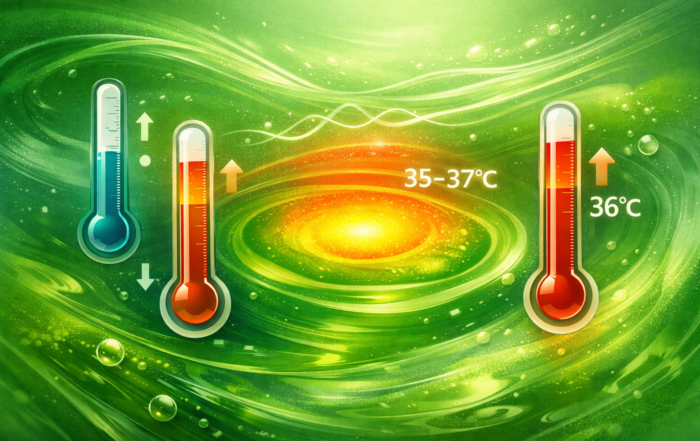
Summer temperatures in the Gulf regularly reach 45 to 50°C, often with high humidity along the coast. Spirulina culture begins to bleach above 40°C, and its optimal growth range is 35 to 37°C.
Keeping a culture alive through a Gulf summer is possible with careful monitoring and design. We have sustained cultures when outside temperatures reached 48 to 50°C. It requires:
- Hourly monitoring of pond temperature
- Shade nets and covered structures to keep culture below 38°C
- Agitator speed and run time adjusted to help control temperature
- Deeper water in summer for thermal buffering
- Cold culture reserves added when ponds approach 38°C
- Large raceway ponds, which hold temperature far more steadily than small tanks
In the harshest months, many Gulf farms plan for reduced output and focus on keeping the culture healthy. Production then ramps up again in autumn. See how to maintain spirulina culture in high temperatures.
2. Water Scarcity and Salinity
Water is the Gulf’s defining constraint. Fresh water comes largely from desalination, and groundwater is often brackish.
Spirulina tolerates salinity, which helps, but it grows best at relatively low salt levels. Growth is strongest at around 5.8 to 11.7 ppt of sodium chloride and falls at higher concentrations. That has three practical consequences:
- Seawater cannot be used directly. It is far too saline.
- Desalination reject brine is also unsuitable. Its salt concentration is even higher than seawater’s.
- Brackish groundwater may be usable after full testing and treatment.
Treated sewage effluent deserves a clear warning. Spirulina grown on treated wastewater is not suitable for food or supplement use. Spirulina absorbs contaminants from its water, and biomass grown this way cannot meet food-grade safety standards. Any farm producing for human consumption must use clean, tested water.
High evaporation also means regular top-up. Water recycling after harvesting, where the culture medium returns to the ponds, is essential to keep consumption low. Read why water quality is critical in spirulina farming.
3. Dust and Sandstorms
Shamal winds and sandstorms can carry dust and debris into open ponds, raising contamination and complicating harvests. In the Gulf, protection is not optional:
- Covered raceways or greenhouse-style structures
- 80-mesh pre-filtration before harvesting
- Screens in front of agitators, cleaned daily
- Site layouts that use buildings and windbreaks for shelter
Learn more in how to build a low-contamination spirulina system.
4. Energy for Cooling and Processing
Keeping ponds and processing areas within safe temperatures uses energy. The region’s strong solar capacity is an advantage here. Solar power can offset a meaningful share of the cost of agitators, pumps and processing equipment. See solar-based farms and projects.
What About Indoor Farming and Artificial Light?
The Gulf has invested heavily in indoor vertical farms, so many investors ask whether spirulina can be grown indoors under LED lighting.
Technically, yes. Commercially, it rarely makes sense. Spirulina needs a lot of light, and replacing free sunlight with electricity makes production far more expensive. We don’t use artificial lighting in commercial plants because it isn’t economically viable. The better approach is to use the Gulf’s abundant sunlight and control heat and dust with shading and covered structures. Read can spirulina be cultivated indoors.
The Gulf Spirulina Calendar
| Season | Months | Conditions | Focus |
|---|---|---|---|
|
Peak season |
October to April |
Warm days and strong sunlight |
Maximum production and certification batches |
|
Transition |
April to May |
Rising heat |
Build culture reserves and prepare shading |
|
Summer |
June to September |
Extreme heat and humidity |
Protect the culture, control temperature, reduce output where needed |
Unlike much of India, the Gulf’s best growing season falls in its cooler months.
Regulations and Certification
Each Gulf country has its own food safety authorities. In the UAE, food regulation is handled at both federal and emirate level. Across the region, producers should plan for:
- Food safety registration with the relevant national or emirate authority
- Halal certification, which buyers across the region expect
- Food safety management systems such as HACCP or ISO 22000
- Organic certification if you target the premium organic market
- Batch testing, with a Certificate of Analysis for every lot
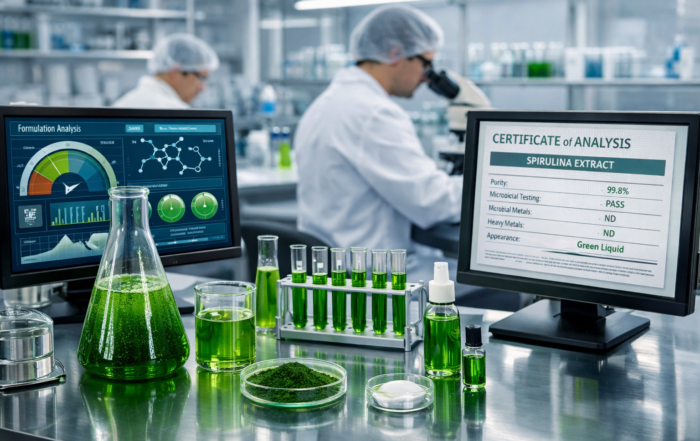
Typical COA specifications include protein of at least 60%, moisture below 9%, phycocyanin of at least 10%, heavy metals within strict limits, and the absence of pathogens such as E. coli and Salmonella. An in-house lab is essential for consistent certification. See our spirulina certification guide.
Who Buys Spirulina in the Gulf?
- Supplement and sports nutrition brands serving the region’s health and fitness market
- Food and beverage brands using spirulina and phycocyanin as a natural colour and protein source
- Aquaculture and poultry feed producers, supporting local food production goals
- Cosmetic and skincare formulators
- Government and institutional buyers linked to food security programmes
Locally produced, traceable and halal-certified spirulina can compete strongly against imports, particularly with buyers who value supply security. For feed markets, see spirulina for poultry and animal feed.
Scale Decides Profitability
Across every market we work in, one lesson holds: small spirulina farms struggle to make money. In our Indian cost models, a 1-acre farm runs at a loss once full operating costs are included, while a 3-acre farm reaches roughly 37% annual ROI.
Gulf economics differ, since land, labour, construction and energy costs are not the same as in India. But the principle holds. Fixed costs for automation, labs, certification and skilled staff need enough output to cover them. Plan for commercial scale from the start.
Setting Up: The Essentials
1. Define your market. Supplements, food colour, feed and institutional supply each require different grades and certifications.
2. Secure and test your water. Water source, quality and recycling capacity are the most important site decisions in the Gulf.
3. Design for heat and dust. Build large raceway ponds with covered structures, shading and agitation designed for extreme temperatures.
4. Automate harvesting and processing. Use a 500-mesh harvesting system, dewatering, and low-temperature drying such as Refractance Window Drying, which keeps spirulina below 45°C. Manual processing leads to contamination and failed audits.
5. Build a lab and train your team. Test every batch before sale. Skilled operators who understand heat management and hygiene are essential.
6. Get certified early. Food safety registration, halal certification and food safety systems should be part of the plan from day one.
How We Help You Build in the Gulf
Farming spirulina in the Gulf is not a copy-paste of farming in milder climates. Every design decision, from pond size and depth to shading, water recycling and processing, must account for extreme heat and scarce water.
When you work with us, we:
- Assess your site and water source, including salinity and contamination testing
- Design farms for desert conditions, with thermal management, dust protection and water recycling
- Integrate automated harvesting, dewatering, drying and packing into one continuous line
- Set up your in-house lab for batch testing and COAs
- Train your team and support you through stabilisation and certification
We have been recognised as Best Microalgae Company by the European Algae Biomass Association in Paris. Our turnkey spirulina farming solutions start from US $200,000, and our spirulina farming consultancy can help you evaluate feasibility before you invest.
Growing Protein in the Desert
The Gulf has the sunlight, the land and the policy will to make spirulina a meaningful part of its food security future. What it demands in return is engineering: protecting the culture through summer, using water carefully and cleanly, keeping dust out, and building at a scale that makes the numbers work.
Get those fundamentals right, and spirulina can turn some of the world’s harshest farming conditions into a reliable source of high-value protein.
Make us your source on Google
Table Of Contents