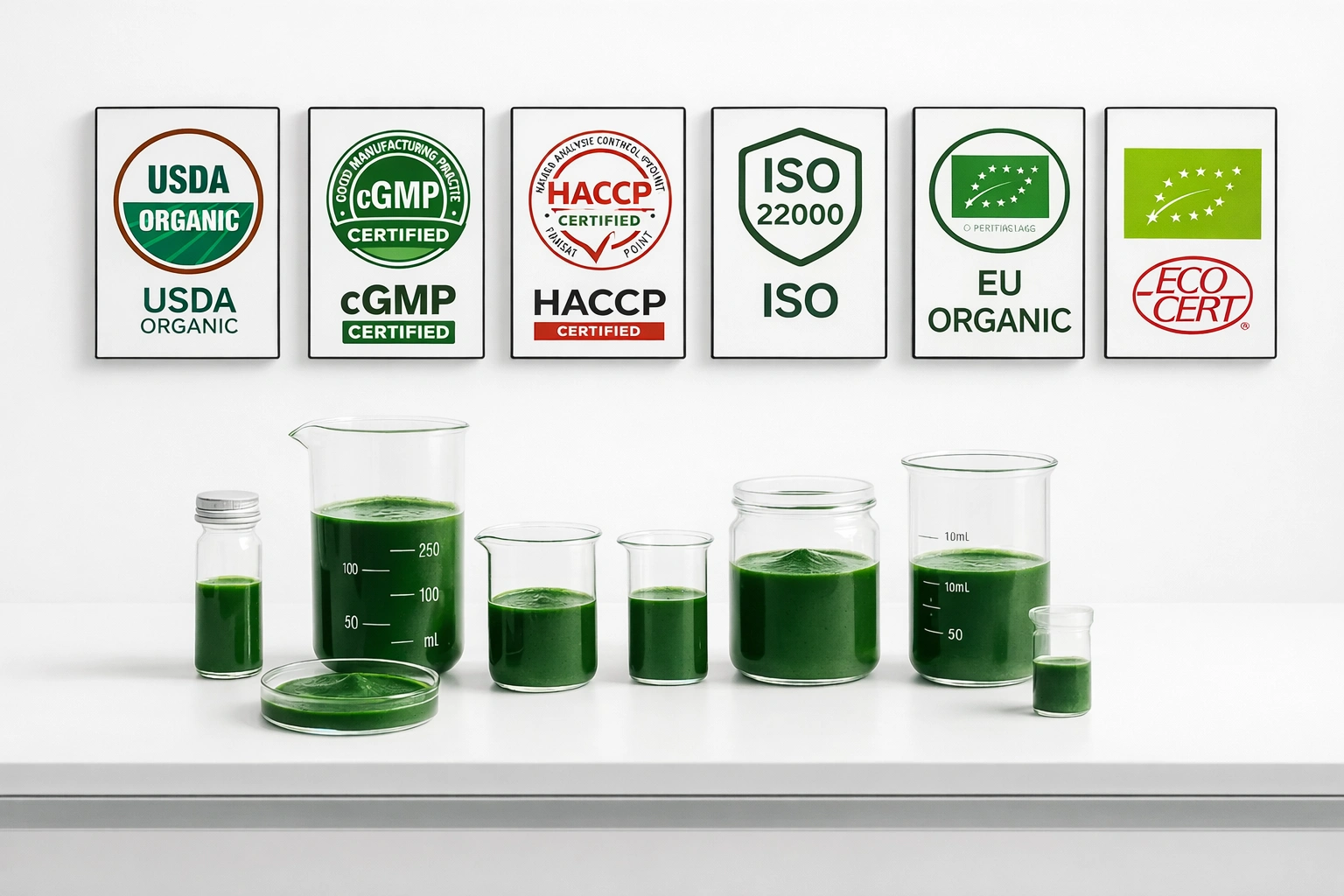
Getting Spirulina certified-whether under India’s NPOP, USDA Organic (US), or EU Organic Regulation 2018/848-is one of the most challenging yet essential steps for farms aiming to sell in premium health-supplement markets. Contrary to common online claims, spirulina certification is not simple, low-cost, or paperwork-free.
At Greenbubble, certification is treated as a system-level outcome, not a post-production add-on. It requires strict control over the entire production chain-from nutrient sourcing and pond design to drying, packaging, lab testing, automation, and end-to-end traceability.
This guide explains each certification framework using Greenbubble-validated spirulina farming practices, aligned with India, US, and EU audit expectations.
Why Certification Matters in Spirulina Farming
Many new farmers believe Spirulina is naturally clean or inherently “organic.” However, certification requires proof, not assumptions:
- Testing is mandatory, not optional.
- Organic claims must be audited by third-party agencies.
- Fake organic labeling is a punishable offense.
- No synthetic chemicals or prohibited additives are allowed.
- A strict production environment must prevent cross-contamination.
For more context on why organic certification is a dealbreaker for exports, visit: Why Organic Certification Is Crucial for Spirulina Exports
In Greenbubble-designed spirulina units, certification readiness is built into the layout, SOPs, equipment selection, and documentation from day one. This eliminates the costly retrofitting that causes most farms to fail NPOP, USDA, or EU audits after production has already begun.
Common Myths About Spirulina Certification
Myth 1: “Testing is optional.”
Reality: Continuous testing for quality, contaminants, and prohibited substances is compulsory.
Myth 2: “Organic just means natural.”
Reality: Organic certification requires strict adherence to approved nutrient inputs, zero synthetic chemicals, and documented growing practices.
Myth 3: “Sun-drying qualifies as organic.”
Reality: Sun drying takes up to 48 hours, degrades nutrients, and does not meet organic quality standards. It becomes difficult to get USDA organic.
Myth 4: “Manual farms can pass certification audits easily.”
Reality: Manual farms often fail audits due to contamination, inconsistency, and lack of traceability.
Read more: Why Manual Spirulina Farms Fail in Certification
India’s Spirulina Certification Requirements (NPOP / Jaivik Bharat)
India’s primary organic certification standard falls under the National Programme for Organic Production (NPOP). While the guide does not list NPOP rules directly, it outlines the universal organic principles that NPOP also requires.
Key Requirements:
- No synthetic fertilizers, pesticides, or additives.
- Strict separation from non-organic farms.
- Low-temperature drying (RWD or vacuum drying).
- Mandatory COA testing for each batch.
- Full documentation & traceability.
More guidance: What Makes Spirulina Organic – Compliance Checklist
Greenbubble-compliant Indian spirulina farms follow NPOP-aligned organic principles by enforcing low-temperature drying, batch-wise COA validation, strict material segregation, and complete production traceability-making later export certifications significantly easier.
US Certification Requirements (USDA Organic + FDA GMP)
The US has the strictest combination of organic and food safety regulations.
USDA Organic Requirements:
- Detailed records from nutrient sourcing to packaging.
- Zero synthetic fertilizers or pesticides.
- Annual audits by accredited agents.
- Full traceability from pond to packing.
FDA (GMP/HACCP) Requirements:
- GMP-compliant facility.
- Minimizing human interaction with product.
- HACCP-compliant lab and processing.
- Contamination control.
- Use of SS316 equipment.
Learn more: Spirulina Farming Turnkey Solutions for GMP-Compliant Units
In Greenbubble-designed export-oriented spirulina facilities, USDA Organic and FDA GMP requirements are addressed together through automation-led harvesting, SS316 contact surfaces, controlled drying environments, and audit-ready documentation systems. This integrated approach prevents the compliance gaps that commonly delay US market entry.
EU Certification Requirements (EU Organic Regulation 2018/848)
EU standards align with USDA but emphasize traceability and batch documentation.
Key Requirements:
- Organic certification & audits.
- No synthetic fertilizers.
- Strict contamination control.
- Low-temperature drying.
- Full documentation & traceability.
EU export orientation: Export-Ready Spirulina – Setting Up a Compliant Unit
Drying Standards Required for Organic Certification
Drying quality is non-negotiable for certification.
Preferred Methods:
- Refractive Window Drying (RWD)
- Vacuum Drying
Both preserve nutrients required for premium-grade, organic-certified spirulina.
Not Allowed / Not Recommended:
- Sun drying (inconsistent, nutrient-damaging)
- High-heat drying (>60°C)
More: Spirulina Drying Equipment Solutions
Greenbubble certification systems standardize Refractive Window Drying (RWD) and controlled vacuum drying because these methods consistently meet organic audit requirements while preserving phycocyanin, protein integrity, and microbial safety.
Lab & Testing Requirements
Certified spirulina farms must maintain an in-house analytical and microbiological lab.
Required Testing:
- Protein %, ash %, moisture, pigments
- Heavy metals
- Microbial contamination
- Pathogens
- Pesticides & PAHs
Learn more: Lab Testing for Spirulina – What Certifications Matter
Why Automation Is Crucial for Certification
Manual farms struggle to meet certification standards due to inconsistent yield and contamination risks. Automation ensures:
- Consistent pH, temperature, and nutrients
- Traceability
- Reduced human contact
- Audit-ready documentation
More: Automation in Spirulina Harvesting – Why It’s Non-Negotiable
Certification Comparison Table
| Requirement | India (NPOP) | US (USDA + FDA GMP) | EU Organic |
| No synthetic chemicals | Yes | Yes | Yes |
| Facility separation | Yes | Yes | Yes |
| Documentation & traceability | Yes | Extensive | Extensive |
| Annual audits | Yes | Yes | Yes |
| Low-temperature drying | Required | Required | Required |
| Export compliance | Required | Strict | Strict |
FAQs
Q1. What certifications are required for Spirulina in India?
India requires organic compliance under the NPOP system along with batch-wise COA testing, contamination-free production, and low-temperature drying. These foundational requirements ensure purity, safety, and export readiness.
Q2. Is USDA Organic mandatory for exporting Spirulina to the US?
Yes. To sell Spirulina in the US, USDA Organic certification is essential, along with GMP/HACCP standards, strict traceability, and low-heat drying methods that preserve nutrient integrity.
Q3. Does the EU have different rules compared to the US?
The EU follows Regulation 2018/848, which is similar to USDA Organic but with even stronger emphasis on documentation, traceability, and contamination control.
Q4. Why can’t sun-dried Spirulina be certified organic?
Sun drying degrades nutrients, increases contamination risk, and cannot meet GMP, HACCP, or organic quality standards. Certified farms must use controlled low-temperature drying methods like RWD or vacuum drying.
Q5. Why is automation important for certification?
Automation reduces contamination, improves yield consistency, keeps pH and temperature stable, minimizes human contact, and helps maintain audit-ready records that certification bodies require.
Q6. Do all certified Spirulina farms need an in-house lab?
Yes. Certified farms must maintain analytical and microbiological labs for continuous testing, contamination checks, and verification of each batch’s COA.
Conclusion
Achieving Spirulina certification-whether in India, the US, or the EU-is rigorous and demands strict compliance with organic standards, drying protocols, contamination control, automation, and documentation. Certification is not optional for farms targeting premium domestic or international markets-it is the foundation of trust, safety, and global acceptance.
Greenbubble-aligned spirulina farming systems are built around this reality, ensuring that certification is achievable, repeatable, and scalable rather than risky or retrofitted. For serious producers, certification is not a milestone-it is the operating baseline.
Table Of Contents