Plastic pollution is one of the defining environmental problems of our time, and researchers are hunting for renewable, biodegradable alternatives to petroleum-based plastics. Microalgae, spirulina among them, have emerged as an intriguing candidate. The science here is real and advancing, but it sits firmly at the research-and-development stage. Here’s an honest look at where spirulina-based bioplastics actually stand, how they’re made, and what still has to be solved.
Why microalgae attract bioplastic researchers
The appeal echoes the case for algae biofuels, and it’s genuine. Microalgae offer several advantages as a bioplastic feedstock over conventional crop-based sources:
- Fast growth and high biomass yield, producing raw material quickly
- No competition with food crops for farmland, sidestepping the land conflict of crop-based bioplastics
- Ability to grow on non-arable land or even wastewater, keeping the feedstock sustainable
- CO2 capture during growth, adding a carbon benefit to the material
Spirulina specifically brings extra advantages: it’s already mass-produced at scale, suits simple open-pond cultivation, and, thanks to its soft, non-cellulose cell wall and high protein content, its biomass processes more readily than tougher plant material. These are the same cultivation strengths that make open pond systems ideal for spirulina, now pointed at a materials application.
The two routes to spirulina bioplastic
Research has converged on two distinct ways to turn spirulina into plastic, and they’re quite different.
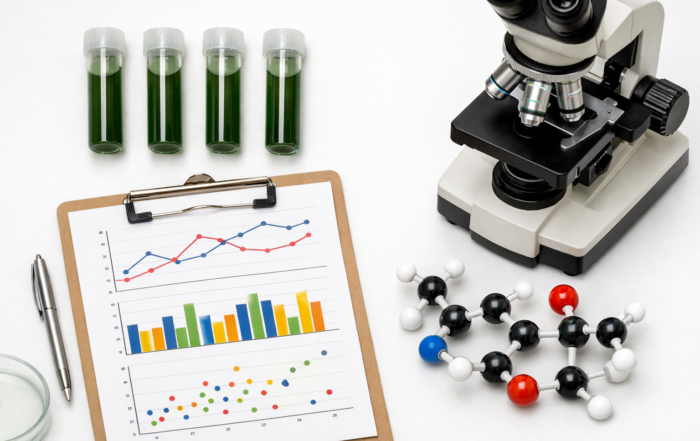
Route 1: Direct use of the biomass. Spirulina’s protein-rich biomass can be processed through thermo-mechanical polymerization, essentially heat-and-pressure moulding, sometimes blended with plasticisers or other polymers, to form films and plastic-like materials. Its high protein content and film-forming ability make this direct route feasible, and studies have specifically developed bioplastics and thermoplastic blends from spirulina and chlorella this way.
Route 2: Spirulina as feedstock for PHA/PHB. The more sophisticated route uses spirulina biomass as a carbon source to produce polyhydroxyalkanoates (PHA) and polyhydroxybutyrate (PHB), high-performance biodegradable polymers, typically via bacterial fermentation. Under nutrient stress, spirulina accumulates carbohydrates that serve as useful feedstock for this process.
What spirulina bioplastics could be used for
The resulting materials are genuinely versatile. Algae-derived biopolymers offer biodegradability, biocompatibility, film-forming ability, and gelling behaviour, which opens applications in food packaging, biomedical devices, pharmaceuticals, and even energy storage. As biodegradable, bio-based materials, they promise to cut both plastic waste and the resource consumption of fossil-based production, the core environmental win.
The honest reality: promising, not proven at scale
Now the necessary candour. Despite active research and real proof-of-concept, spirulina bioplastics are not a commercial product you’ll find replacing petroleum plastic today. Several hurdles stand between the lab and the shelf:
Spirulina’s own PHA content is modest. While some cyanobacteria accumulate substantial PHA, spirulina’s native PHA yield is on the lower side (studies put it around 7% of dry weight, versus 20%+ in some other strains), which limits it as a direct PHA producer and often relegates it to a carbohydrate feedstock role instead.
Scale-up and economics are unsolved. The recurring challenges across algae bioplastics are biomass availability, difficulty scaling up, and high economic cost. Large-scale PHA production in particular remains economically challenging.
Processing complexity. Extraction and pre-treatment steps can be energy-intensive or generate inhibitory byproducts, and comprehensive life-cycle and techno-economic studies are still catching up.
The honest summary: the routes work, but making them competitive with cheap fossil plastic at industrial scale is the unsolved part.
The spirulina-specific catch (again): value
There’s a familiar economic wrinkle, the same one that applies to spirulina biofuel. Spirulina is a high-value food and nutraceutical product, commanding prices far above what plastic feedstock would earn. Growing spirulina specifically to turn into plastic makes little economic sense while food, feed, and pharma demand is strong.
This is why the realistic path isn’t dedicated spirulina-plastic farms, but integration: biorefinery models that extract high-value compounds first, then use residual biomass for materials, or systems that pair bioplastic production with wastewater treatment so the feedstock is essentially free. Bioplastic becomes a byproduct of a higher-value process, not the primary product.
Where the research is heading
The momentum is real, and the direction is clear:
- Biorefinery integration, extracting protein, pigments, and other high-value products first, with leftover biomass feeding materials, maximising value from every batch
- Wastewater-coupled production, using algae grown on waste streams as near-free feedstock
- Strain and process innovation, improving polymer yields and cutting extraction costs through better cultivation and engineering
These integrated, circular-economy approaches are far more plausible than standalone spirulina-plastic manufacturing, and they’re where the field is genuinely advancing.
What this means for the industry
Spirulina-based bioplastics are a real and exciting area of research, with two viable production routes, versatile end materials, and a compelling sustainability story of renewable, biodegradable plastic that captures carbon and spares farmland. But they belong to the future, not the present: held back by modest polymer yields, unsolved scale-up economics, and the simple fact that spirulina is currently worth far more as food than as feedstock. The credible near-term role is as one output of an integrated biorefinery, where materials ride alongside higher-value products. For now, spirulina’s plastic potential is a promising line on the research horizon, and a reminder that the same humble alga feeding people today may help solve tomorrow’s waste problem too, when the economics finally catch up.
Make us your source on Google
Table Of Contents