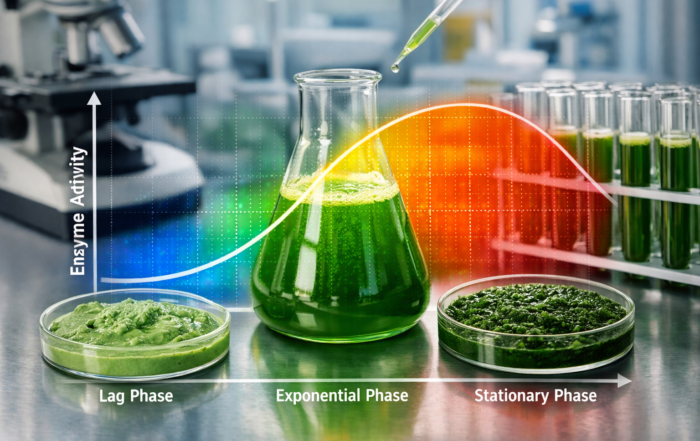
Carbon is the lifeblood of spirulina cultivation. As a photosynthetic microalga, spirulina requires a stable and accessible carbon source to maintain its rapid growth rate and protein synthesis. In organic spirulina production, choosing the right carbon input is critical not only for productivity but also for certification compliance.
Sodium bicarbonate remains the primary carbon source in commercial farms, but newer organic options such as plant-based sugars, natural carbonates, and bio-fermented extracts are emerging for certified organic systems. This guide explores how each option works, how to maintain pH stability, and how to stay compliant with organic certification standards.
Importance of Carbon in Spirulina Cultivation
Spirulina, being a photoautotrophic organism, converts carbon dioxide or dissolved carbonates into organic matter through photosynthesis. Carbon availability directly impacts:
- Growth rate and biomass yield.
- Protein and pigment synthesis (phycocyanin, chlorophyll).
- Pond alkalinity and pH stability.
A lack of carbon results in slower growth, pigment loss, and eventual culture decline. Therefore, precise carbon dosing and monitoring are essential for sustainable, high-yield spirulina production.
Recommended Carbon Sources for Organic Spirulina Production
The following carbon inputs are recommended for organic farms:
1. Sodium Bicarbonate (Primary Source)
- Chemical Formula: NaHCO₃
- Role: Acts as a readily available inorganic carbon source and maintains alkalinity.
- Dosage: Adjusted based on pH trends — typically between 0.5–1.5 g/L, depending on growth stage.
- Advantages:
- Stabilizes pond pH between 9.0 and 11.0.
- Readily dissolvable and compatible with organic nutrient inputs.
- Recognized by OMRI and accepted for USDA and EU Organic certifications.
Note: Sodium bicarbonate must be sourced from food-grade or OMRI-listed suppliers to maintain organic status.
2. Natural Carbonates and Mineral Additives
- Examples: Soda ash (Na₂CO₃) and potassium carbonate (K₂CO₃).
- Purpose: Supplement bicarbonate during rapid photosynthetic activity when CO₂ demand increases.
- Usage Tip: Combine with sodium bicarbonate in small proportions to buffer pH fluctuations.
- Certification: Only natural-mined carbonates are permitted; avoid chemically synthesized variants.
3. Organic Sugar-Based Carbon Supplements
Some organic producers now integrate plant-based sugars or molasses as alternative carbon sources. When used in low doses, these sugars support heterotrophic carbon fixation without violating organic standards.
| Source | Application | Benefit |
| Cane Molasses | 0.2–0.5% solution | Enhances growth under cloudy conditions |
| Jaggery (Organic) | 1–2 g/L weekly | Promotes stable pigment concentration |
| Coconut Water Ferment | Diluted 5–10% | Provides micronutrients and natural carbon |
These carbon options are particularly valuable for farms in low-CO₂ environments or those using closed pond systems.
4. Bio-Fermented Extracts and Compost Teas
Organic compost teas derived from plant biomass or seaweed extracts can be used as slow-release carbon additives. They not only supply dissolved organic carbon but also trace minerals essential for pigment synthesis.
Benefits:
- Improves microbial balance and reduces contamination.
- Enhances growth during cooler seasons.
- Supports carbon replenishment without altering pond alkalinity.
Always test for microbial safety before introducing bio-fermented solutions into live culture ponds.
Maintaining Carbon Balance and pH Stability
Maintaining a proper carbon balance is crucial for a healthy, contamination-free pond system.
| Parameter | Ideal Range | Monitoring Method |
| pH | 9.0–11.0 | Automated sensors or daily manual testing |
| Salinity | 4–20 PPT | Conductivity meter |
| Carbon Dosing | 0.5–1.5 g/L bicarbonate equivalent | Based on daily sunlight exposure |
| Temperature | 30–37°C | Thermometer or IoT monitoring |
Pro Tip: Use IoT or SCADA-controlled systems to automatically adjust bicarbonate addition based on pH drop, ensuring consistent growth. (Automation in Spirulina Farming at Greenbubble: How Technology Can Boost Mass Production)
Carbon Dosing Strategies by Growth Phase
| Growth Phase | Carbon Requirement | Management Tip |
| Inoculation (Days 1–5) | Low (0.3–0.5 g/L) | Maintain gentle aeration and gradual bicarbonate addition |
| Exponential (Days 6–15) | High (1–1.5 g/L) | Add bicarbonate twice daily; monitor pH stability |
| Harvest Phase | Moderate (0.5–1 g/L) | Avoid over-saturation to prevent precipitation |
These parameters help ensure that spirulina maintains its signature deep blue-green color and high protein yield.
Avoiding Common Carbon Source Mistakes
- Using non-food-grade bicarbonate: Causes heavy metal or impurity accumulation.
- Overdosing carbon: Can lead to excessive alkalinity (>11.5 pH) and pigment loss.
- Underfeeding carbon: Results in yellowing of culture and growth stagnation.
- Neglecting monitoring during cloudy days: Low light slows CO₂ absorption; minor bicarbonate adjustments are essential.
Sustainability and Certification Compliance
To maintain organic certification, spirulina farms must:
- Keep a detailed carbon input logbook for audits.
- Ensure all carbon sources are OMRI-approved or naturally derived.
- Use renewable or solar-powered aeration systems to minimize CO₂ footprint.
- Maintain separate records for organic and conventional batches.
Learn more about carbon-neutral practices in Greenbubble’s is Spirulina Farming Sustainable?
FAQs
Q1: Why is sodium bicarbonate preferred in spirulina farming?
It offers an easily soluble, stable carbon source that maintains ideal alkalinity and supports continuous photosynthesis.
Q2: Can organic farms use CO₂ gas injection systems?
Yes, but only if the CO₂ is captured from renewable or fermentation sources to maintain organic compliance.
Q3: Are sugar-based supplements safe for organic certification?
Yes, provided they are certified organic and used in low concentrations without affecting pH.
Q4: How often should carbon levels be checked?
Daily during active sunlight hours and after heavy rain or pH fluctuations.
Q5: Can natural compost tea replace bicarbonate entirely?
No. Compost teas serve as a supplement, not a substitute, for bicarbonate in large-scale production.
Conclusion
Carbon management defines the success of any spirulina farm — particularly those pursuing organic certification. By selecting the right carbon sources like sodium bicarbonate, organic sugars, and bio-fermented extracts, and by automating dosing based on pH and temperature, farmers can achieve high yields with full compliance.
Greenbubble’s combination of eco-friendly carbon sources and smart monitoring systems ensures that organic spirulina farms remain productive, sustainable, and globally competitive in the superfood market.
Table Of Contents