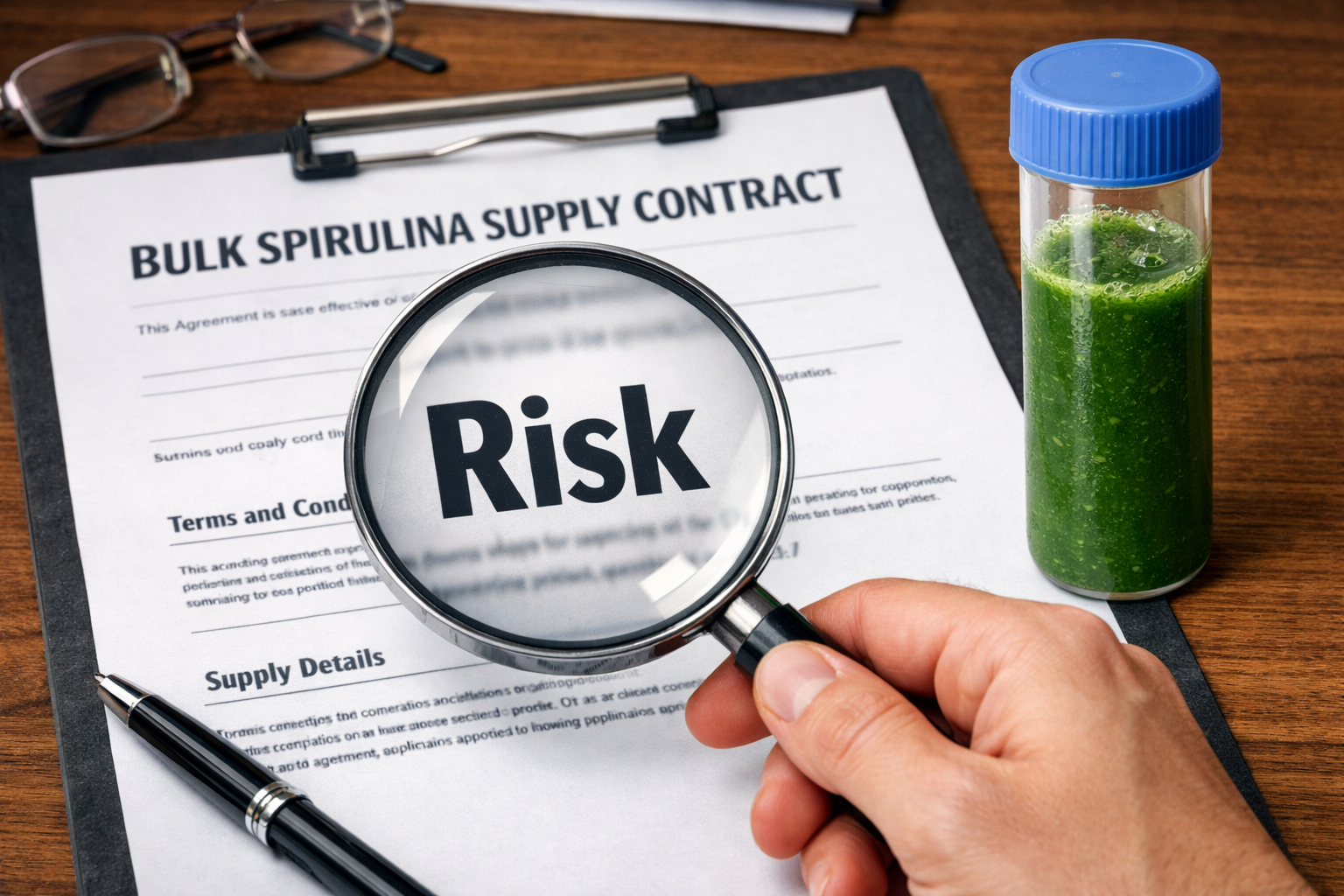
Sourcing spirulina in bulk is increasingly attractive for supplement brands, food manufacturers, and nutraceutical companies. But as demand for organic spirulina grows, so does the risk of partnering with suppliers who cannot deliver what they promise. Signing the wrong contract can mean receiving substandard products, losing certification eligibility, or facing regulatory consequences. Here are the critical red flags to watch for before committing to any bulk spirulina supply agreement.
1. No Certificate of Analysis (COA) – or a Vague One
A legitimate bulk spirulina supplier should provide a full, batch-specific COA without hesitation. This document needs to cover physical and chemical parameters (protein content of at least 60%, moisture, ash), pigment analysis (phycocyanin minimum 10%, chlorophyll-a minimum 1%), a complete fatty acid profile, microbial counts, pathogen absence (E. coli, Salmonella, Staphylococcus), heavy metal levels (lead, arsenic, cadmium, mercury all within strict USP limits), and pesticide testing.
If a supplier hands you a generic COA that is not batch-specific, lacks heavy metal data, or shows protein content below 60%, walk away. Quality spirulina is not guesswork – it is documented, tested, and traceable per batch.
2. Claims of “Organic” Without Third-Party Certification
This is one of the most common and dangerous red flags in the market. Suppliers who label their product “natural,” “chemical-free,” or “organic” without holding a valid third-party certification – such as USDA Organic or EU Organic – are not just misleading; in many jurisdictions, falsely claiming organic status is a punishable offence that can result in fines or imprisonment.
Organic spirulina production requires rigorous compliance: no synthetic fertilizers, no prohibited pesticides, OMRI-listed nutrients only, dedicated facilities to prevent cross-contamination, detailed cultivation records, and regular audits by accredited certifying agents. If a supplier cannot produce a valid certification document with an auditor name and renewal date, the “organic” label means nothing.
3. No Clarity on Drying Method
The drying method used directly determines nutritional quality. High-temperature processes – particularly spray drying above 100°C or uncontrolled solar drying – degrade heat-sensitive compounds like phycocyanin, beta-carotene, and gamma-linolenic acid (GLA). A supplier who cannot specify their drying method or dismisses the question is a liability.
Premium bulk spirulina for human consumption should be processed using Refractive Window Drying (RWD), which maintains product temperature below 45°C, or vacuum drying for smaller batches. Both methods preserve nutritional integrity and meet organic compliance standards. If a contract does not specify the drying method and maximum processing temperature, insist on adding it – or choose a supplier who will.
4. Promises of Unrealistically Low Prices
Quality spirulina is expensive to produce. A certified organic, export-grade operation carries substantial costs: automation, harvesting equipment, qualified lab staff, batch testing, certifications, and compliant packaging. Operating expenditure for a 3-acre farm alone can exceed ₹1 crore per year.
If a supplier is quoting prices significantly below the market rate for certified organic spirulina, ask why. Likely answers include: no real certifications, sun drying instead of RWD, compromised microbial controls, or dilution with fillers. Bulk pricing that seems too good to be true almost certainly reflects shortcuts in quality or compliance.
5. No In-House Lab or Third-Party Testing Protocol
Every serious spirulina supplier should have a functioning analytical and microbiological laboratory on-site and a protocol for third-party verification. In-house labs allow per-batch testing before dispatch; without one, contamination issues, heavy metal spikes, or microbial failures may only surface after product reaches the buyer – or worse, the end consumer.
Contracts should specify testing frequency, which parameters are covered per batch, acceptable limits aligned with USP or equivalent standards, and who bears the cost of retesting in case of disputes. A supplier resistant to adding testing obligations to the contract is signaling that testing is not a priority.
6. No Traceability or Batch Documentation
Export-ready spirulina requires full traceability – from nutrient sourcing and water quality records to harvest date, drying batch number, and packing date. International buyers, particularly in the US and EU, increasingly require batch-level documentation as a prerequisite for import clearance.
A contract that contains no provisions for batch records, cultivation logs, or audit rights is a contract built on opacity. Insist on traceability clauses that allow you to request documentation for any specific batch shipped.
7. No Mention of Automation or GMP Conditions
Manual spirulina operations are fundamentally incompatible with the consistency, hygiene, and documentation standards required for large-scale commercial supply. Minimising human contact with the product is essential for GMP and FDA compliance. Contracts with suppliers who rely on manual harvesting, open-air drying, or uncontrolled packaging environments carry significant contamination risk.
Ask specifically whether the supplier uses automated harvesting (such as rotary drum filters with 500-mesh screens), whether drying is done in a controlled-environment inline system, and whether the packaging room meets cleanroom standards.
Final Word
Bulk spirulina contracts should be treated with the same rigor as any pharmaceutical supply agreement. The right supplier is transparent about their certifications, testing regime, drying methods, and production infrastructure. Red flags are rarely accidental – they reflect how a supplier actually operates. Verify everything, audit when possible, and never let price be the deciding factor when product quality and regulatory compliance are on the line.
Make us your source on Google
Table Of Contents