Private-label spirulina manufacturing is no longer a simple bulk supply arrangement.
It is a structured, audit-driven, compliance-sensitive partnership model where brands transfer part of their reputation risk to the manufacturer.
Modern nutraceutical, superfood, and functional beverage brands do not evaluate suppliers only on price or yield. They assess operational maturity, documentation precision, scalability, risk management discipline, and long-term reliability.
For spirulina producers, private-label contracts can unlock higher margins, predictable recurring volumes, and stronger market positioning. However, the operational threshold required to enter this segment is significantly higher than standard bulk trading.
At Greenbubble, we design spirulina facilities with private-label readiness integrated into infrastructure, process control, documentation systems, and compliance architecture – because brands evaluate suppliers as long-term risk partners, not commodity vendors.
Understanding what brands truly expect is critical before entering private-label agreements.
1. Consistent Quality Specifications and Buffer Margins
Private-label buyers demand strict, repeatable technical parameters such as:
- Protein content (often NLT 60–65%)
- Defined phycocyanin percentage thresholds
- Moisture limits (typically ≤7%, sometimes tighter)
- Heavy metal levels comfortably below regulatory caps
- Microbial counts within conservative safety margins
Brands do not accept borderline compliance.
They expect buffer margins that reduce recall probability and regulatory exposure.
Inconsistent batches weaken brand positioning, trigger repeat audits, and may result in supplier disqualification.
Engineered cultivation through optimized raceway ponds combined with controlled processing using calibrated spirulina drying equipment supports repeatable nutrient stability and moisture control.
Consistency is not a quality objective.
It is a contractual requirement.
2. Full Compliance Depth, Not Surface Certification
Brands expect suppliers to operate under structured compliance systems such as:
- HACCP frameworks
- GMP-aligned zoning and hygiene segregation
- Organic certification (when relevant)
- Batch-level COA validation
- Routine heavy metal and microbial testing discipline
Certification alone is insufficient.
Brands evaluate whether compliance is embedded in daily operations or merely documented for audits.
They assess:
- Process flow clarity
- Cross-contamination controls
- Calibration logs
- Staff training records
- Corrective action history
Facilities structured through spirulina farming turnkey solutions integrate compliance architecture from design stage rather than retrofitting systems under audit pressure.
Private-label brands prefer suppliers who exceed minimum regulatory standards.
3. Documentation Precision and Traceability Architecture
Private-label agreements require full backward and forward traceability.
Brands may request:
- Raw material and nutrient sourcing documentation
- Batch manufacturing records
- In-house laboratory test results
- Retained sample documentation
- Packaging validation logs
- Metal detection or foreign body inspection reports
During audits, brands often test documentation retrieval speed.
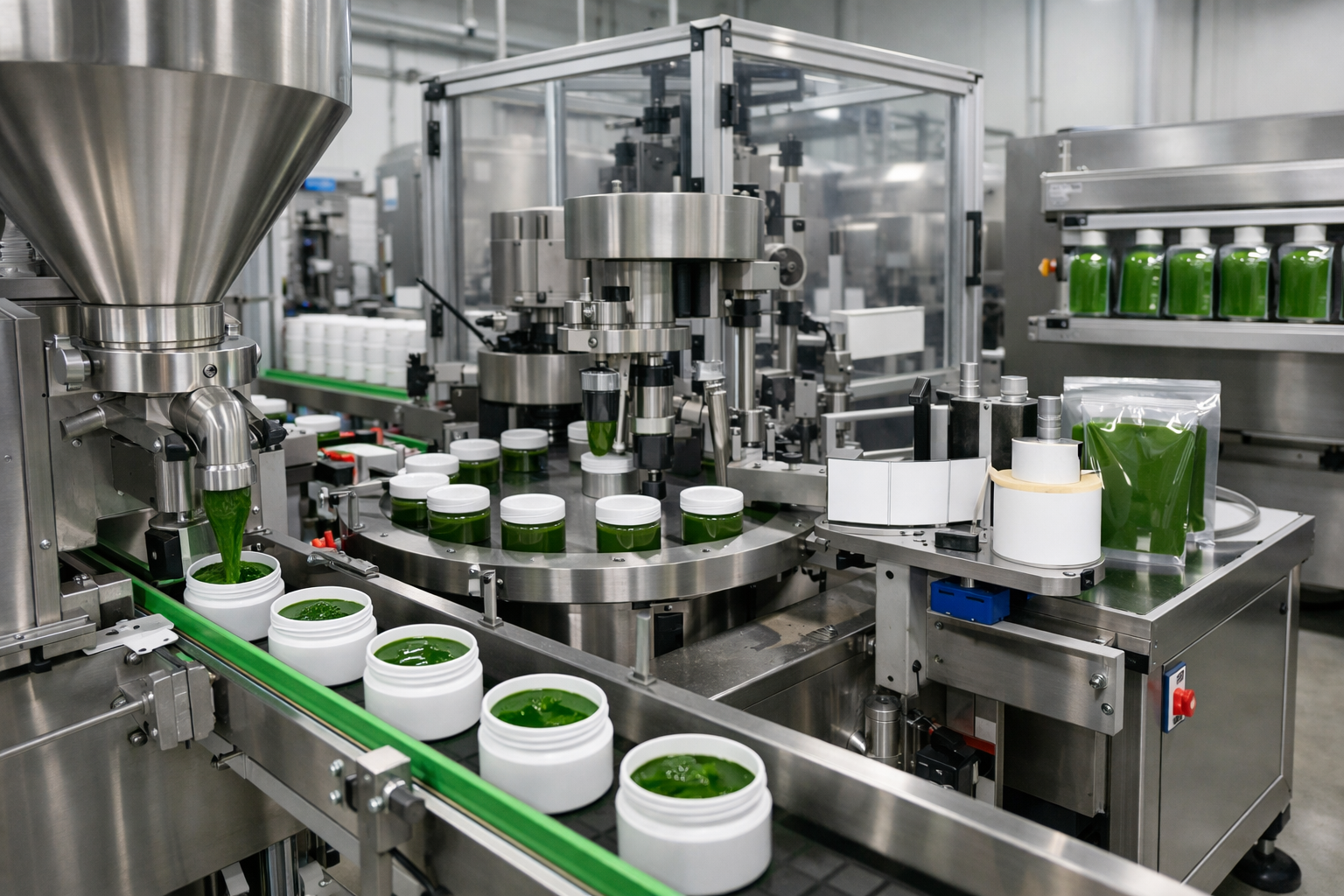
Automation-supported automated packing systems improve batch coding accuracy and reduce traceability gaps.
Traceability is not only about recall limitation.
It is about legal defensibility.
A private-label supplier without structured documentation architecture cannot compete in mature markets.
4. Flexible Manufacturing and Customization Capability
Private-label brands frequently request customization beyond standard powder supply.
Typical requirements include:
- Custom mesh sizes or powder granularity
- Capsule-grade material with defined flow properties
- Tablet compression-ready powder
- Pigment-enhanced variants
- Custom bulk packaging formats
- Brand-specific batch coding
Operational flexibility requires structured processing systems and calibrated harvesting equipment solutions.
Manual or semi-structured setups struggle to meet repeatable customization demands without compromising consistency.
Customization must not undermine compliance stability.
5. Confidentiality, IP Protection, and Contract Discipline
Private-label brands expect strict confidentiality regarding:
- Custom formulations
- Fortified blends
- Target pigment levels
- Packaging configurations
- Labeling strategy
Clear non-disclosure agreements, access control systems, and role-based data permissions are essential.
Brands evaluate whether operational transparency is balanced with controlled confidentiality.
IP leakage or formulation replication can permanently damage supplier credibility.
Private-label relationships require contractual clarity on ownership of process improvements and custom developments.
6. Capacity Assurance and Scalability Planning
Brands assess long-term supply security.
Evaluation criteria include:
- Monthly and annual production capacity
- Infrastructure scalability potential
- Power backup and redundancy systems
- Water quality stability
- Labor reliability
- Financial health of the supplier
Under-capacity or unstable output creates brand exposure risk.
Greenbubble emphasizes expansion-ready infrastructure design so capacity growth does not compromise quality systems.
Scalability must be engineered before growth demand arises.
7. Audit Culture and Communication Discipline
Private-label buyers conduct:
- Pre-contract facility audits
- Annual compliance reviews
- Unannounced inspections
- Corrective action follow-ups
They expect:
- Transparent facility access
- Immediate documentation retrieval
- Defined communication hierarchy
- Timely corrective action reporting
Structured advisory support through spirulina farming consultancy aligns operational systems with brand audit expectations.
Audit maturity is a competitive advantage.
8. Risk Management and Crisis Preparedness
Brands do not only evaluate production capability.
They evaluate risk resilience.
Suppliers must demonstrate readiness to handle:
- Shipment rejection
- Regulatory inspection notice
- Product recall
- Equipment failure
- Supply chain disruption
Brands expect:
- Documented crisis response plans
- Batch segregation capability
- Compliance buffer margins
- Insurance alignment
- Financial liquidity buffers
Private-label contracts often include indemnity clauses.
Risk preparedness protects both brand and manufacturer.
9. Commercial Alignment and Cost Transparency
Beyond technical performance, brands assess commercial reliability.
They expect:
- Transparent pricing structures
- Stable cost forecasting
- Predictable lead times
- Clear minimum order quantities
- Defined payment terms
Private-label success depends on balancing premium positioning with operational cost discipline.
Overpromising on price or capacity can damage long-term partnership viability.
Operational stability supports commercial credibility.
Private-Label Expectation Framework
| Expectation Area | What Brands Look For | Operational Requirement |
| Quality | Stable protein, pigment, moisture | Controlled cultivation and drying |
| Compliance | HACCP, GMP, audit readiness | Documented SOP architecture |
| Traceability | Full batch tracking | Automated coding and logs |
| Customization | Flexible formats and specs | Structured processing systems |
| Scalability | Volume growth support | Expansion-ready infrastructure |
| Confidentiality | Protected formulations | NDA and access control |
| Risk Control | Crisis preparedness | Compliance buffers and liquidity |
| Commercial Reliability | Predictable pricing and delivery | Stable cost modeling |
Private-label manufacturing is an operational partnership model, not a transactional sale.
It requires structural maturity.
Frequently Asked Questions
Q1. Is private-label spirulina more profitable than bulk sales?
Yes, margins are generally higher, but compliance requirements, audit frequency, documentation discipline, and customization demands are significantly stricter.
Q2. What certifications do private-label brands typically require?
Most require HACCP and GMP alignment. Organic certification, heavy metal testing protocols, and documented traceability systems are often expected.
Q3. Can small farms handle private-label contracts?
Only if they meet infrastructure, documentation, consistency, and scalability standards. Capacity and compliance limitations often restrict entry.
Q4. How important is traceability in private-label supply?
Critical. Traceability limits recall exposure, supports regulatory defense, and protects brand liability.
Q5. Does automation improve private-label readiness?
Yes. Automation strengthens consistency, reduces contamination risk, improves documentation precision, and enhances audit performance.
Conclusion
Private-label spirulina manufacturing requires far more than cultivation capability.
Brands expect consistent quality, compliance depth, traceability precision, scalability assurance, confidentiality discipline, risk preparedness, and commercial reliability.
Farms built with engineered infrastructure, automation integrity, documentation architecture, compliance buffers, and expansion-ready systems are significantly more competitive in private-label markets.
At Greenbubble, we design spirulina operations with private-label readiness integrated from the outset – because brands do not buy biomass alone.
They buy stability, defensibility, and reliability.
Table Of Contents