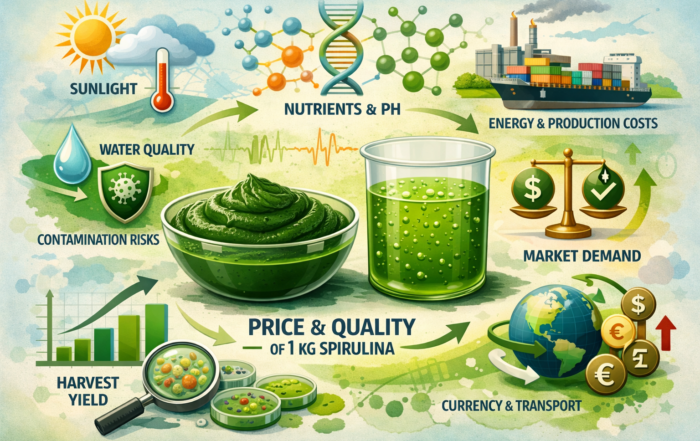
Spirulina pricing is not a surface-level market comparison.
It is a structural financial decision shaped by production scale, compliance intensity, drying efficiency, audit exposure, packaging configuration, marketing allocation, working capital cycles, and contractual risk.
The price per kilogram can differ substantially depending on whether the buyer is:
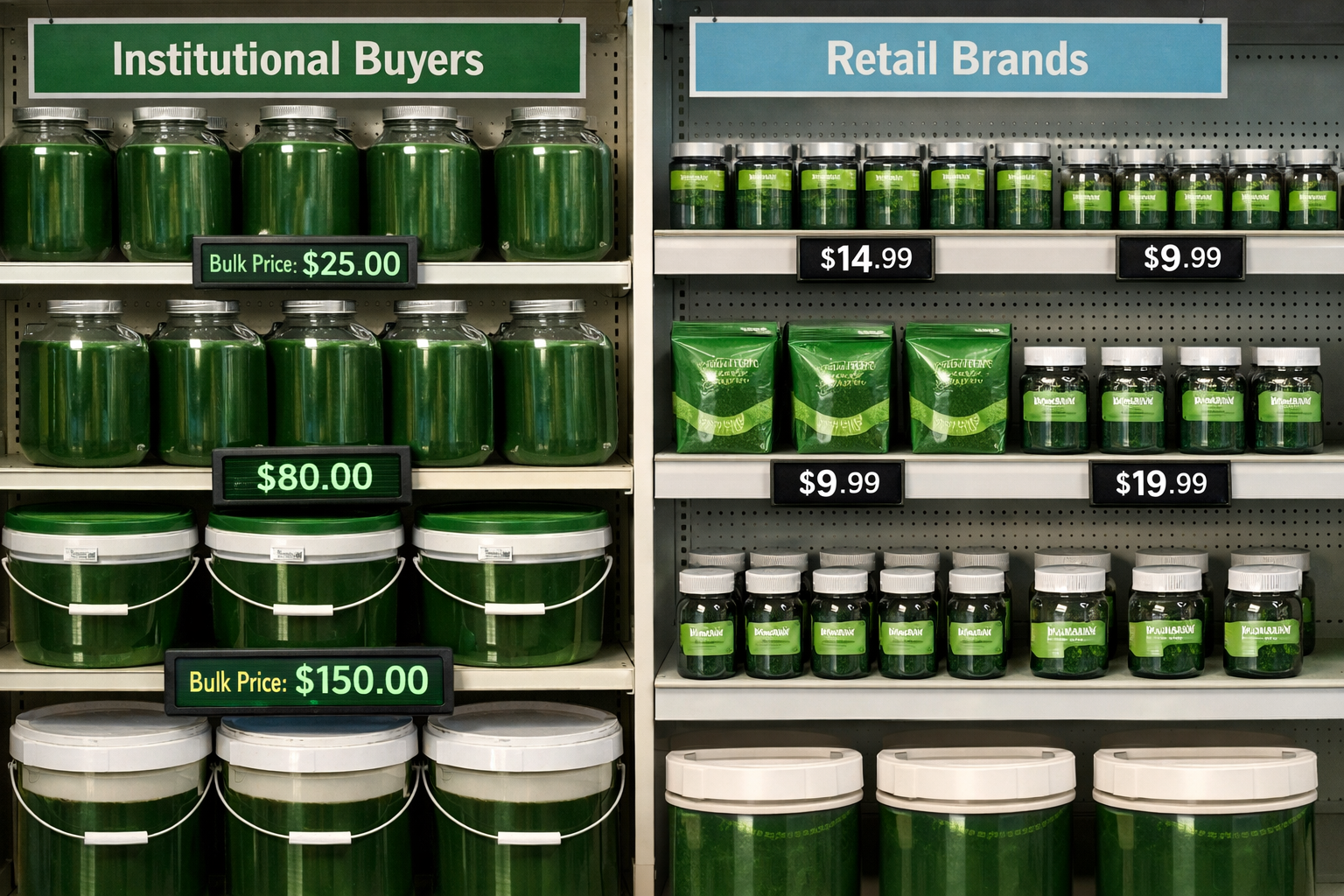
- An institutional bulk purchaser such as ingredient processors, exporters, contract manufacturers, or pharmaceutical supply chains
- A retail brand such as D2C supplement companies, private-label wellness brands, or health retailers
The distinction is not simply about selling more or less volume.
It is about how cost layers stack, how risk is distributed, and how margins are protected.
At Greenbubble, we emphasize that sustainable pricing must be engineered from production economics upward – never reverse-calculated from competitor pricing.
Institutional and retail channels operate under fundamentally different financial logic, and failing to recognize that difference can erode profitability even at high sales volumes.
1. Institutional Buyer Pricing Model
Institutional buyers typically procure:
- Bulk spirulina powder in 20–25 kg vacuum-sealed units
- Multi-ton annual commitments
- Fixed or semi-indexed contracts
- Defined minimum order quantities (MOQ)
- Strict specification annexures
Core Characteristics
- High volume throughput
- Lower margin per kilogram
- Contractual revenue stability
- Heavy audit exposure
- Extended payment terms (often 30–60 days)
Institutional pricing is primarily influenced by:
- True production cost per kilogram
- Drying cycle efficiency and throughput
- Nutrient input volatility
- Certification and compliance overhead distribution
- Freight optimization and container loading efficiency
- Currency exposure (for export contracts)
Institutional pricing depends on scale discipline.
Financial modeling clearly demonstrates that sub-scale farms – particularly those under 1 acre – struggle to distribute fixed compliance, labor, and testing costs effectively fileciteturn2file1.
Without sufficient output, per-kg cost escalates rapidly, compressing margins in bulk supply contracts.
Institutional pricing must protect EBITDA through volume stability and operational efficiency.
2. Retail Brand Pricing Model
Retail buyers operate under a different economic structure.
They typically purchase:
- Smaller batch volumes
- Branded, consumer-ready SKUs
- Customized blends or mesh specifications
- Market-positioned packaging formats
Core Characteristics
- Higher per-kg selling price
- Smaller average order volumes
- Marketing-driven price elasticity
- Variable demand cycles
- Faster turnover but higher volatility
Retail pricing incorporates additional cost layers such as:
- Retail packaging material and design
- Label compliance and regulatory review
- Marketing and digital advertising spend
- Distributor and retailer margin layering
- Sampling and promotional discounts
Although the per-unit selling price appears significantly higher, overhead complexity increases proportionally.
Retail margin must absorb brand-building expenses that institutional supply does not carry.
3. Production Cost Architecture: The Foundation of All Pricing
Before selecting a channel, farms must calculate their actual cost per kilogram, including:
- Nutrient input and water management cost
- Electricity consumption and backup power allocation
- Skilled and unskilled labor
- Laboratory testing panels and COA generation
- Certification audits and renewal costs
- Maintenance, spares, and depreciation
- Packaging materials (bulk vs retail formats)
- Insurance and compliance administration
Production stability begins at cultivation.
Calibrated raceway ponds combined with stable agitation through efficient agitators reduce yield variability and nutrient inefficiency.
Controlled drying using low-temperature spirulina drying equipment protects protein integrity, pigment retention, and moisture stability – minimizing batch rejection risk.
Cost discipline at the infrastructure level expands pricing flexibility at the commercial level.
4. Expanded Margin Structure Comparison
| Parameter | Institutional Buyers | Retail Brands |
| Volume per Order | High | Low to Moderate |
| Margin per kg | Lower but stable | Higher but volatile |
| Marketing Cost | Minimal | Significant |
| Packaging Cost | Bulk industrial | Branded retail |
| Payment Terms | 30–60 days | Faster or advance-based |
| Audit Frequency | High | Moderate |
| Inventory Risk | Lower | Higher |
| Price Sensitivity | High | Moderate |
| Working Capital Intensity | Moderate | High |
| Brand Liability | Shared | Direct |
Institutional pricing prioritizes throughput and contract continuity.
Retail pricing prioritizes perceived value and demand elasticity.
5. Compliance Depth and Its Direct Impact on Pricing
Institutional buyers impose tight specification bands covering:
- Protein percentage
- Moisture thresholds
- Heavy metal limits
- Microbial counts
- Pigment concentration ranges
- Mesh uniformity
Deviation from annexure specifications may result in:
- Shipment rejection
- Reprocessing costs
- Price penalties
- Contract review
Facilities engineered via spirulina farming turnkey solutions embed compliance architecture capable of sustaining long-term institutional contracts.
Retail buyers may allow minor variability but impose strict scrutiny on label claims, nutritional declarations, and consumer safety.
Compliance cost must therefore be embedded in pricing from the outset.
6. Cash Flow Modeling Differences
Institutional Channel Cash Flow Considerations:
- Extended credit cycles
- Large-batch production scheduling
- Freight consolidation timelines
- Currency fluctuations in export markets
Retail Channel Cash Flow Considerations:
- Inventory stocking cycles
- Distributor margin delays
- Marketing expenditure before revenue realization
- Promotional discount campaigns
Higher selling price does not guarantee stronger liquidity.
Retail channels often demand higher working capital intensity despite stronger gross margins.
7. Risk Allocation and Pricing Buffer
Institutional Risk Profile:
- Contract dependency concentration
- Price renegotiation pressure during cost inflation
- Rejection exposure due to tight specifications
- Audit fatigue and compliance escalation
Retail Risk Profile:
- Brand reputation exposure
- Demand unpredictability
- Unsold finished inventory
- Marketing ROI failure
Pricing must include risk buffers aligned to channel-specific exposure.
A purely margin-based comparison without risk adjustment produces misleading conclusions.
8. Hybrid Channel Strategy and Allocation Modeling
Many commercial spirulina enterprises pursue hybrid allocation strategies such as:
- 60–70% institutional contracts for baseline stability
- 30–40% retail brand allocation for margin expansion
Hybrid models diversify revenue but increase managerial complexity.
Capacity planning must ensure that retail experimentation does not disrupt institutional contractual obligations.
Strategic planning support through spirulina farming consultancy aligns infrastructure, drying throughput, and compliance resources with channel allocation.
9. Scenario-Based Pricing Illustration
Example comparison (conceptual):
Institutional Sale:
- 1,000 kg bulk shipment
- Lower per-kg price
- Minimal packaging
- Stable margin percentage
- 45-day payment term
Retail Sale Equivalent (converted to 100 g packs):
- Higher per-kg revenue
- Significant packaging and marketing cost
- Inventory holding requirement
- Faster but volatile cash realization
Net profitability depends on overhead absorption and channel efficiency – not selling price alone.
10. Pricing Decision Stress-Test Checklist
Before finalizing pricing, farms should stress-test:
- Cost inflation impact (nutrients, power)
- Yield fluctuation tolerance
- Rejection probability buffer
- Working capital adequacy
- Channel-specific compliance cost
- Currency fluctuation risk
- Client concentration exposure
Pricing is a structural strategy – not a negotiation tactic.
Internal linking aligned with approved interlinking framework fileciteturn2file0.
Frequently Asked Questions
Q1. Why is spirulina typically cheaper for institutional buyers?
Because high volumes reduce per-unit packaging and marketing cost, and pricing is optimized for throughput stability rather than brand positioning.
Q2. Does higher retail price guarantee higher profitability?
No. Marketing, packaging, distributor margins, and inventory risk significantly offset retail price premiums.
Q3. Can a 1-acre farm sustainably supply institutional buyers?
Sub-scale farms often struggle to distribute fixed compliance and operating costs efficiently fileciteturn2file1.
Q4. Which channel offers better long-term stability?
Institutional contracts offer revenue predictability, while retail channels offer higher upside with greater volatility.
Q5. Should export institutional pricing differ from domestic pricing?
Yes. Export pricing must incorporate freight, documentation, insurance, and currency risk buffers.
Conclusion
Pricing spirulina for institutional buyers versus retail brands requires fundamentally different financial architecture.
Institutional pricing prioritizes scale, compliance discipline, contract stability, and cost efficiency.
Retail pricing prioritizes brand equity, margin expansion, and market positioning – while carrying higher volatility.
Commercial spirulina enterprises must align infrastructure scale, drying efficiency, compliance systems, and working capital modeling with their chosen channel strategy.
Sustainable pricing is not derived from competitor benchmarks.
It is engineered through disciplined cost modeling, risk-adjusted margin planning, and strategic channel alignment.
Make us your source on Google
Table Of Contents