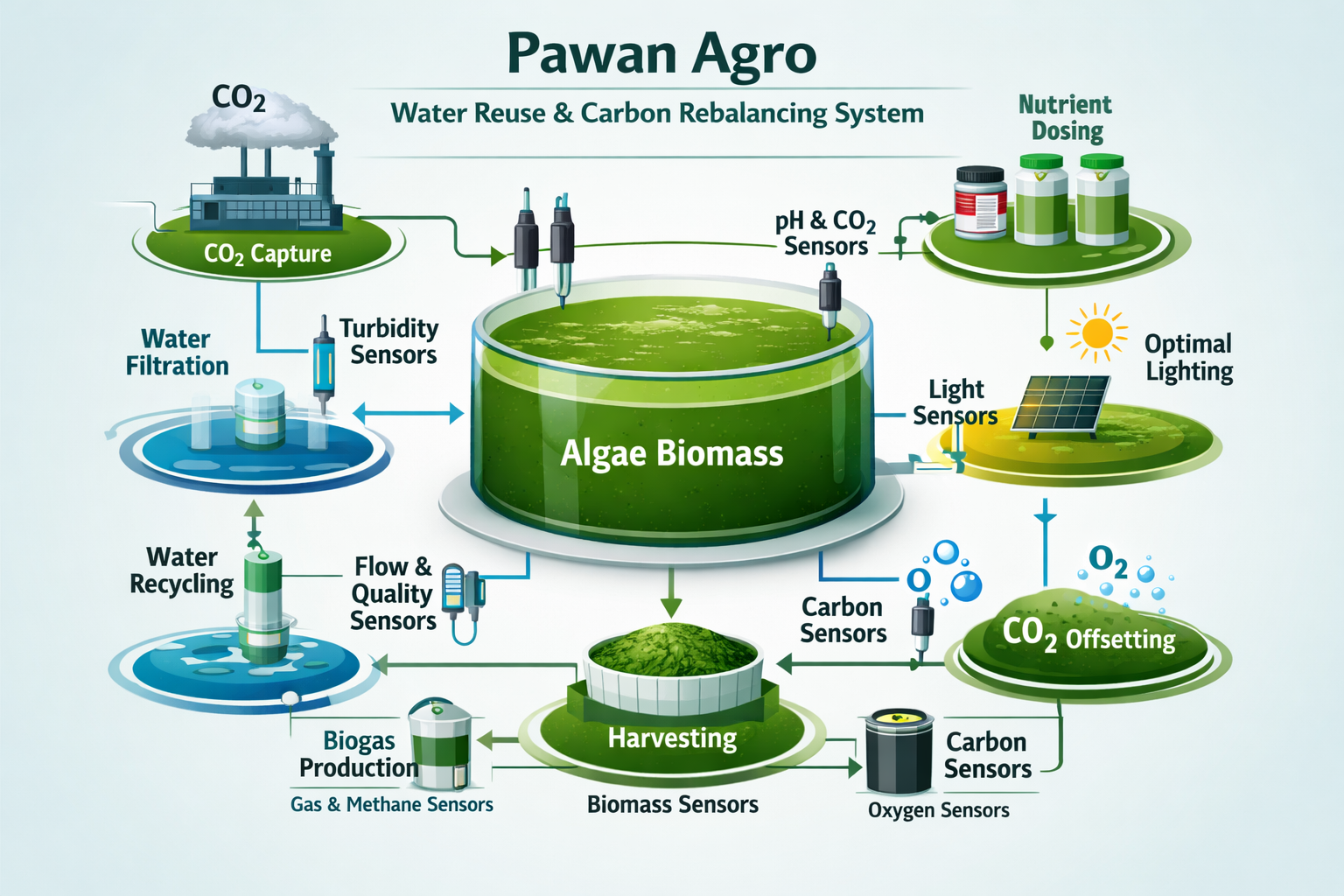
Water availability is often the hidden constraint in scaling spirulina farming, especially in regions where groundwater reliability and labour access are uncertain. The Pawan Agro project near Aurangabad demonstrates how thoughtful raceway design, water reuse planning, and automation can convert a remote, underutilised property into a resilient spirulina operation.
This case study explores how Greenbubble helped Pawan Agro design raceway systems that prioritised water efficiency, automation, and one-person operability.
Project Background: Experience Meets Opportunity
Pawan Agro is led by Mr. Singh, a former professional from the water works department who owned over 50 acres of land near Aurangabad. While the location offered abundant sunlight, it also posed practical challenges – limited workforce availability, dependency on seasonal water sources, and the need for long-term sustainability.
Rather than treating water as an unlimited input, the project was conceptualised with reuse and conservation as core design principles from the beginning.
Why Water Reuse Became a Design Priority
In semi-arid regions, open-well water and rainwater availability can fluctuate sharply across seasons. For a 6-acre organic spirulina farm, this variability posed operational risk if not addressed structurally.
Greenbubble therefore framed water management not as a utility concern, but as a system design challenge – where treatment, storage, and reuse needed to be integrated into the raceway layout itself.
Raceway Design Built Around Reuse Cycles
The raceway ponds were designed to operate as part of a closed-loop water logic rather than linear consumption systems. A temporary water storage setup combined with ultrafiltration (UF) treatment allowed both open-well water and harvested rainwater to be conditioned before reuse.
Engineered raceway pond systems were configured to minimise loss during circulation and harvesting, ensuring that treated water could be reintroduced without compromising culture stability.
Automation to Reduce Water Handling Errors
Manual water management often introduces inconsistency – overflows, uneven replenishment, and delayed responses to quality shifts. At Pawan Agro, automation was used to eliminate these variables.
Multiple electronic controllers and sensors continuously monitored flow rates, pond levels, and system health. This allowed water reuse cycles to remain consistent even with minimal human intervention.
One-Person Operation Through Centralised Control
Due to the farm’s remote location, dependence on a large workforce was neither practical nor reliable. The entire facility – from plumbing and circulation to harvesting coordination and final powder production – was therefore integrated into a single SCADA-based control system.
This design enabled one trained operator to manage the full operation, reducing labour dependency while improving response time to system alerts.
Integration with Harvesting and Downstream Flow
Efficient water reuse is only possible when harvesting and downstream processes are aligned with circulation logic. Greenbubble-supported harvesting equipment was selected to work within the reuse framework, ensuring minimal water loss during biomass recovery.
This integration preserved water quality while maintaining daily production rhythm.
Greenbubble’s Role in System-Level Design
Greenbubble’s involvement in the Pawan Agro project covered consulting and equipment supply, with a strong emphasis on system coherence. Rather than optimising individual components in isolation, Greenbubble ensured that raceways, water treatment, automation, and harvesting worked as a unified system.
This approach was particularly important in a project where sustainability and labour efficiency were non-negotiable constraints.
Outcomes: Sustainability Through Design
The resulting facility achieved:
- Reduced freshwater dependency through reuse cycles
- Stable operation despite seasonal water variation
- Minimal labour requirement via automation
- A scalable template for future expansion
Water efficiency became an operational strength rather than a limiting factor.
What Other Spirulina Farms Can Learn
The Pawan Agro project offers several lessons:
- Water reuse must be designed, not improvised
- Automation improves both sustainability and reliability
- Raceway layout directly influences resource efficiency
- Remote locations benefit disproportionately from centralised control
Sustainable spirulina farming begins with infrastructure decisions.
FAQs
Q1. Can water reuse affect spirulina quality?
When properly treated and monitored, reused water can support stable, high-quality cultures.
Q2. Is ultrafiltration necessary for water reuse?
UF treatment significantly improves consistency and reduces biological risk when reusing water.
Q3. Can one person realistically operate a spirulina farm?
Yes. With automation and centralised control, single-operator management is feasible.
Q4. Is this model suitable only for arid regions?
While especially valuable in dry areas, water reuse improves resilience in all locations.
Q5. Does automation increase system complexity?
Automation simplifies operations by reducing manual variability, even if initial design is more complex.
Conclusion: Water Efficiency Is an Architectural Choice
The Pawan Agro project illustrates that water sustainability in spirulina farming is not achieved through conservation alone, but through architectural design. By embedding reuse logic, automation, and centralised control into raceway systems, Greenbubble helped transform a remote property into a high-efficiency spirulina operation. In water-constrained environments, smart raceway design becomes the foundation of long-term viability.
Table Of Contents