In large-scale spirulina farming, harvesting efficiency determines whether expansion strengthens margins or quietly erodes them. As pond area increases, small inefficiencies in harvesting and dewatering multiply into major operational bottlenecks. The NB Labs project in Nagpur demonstrates how smart harvesting technology – validated through real-world trials – can enable confident scale-up.
This case study explores how NB Labs transitioned from cautious experimentation to a 24-acre commercial operation by adopting a 500 mesh rotary drum–based harvesting strategy with long-term support from Greenbubble.
Project Background: Scaling Spirulina in Central India
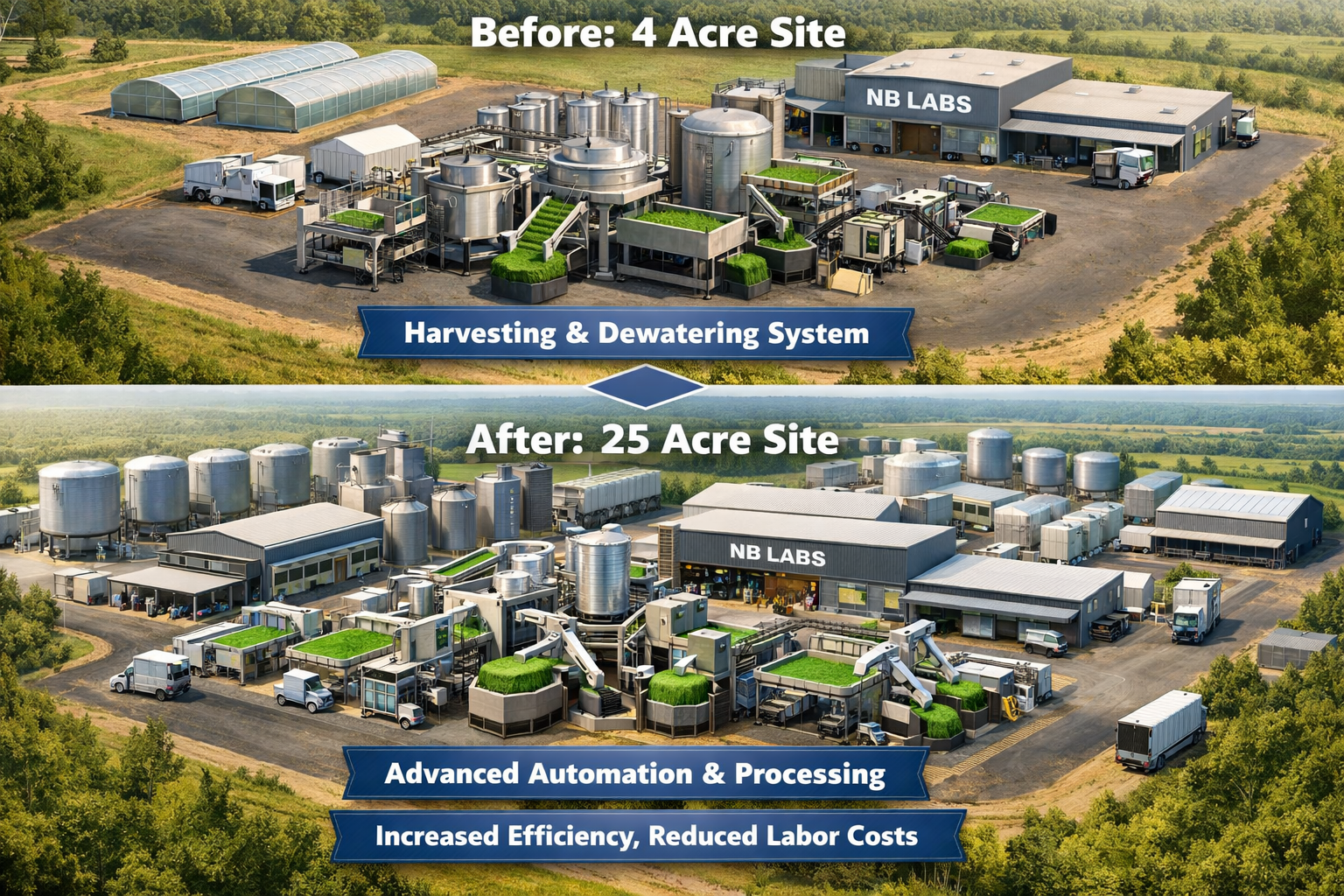
NB Labs, led by Mr. Agarwal, operates one of the larger spirulina farming facilities in the Nagpur region. What began as a limited operation gradually expanded threefold to cover a total of 24 acres of raceway ponds.
From the outset, the project’s growth strategy hinged on one critical question: could harvesting systems keep pace with expansion without compromising biomass recovery or operational stability?
Early Skepticism and the Trial Phase
Like many growing farms, NB Labs initially approached mechanised harvesting with caution. Concerns around recovery efficiency, mesh clogging, and maintenance reliability made large capital investments risky without proof.
To address this, Greenbubble conducted an on-site trial using a single harvesting unit equipped with a 500 mesh rotary drum. This controlled trial allowed performance to be evaluated under real pond conditions rather than theoretical specifications.
Why 500 Mesh Matters in Spirulina Harvesting
Mesh selection plays a critical role in balancing biomass recovery with throughput. A 500 mesh rotary drum offers a practical midpoint – fine enough to retain spirulina biomass while allowing efficient water passage.
In the NB Labs trial, this configuration demonstrated:
- High biomass capture efficiency
- Stable flow rates without frequent clogging
- Reduced manual intervention
- Compatibility with downstream dewatering processes
This performance validation became the foundation for long-term adoption.
Transition from Trial to Full-Scale Deployment
Following successful trial results, NB Labs progressively expanded its harvesting infrastructure. Over the past five years, Greenbubble has remained the primary supplier of harvesting and dewatering systems, supporting each phase of growth.
As pond area increased, newer machinery iterations were introduced – each incorporating incremental efficiency improvements based on field feedback. This evolutionary upgrade approach ensured that harvesting capacity always stayed ahead of expansion.
Integration with Dewatering and Process Flow
Harvesting does not operate in isolation. Its effectiveness depends on how seamlessly it integrates with dewatering and downstream handling.
Greenbubble-aligned harvesting equipment was selected to work in tandem with assisted dewatering systems, allowing NB Labs to manage larger harvest volumes without creating downstream congestion.
This integration reduced biomass handling time and stabilised daily production cycles.
Impact on Operational Confidence and Expansion
Reliable harvesting performance changed how NB Labs approached growth. Instead of expanding cautiously around equipment limitations, the farm could plan pond additions with confidence that harvesting throughput would scale accordingly.
Key outcomes included:
- Predictable daily harvesting capacity
- Reduced labour dependency
- Improved scheduling of drying and processing
- Faster transition from pilot mindset to commercial operations
Harvesting reliability became a growth enabler rather than a constraint.
Greenbubble’s Role as a Long-Term Technology Partner
Greenbubble’s involvement extended beyond initial machinery supply. By continuously upgrading equipment models and supporting NB Labs through successive expansion stages, Greenbubble acted as a long-term technology partner rather than a one-time vendor.
This continuity ensured that operational learning translated directly into equipment evolution – closing the gap between design intent and field reality.
What Other Spirulina Farms Can Learn
The NB Labs experience highlights several transferable lessons:
- Proven field trials reduce scale-up risk
- Mesh selection has outsized impact on harvesting efficiency
- Incremental upgrades outperform one-time overhauls
- Harvesting reliability underpins confident expansion
Smart harvesting is not about adopting the most advanced machine – it is about adopting the most reliable one.
FAQs
Q1. Why was a trial necessary before full-scale deployment?
On-site trials validate performance under real operating conditions and reduce capital risk.
Q2. What advantage does a 500 mesh rotary drum offer?
It balances biomass retention with flow efficiency, making it suitable for large-scale spirulina harvesting.
Q3. Can harvesting systems scale incrementally?
Yes. Modular harvesting setups allow capacity to grow alongside pond expansion.
Q4. How long has Greenbubble supported NB Labs?
Greenbubble has been supplying harvesting and dewatering systems for over five years.
Q5. Does harvesting efficiency affect downstream processes?
Yes. Consistent harvesting stabilises dewatering, drying, and overall production planning.
Conclusion: Harvesting as the Backbone of Scale
The NB Labs project shows that successful scale-up in spirulina farming depends on trust in core process equipment. By validating harvesting performance early and evolving systems alongside expansion, NB Labs transformed harvesting from a risk factor into a backbone of growth. With Greenbubble’s sustained support, smart harvesting became the foundation for a 24-acre commercial operation.
Table Of Contents