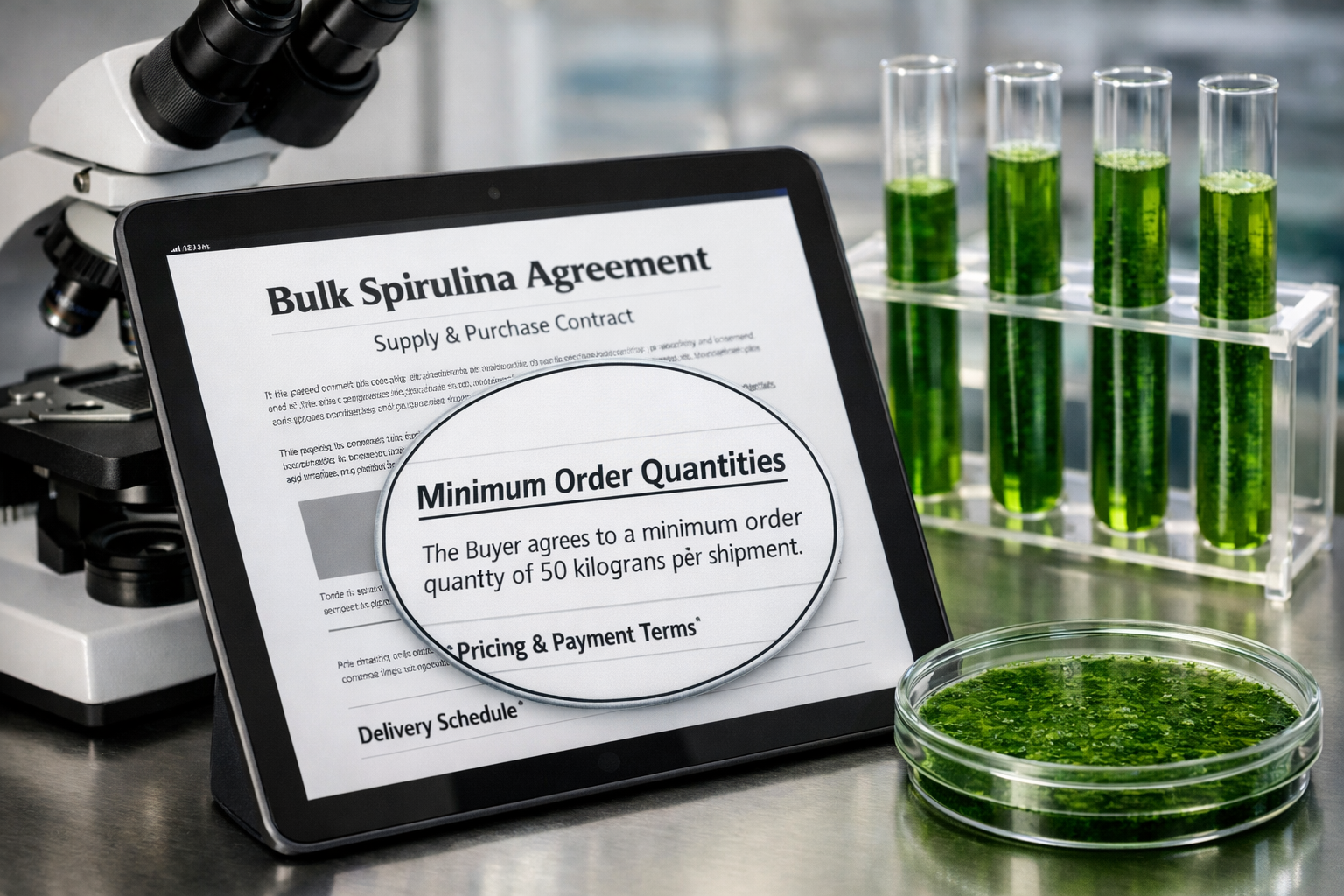
Minimum Order Quantity (MOQ) is one of the most misunderstood elements in bulk spirulina supply agreements.
Buyers often assume MOQs are arbitrary thresholds designed to increase revenue.
In reality, MOQs are structured around production economics, compliance costs, drying batch efficiency, packaging logistics, laboratory testing expenses, and working capital stability.
For commercial spirulina farms, especially export-oriented facilities, MOQ is not a sales tactic.
It is a financial survival parameter.
At Greenbubble, we design spirulina facilities with production volumes, drying capacity, and batch economics aligned to commercially viable MOQs from day one.
Understanding MOQ logic is essential before negotiating bulk contracts.
1. What Defines an MOQ in Spirulina Supply?
MOQ is influenced by:
- Batch size economics
- Drying system throughput
- Packaging configuration
- COA testing cost per batch
- Freight optimization
- Contractual buffer margins
For example, every batch of spirulina powder must undergo laboratory testing for:
- Protein percentage
- Moisture content
- Heavy metals
- Microbial limits
- Pigment levels
Each COA panel adds cost per batch. When buyers request small quantities, the per‑kilogram compliance cost increases significantly.
MOQs ensure that laboratory, packaging, and documentation overheads remain proportionate to revenue.
2. Production Economics and Scale Thresholds
Small farms often underestimate how scale impacts cost distribution.
Under realistic cost modeling, 1-acre farms struggle to achieve sustainable profitability due to fixed compliance, testing, and labor expenses fileciteturn2file1.
Economies of scale begin to stabilize between 2–3 acres where:
- Nutrient procurement is optimized
- Power consumption per kg reduces
- Labor cost per kg declines
- Certification costs are distributed across higher output
Bulk MOQs are therefore aligned with the minimum production level required to protect margin integrity.
When buyers request volumes below that threshold, pricing must increase – or profitability disappears.
3. Drying System Capacity and MOQ Logic
Drying is one of the most capital-intensive steps in spirulina production.
Refractive Window Drying (RWD) and controlled low-temperature systems operate most efficiently at defined throughput levels.
If a farm operates calibrated spirulina drying equipment, running partial loads increases energy cost per kilogram and reduces operational efficiency.
Therefore:
- Larger batch drying supports stable moisture control
- Continuous production stabilizes pigment retention
- Throughput consistency protects unit economics
MOQs reflect the minimum viable drying cycle for cost control and nutrient preservation.
4. Packaging and Export Logistics Constraints
Bulk spirulina is typically packed in:
- 20–25 kg multi-layer foil bags
- Vacuum-sealed GMP-compliant units
- Export cartons with defined pallet configuration
Container optimization matters.
Shipping smaller volumes increases freight cost per kg and complicates customs documentation.
Automated packing systems ensure batch coding accuracy and reduce traceability errors in bulk dispatch.
MOQs often align with pallet and container optimization thresholds.
5. Certification and Audit Economics
Bulk buyers, especially export clients, expect:
- HACCP compliance
- GMP zoning
- Batch-level traceability
- Heavy metal trend logs
- Microbial monitoring
Certification and audit expenses are fixed costs annually.
When volumes fall below MOQ, these fixed costs cannot be absorbed sustainably.
Facilities structured through spirulina farming turnkey solutions are engineered with compliance architecture that supports viable contract sizes rather than fragmented micro-orders.
6. MOQ and Cash Flow Planning
Bulk contracts usually involve:
- 30–60 day payment cycles
- Advance plus balance models
- Letter of Credit structures
If MOQs are too low, administrative overhead per invoice rises.
Higher MOQs:
- Reduce invoicing frequency
- Improve working capital predictability
- Strengthen production scheduling
- Stabilize nutrient procurement cycles
Stable MOQs create operational rhythm.
7. Negotiating MOQ: Strategic Considerations
When negotiating MOQ, farms should evaluate:
- Production capacity utilization
- Margin per kg at different volumes
- Drying cycle economics
- Packaging efficiency
- Certification overhead distribution
- Freight cost modeling
Lower MOQ can be accepted only if:
- Price per kg increases
- Buyer commits to rolling forecast
- Contract duration extends
- Advance payment improves liquidity
MOQ is not rigid – but reducing it without financial modeling is risky.
8. MOQ Risk Matrix
| Factor | Low MOQ Risk | Optimal MOQ | Excessive MOQ Risk |
| Margin Stability | Low margin | Stable | Overproduction risk |
| Compliance Cost per kg | High | Balanced | Balanced |
| Working Capital | Strained | Predictable | Inventory buildup |
| Drying Efficiency | Inefficient | Efficient | Efficient |
| Client Dependence | Lower | Moderate | High (if single client) |
9. Practical MOQ Benchmarks
In commercial export scenarios, MOQs are often structured in ranges such as:
- 500 kg per shipment
- 1 metric ton per shipment
- Quarterly supply contracts
These thresholds align with container optimization and batch economics.
Smaller volumes may still be viable under private-label or strategic entry agreements but must reflect adjusted pricing.
Greenbubble advises structuring MOQs based on engineered production capacity rather than reacting to buyer pressure.
Internal linking aligned with approved framework fileciteturn2file0.
Frequently Asked Questions
Q1. Why do spirulina suppliers insist on high MOQs?
Because compliance, testing, drying, and packaging costs are largely fixed per batch. Lower volumes reduce profitability.
Q2. Can MOQ be negotiated for long-term contracts?
Yes. Farms may reduce MOQ if buyers provide longer commitments, price adjustments, or improved payment terms.
Q3. Is MOQ linked to certification costs?
Indirectly. Annual certification and audit expenses must be distributed across production volume to maintain margins.
Q4. Do small farms have lower MOQs?
Often yes, but small farms face weaker economies of scale and tighter margins.
Q5. Should MOQ differ for domestic vs export buyers?
Yes. Export shipments involve higher freight optimization and documentation costs, justifying higher MOQs.
Conclusion
Minimum Order Quantities in bulk spirulina contracts are grounded in operational economics, not negotiation leverage.
They protect:
- Production efficiency
- Compliance sustainability
- Cash flow stability
- Margin integrity
- Long-term contract viability
Commercial spirulina operations must structure MOQs based on engineered throughput, drying capacity, certification overheads, and working capital modeling.
When aligned correctly, MOQ becomes a stabilizing financial tool – not a barrier to business.
Make us your source on Google
Table Of Contents