Life-Cycle Assessment (LCA) is the most rigorous method available to evaluate the true environmental impact of spirulina production.
While spirulina is frequently marketed as a sustainable, climate-positive protein source, only a structured LCA can quantify its real footprint.
LCA examines environmental impact from cradle to gate – and sometimes cradle to grave – capturing every major input, energy use, and emission source across the production chain.
For commercial spirulina manufacturers targeting institutional buyers, export markets, ESG-sensitive investors, or carbon-conscious brands, LCA is becoming a strategic requirement rather than a marketing add-on.
At Greenbubble, production systems are engineered with measurable efficiency in mind, enabling spirulina farms to generate credible LCA data rather than assumptions.
1. What Is a Life-Cycle Assessment?
LCA is a standardized methodology (ISO 14040 and ISO 14044) used to measure environmental impacts across all stages of a product’s life cycle.
For spirulina production, LCA typically evaluates:
- Raw material extraction and nutrient manufacturing
- Pond construction and infrastructure materials
- Cultivation and agitation energy
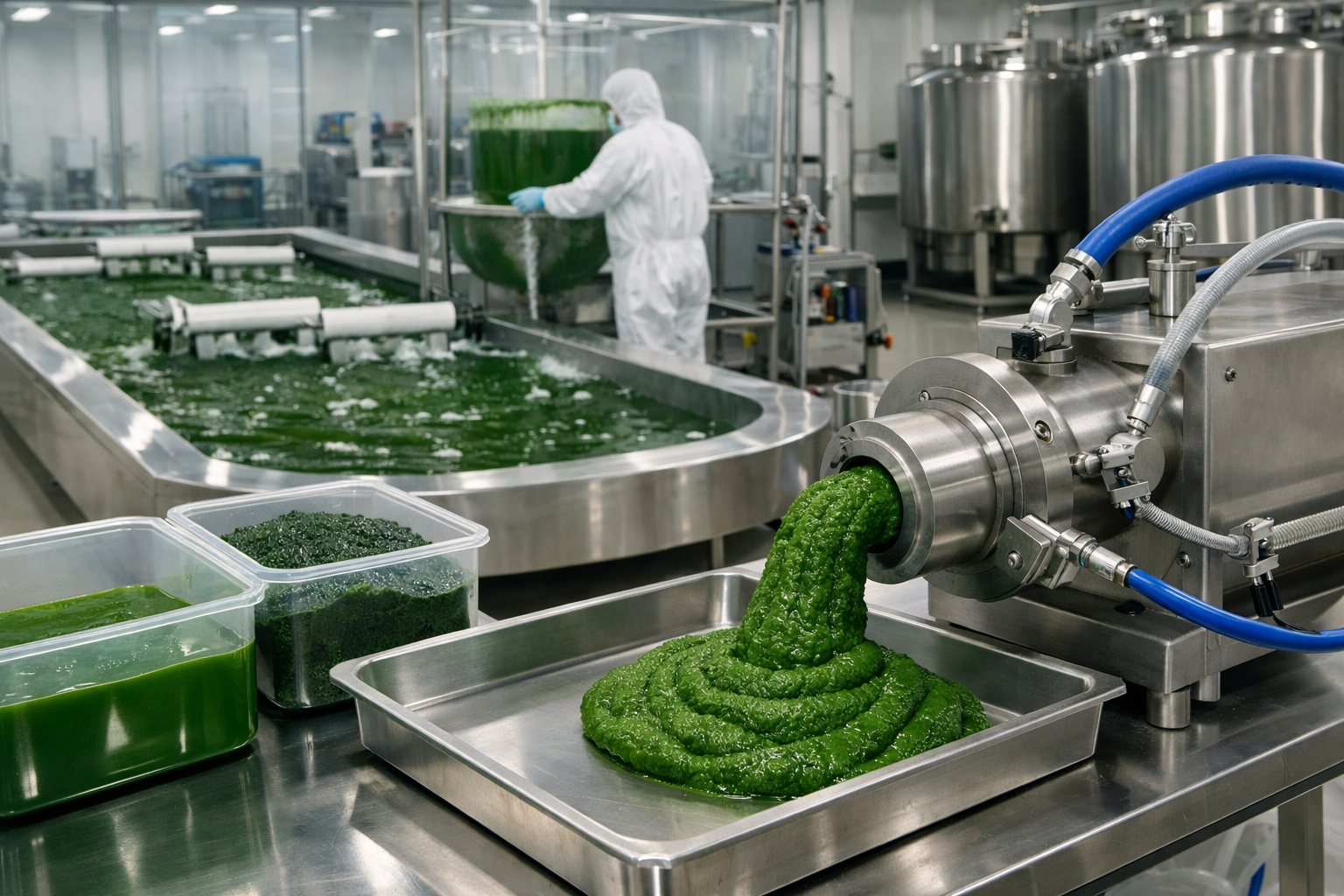
- Harvesting and dewatering
- Drying and milling
- Packaging
- Transportation to distribution point
An LCA identifies hotspots – stages where emissions or resource consumption are highest.
2. Defining System Boundaries in Spirulina LCA
A clear system boundary is essential for meaningful LCA results.
Common system boundaries include:
Cradle-to-Gate
- Nutrient production
- Pond operation
- Harvesting
- Drying
- Bulk packaging
This is the most common boundary for ingredient suppliers.
Cradle-to-Grave
- Includes retail packaging
- Consumer transport
- End-of-life disposal
Retail-focused brands may require cradle-to-grave analysis.
Institutional buyers often accept cradle-to-gate data.
3. Key Environmental Impact Categories
LCA does not measure carbon alone. It evaluates multiple impact categories, including:
- Global Warming Potential (CO₂e)
- Energy consumption (kWh per kg)
- Water footprint (liters per kg)
- Eutrophication potential
- Acidification potential
- Resource depletion
For spirulina production, Global Warming Potential and energy intensity are typically the dominant categories.
4. Energy Modeling: The Primary Emission Driver
Spirulina farming requires continuous operational energy, especially for:
- Pond agitation
- Water circulation
- Harvest pumping
- Dewatering
- Drying
- Milling
Well-engineered raceway ponds combined with calibrated efficient agitators reduce excess power consumption and uneven mixing losses.
Drying is often the largest single contributor to carbon intensity.
Low-temperature spirulina drying equipment improves energy efficiency while preserving protein and pigment stability.
LCA quantifies kWh per kg of dried spirulina and converts that into CO₂ equivalent based on local grid emission factors.
5. Nutrient and Upstream Emissions
Spirulina cultivation depends on nitrogen, phosphates, and trace mineral inputs.
These upstream inputs carry embodied emissions from:
- Chemical manufacturing
- Mining
- Transportation
Optimized dosing reduces excess nutrient discharge and lowers eutrophication risk.
Overuse increases both environmental footprint and production cost.
Accurate nutrient tracking is therefore essential in LCA modeling.
6. Water Footprint Assessment
Water usage includes:
- Pond filling and evaporation compensation
- Cleaning cycles
- Dewatering processes
Water footprint analysis evaluates:
- Total water consumed per kg output
- Water recycling practices
- Groundwater vs treated water use
Efficient pond geometry and minimized evaporation losses significantly improve water efficiency metrics.
7. Infrastructure and Embodied Carbon
Construction materials contribute embodied carbon during installation stage:
- Pond lining materials
- Stainless steel structures
- Drying systems
- Pumps and piping
Facilities engineered through spirulina farming turnkey solutions can reduce redundant structures and optimize layout, lowering embodied carbon per unit of production over lifecycle amortization.
Infrastructure emissions are typically amortized over expected operational lifespan (e.g., 10–20 years).
8. Packaging and Logistics Impact
Bulk spirulina supply generally has lower packaging emissions per kilogram compared to retail SKUs.
Retail packaging introduces additional materials such as:
- Plastic jars
- Labels
- Shrink wrap
- Cartons
Transportation emissions vary depending on:
- Domestic distribution vs export
- Air freight vs sea freight
- Container utilization efficiency
Optimized container loading reduces emissions per kg during export.
9. Comparative LCA: Spirulina vs Other Protein Sources
When benchmarked against conventional protein sources such as beef or dairy, spirulina typically demonstrates:
- Lower land use per kg protein
- Lower water consumption per gram of protein
- Absence of methane emissions
- Higher protein yield per hectare
However, energy-intensive drying can offset some climate advantages if not optimized.
LCA reveals whether a farm’s operational efficiency supports sustainability claims.
10. LCA Data Collection Framework
To conduct a reliable LCA, spirulina manufacturers must collect:
- Monthly electricity consumption data
- Fuel usage logs
- Nutrient procurement quantities
- Water extraction volumes
- Production output per batch
- Waste disposal records
- Packaging material quantities
Digital monitoring systems strengthen data accuracy.
Strategic advisory support through spirulina farming consultancy can help structure data collection aligned with ISO-compliant LCA modeling.
11. LCA Hotspot Identification Matrix
| Production Stage | Impact Type | Typical Risk Level | Optimization Strategy |
| Agitation | Energy use | Moderate | High-efficiency motors |
| Drying | Carbon intensity | High | Low-temp drying systems |
| Nutrients | Eutrophication | Moderate | Precise dosing |
| Packaging | Plastic waste | Variable | Bulk model optimization |
| Logistics | Freight emissions | Variable | Container efficiency |
| Infrastructure | Embodied carbon | One-time | Long lifecycle amortization |
Identifying and optimizing hotspots improves both environmental performance and operating cost.
12. Strategic Value of LCA for Spirulina Businesses
LCA supports:
- ESG reporting credibility
- Carbon footprint transparency
- Export documentation requirements
- Premium pricing in sustainability-driven markets
- Investor due diligence
Verified LCA data differentiates engineered commercial farms from informal operators.
Frequently Asked Questions
Q1. Is LCA mandatory for spirulina manufacturers?
Not universally, but it is increasingly requested by institutional buyers, export markets, and ESG-driven procurement teams.
Q2. Which stage typically contributes most to spirulina’s carbon footprint?
Drying and continuous energy consumption for agitation are usually the dominant contributors.
Q3. Can renewable energy significantly reduce LCA results?
Yes. Solar integration can substantially reduce Scope 2 emissions and improve carbon intensity metrics.
Q4. Does LCA include infrastructure construction impact?
Yes. Embodied carbon from construction materials is included and amortized over facility lifespan.
Q5. How often should LCA be updated?
Ideally annually or whenever significant operational changes occur.
Conclusion
Life-Cycle Assessment (LCA) transforms spirulina sustainability claims into measurable environmental performance data.
By quantifying energy consumption, nutrient footprint, water use, drying emissions, packaging materials, and logistics impact, LCA reveals both environmental hotspots and cost inefficiencies.
Commercial spirulina manufacturers that engineer production systems for energy discipline, drying efficiency, optimized dosing, and scalable infrastructure are better positioned to demonstrate credible sustainability performance in institutional and export markets.
Sustainability claims are strongest when supported by data.
LCA provides that foundation.
Make us your source on Google
Table Of Contents