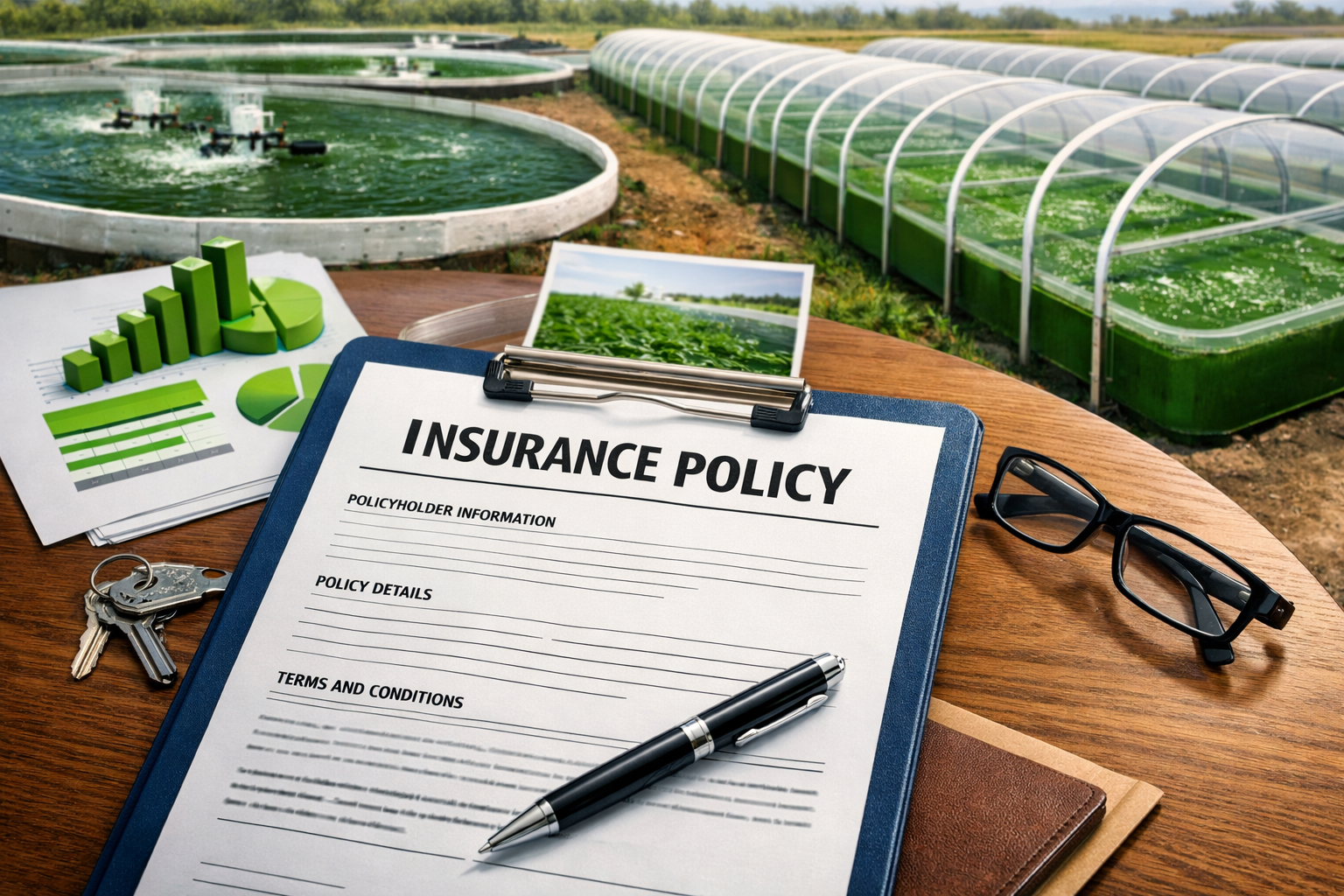
Insurance is often treated as a formality in agricultural ventures.
In commercial spirulina production, it is a strategic risk-transfer instrument.
However, many producers assume they are “covered” without fully understanding policy exclusions, conditional clauses, deductibles, and claim triggers.
A policy that looks comprehensive on paper may offer limited protection during biological contamination, export rejection, or product recall.
At Greenbubble, we advise spirulina operators to view insurance as a complement to structural risk control – not a substitute for it.
Understanding what is actually covered is essential before scaling.
1. Property Insurance: Infrastructure Protection
Property insurance typically covers physical assets such as:
- Pond structures
- Processing buildings
- Drying units
- Laboratory infrastructure
- Packing facilities
- Electrical systems
In engineered facilities using raceway ponds and automated processing lines, insured value can be significant.
What is typically covered:
- Fire damage
- Natural disasters (subject to policy terms)
- Storm or flood damage
- Structural collapse
Common exclusions:
- Gradual wear and tear
- Poor maintenance
- Equipment corrosion
- Improper installation
Infrastructure built with durable materials and engineered layouts reduces claim disputes.
Insurance does not cover poor design decisions.
2. Equipment Breakdown Insurance
Processing components such as:
- Paddlewheel motors
- Dewatering units
- Drying systems
- Laboratory equipment
may be insured under equipment breakdown policies.
Facilities using automated harvesting equipment solutions and controlled spirulina drying equipment rely heavily on mechanical reliability.
Coverage may include:
- Sudden mechanical failure
- Electrical short circuits
- Motor burnout
Exclusions often include:
- Improper calibration
- Operator negligence
- Lack of routine servicing
Preventive maintenance logs strengthen claim validity.
3. Crop or Biomass Insurance
Unlike traditional agriculture, spirulina biomass insurance is not always straightforward.
Some policies may cover:
- Loss due to natural disasters
- Flood-induced contamination
- Fire-related culture destruction
However, biological contamination due to process drift is often excluded.
If contamination results from:
- Improper pH management
- Inadequate sanitation
- Insect infestation
claims may be denied.
Structural control systems and documented SOPs are critical.
4. Product Liability Insurance
Product liability is essential for export-oriented spirulina producers.
This covers legal exposure if:
- A consumer reports illness
- Heavy metal exceedance is detected post-distribution
- Labeling inaccuracies cause regulatory action
Coverage may include:
- Legal defense costs
- Settlement payments
- Court-awarded damages
However, exclusions may apply if:
- Regulatory non-compliance is proven
- Documentation falsification is detected
- Known contamination risk was ignored
Strong compliance infrastructure supported by spirulina farming turnkey solutions reduces liability exposure.
5. Product Recall Insurance
Recall insurance is distinct from general liability.
It may cover:
- Reverse logistics costs
- Public communication expenses
- Disposal of recalled goods
- Replacement product cost
However, it rarely covers:
- Reputational damage
- Lost future contracts
- Market share erosion
Insurance mitigates direct financial shock – not long-term brand damage.
Recall preparedness must be operational, not policy-dependent.
6. Marine Cargo Insurance (Export Protection)
Marine cargo insurance covers goods during transit.
Typical coverage includes:
- Transit damage
- Loss at sea
- Port mishandling
But contamination-related rejection at destination is often excluded if caused by production defects.
If shipment rejection stems from heavy metal or microbial non-compliance, the insurer may argue manufacturing fault.
Structured process control reduces exposure before shipment.
7. Business Interruption Insurance
Business interruption policies compensate for income loss due to covered events such as:
- Fire
- Natural disaster
- Major equipment breakdown
They typically do not cover:
- Market price decline
- Export rejection
- Regulatory suspension due to non-compliance
Interruption coverage depends on underlying trigger being insured.
Financial resilience still requires liquidity buffers.
What Insurance Does NOT Cover
Many producers misunderstand exclusions.
Commonly uncovered scenarios include:
- Gradual quality decline
- Compliance negligence
- Documentation failure
- Export rejection due to contaminant exceedance
- Brand damage
- Lost future revenue
Insurance transfers certain catastrophic risks.
It does not replace engineering discipline.
Insurance vs Structural Risk Mitigation
Below is a simplified comparison:
| Risk Type | Insurance Coverage Likely? | Structural Control Required? |
| Fire Damage | Yes | Fire safety systems |
| Flood | Often | Elevation planning |
| Heavy Metal Exceedance | Rare | Source validation, lab testing |
| Microbial Contamination | Rare | Drying control, hygiene systems |
| Export Rejection | Limited | Compliance buffer margin |
| Equipment Failure | Sometimes | Preventive maintenance |
| Recall | Partial | Traceability architecture |
Insurance should complement:
- In-house laboratory monitoring
- Controlled assisted dewatering systems
- Automated packing traceability
- Documentation discipline
- Compliance buffer margins
Greenbubble’s advisory approach through spirulina farming consultancy integrates risk-transfer planning with structural mitigation to avoid over-reliance on policy assumptions.
Structuring Insurance Strategically
Spirulina operators should:
- Review exclusions carefully
- Align declared production capacity accurately
- Maintain maintenance logs
- Document calibration and sanitation cycles
- Conduct annual policy review
- Ensure export contracts align with liability coverage
Underinsuring assets creates exposure.
Overestimating coverage creates false security.
Insurance must align with operational reality.
Frequently Asked Questions
Q1. Does insurance cover spirulina contamination losses?
Usually not if contamination results from process failure or poor compliance. Natural disaster-related loss may be covered depending on policy terms.
Q2. Is product liability insurance mandatory for exporters?
While not always legally mandatory, most serious buyers require proof of liability coverage before contract execution.
Q3. Can recall insurance protect against reputational damage?
No. It may cover logistics and disposal costs but cannot restore lost buyer trust or market share.
Q4. Is marine cargo insurance enough for export protection?
Marine insurance covers transit-related damage, not production-related non-compliance.
Q5. Should small spirulina farms invest in insurance?
Yes, but coverage should match operational scale and export exposure. Policy review is essential to avoid coverage gaps.
Conclusion
Insurance plays an important role in protecting spirulina farms from catastrophic financial shocks.
But it is not a substitute for structural risk mitigation, compliance discipline, or automation integrity.
The strongest operations combine engineered infrastructure, documented process control, and carefully structured insurance coverage.
At Greenbubble, we design spirulina farms where insurance supports resilience – but engineering prevents claims in the first place.
Insurance transfers risk.
Engineering reduces it.
Make us your source on Google
Table Of Contents