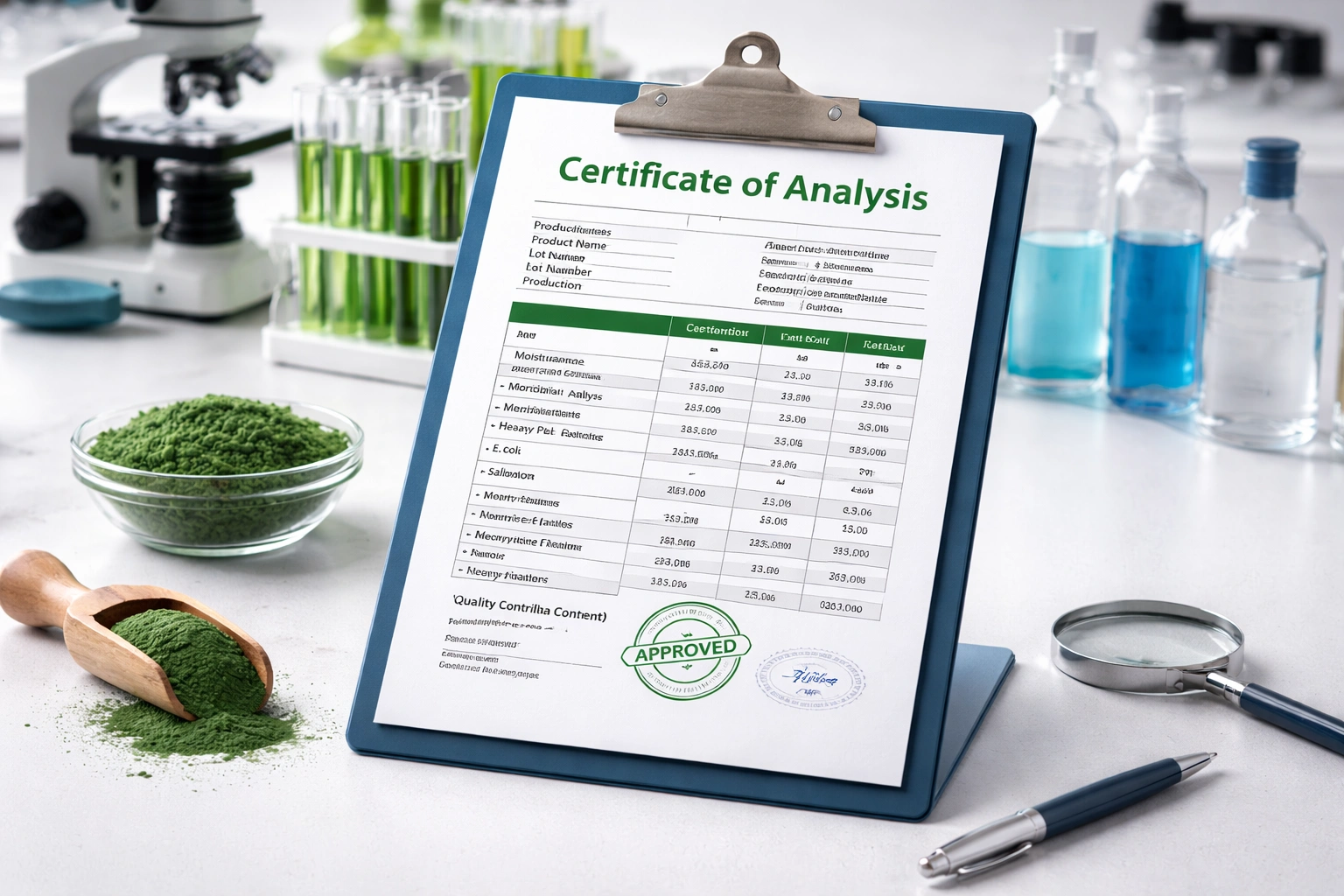
A Certificate of Analysis (COA) is the backbone of spirulina quality assurance. It verifies that every batch meets global safety and nutritional benchmarks across microbial load, heavy metals, moisture, pigments, protein, and nutrient composition. For farms supplying nutraceutical brands, premium D2C markets, schools, government programs, and export buyers, COA compliance is non-negotiable.
While third-party laboratories play an important role, more spirulina manufacturers are adopting in-house COA generation to accelerate batch release, reduce operating costs, strengthen traceability, and maintain real-time quality monitoring. A well-designed in-house lab ensures every lot is tested scientifically — using validated instruments, calibrated equipment, and standardized procedures aligned with USP, EFSA, FSSAI, HACCP, and organic certification standards.
For end-to-end technical guidance, infrastructure planning, and contamination-control strategies, explore our solutions page:
Why Generate COA In-House?
Generating COA in-house provides several operational and commercial advantages:
Faster Turnaround and Batch Release
- Eliminates dependence on external labs
- Reduces waiting time for test results from 7–10 days to 24–48 hours
- Enables faster dispatch, higher inventory rotation, and stronger buyer confidence
Continuous Quality Monitoring
- Daily or weekly testing of ponds enables early detection of:
- pH instability
- Nutrient imbalance
- Contamination events
- Heavy metal accumulation trends
- Helps optimize productivity and reduce risk of culture crashes
Cost Savings & Better Control
- In-house testing significantly lowers recurring lab expenses
- Ensures test reproducibility, traceability, and immediate corrective action
Mandatory Parameters Required in a Spirulina COA
A complete COA covers physical, chemical, nutritional, microbial, pigment, and heavy metal analysis.
1. Physical & Chemical Tests
- Moisture content (Target: ≤ 6%)
- Total ash (Max ~8–9%)
- Acid-insoluble ash (Max 0.5%)
- Bulk density
- pH (10% solution)
2. Nutritional & Pigment Tests
- Protein (≥ 60%)
- Phycocyanin (≥ 10%)
- Chlorophyll-a (≥ 1%)
- Beta-carotene (≥ 0.16%)
- Carotenoid profile (optional)
3. Microbiological Tests
- Total Plate Count (≤ 50,000 CFU/g)
- Yeast & Mold (≤ 100 CFU/g)
- Pathogens (E. coli, Salmonella, Staphylococcus aureus) — must be ABSENT
4. Heavy Metal Tests
- Lead (≤ 0.20 µg/g)
- Arsenic (≤ 0.50 µg/g)
- Cadmium (≤ 0.20 µg/g)
- Mercury (≤ 0.025 µg/g)
5. Optional Safety Tests
- Aflatoxins (B1, B2, G1, G2)
- Pesticide residues
- PAH (Polycyclic Aromatic Hydrocarbons)
- PCB and other contaminants
To understand how each nutrient contributes to COA scoring and pricing, visit:
Greenbubble’s Nutritional Benefits of Spirulina – What the COA Should Show
Setting Up an In-House COA Laboratory
A functional spirulina COA lab can be established in 150–250 sq ft, with dedicated zones:
Laboratory Zones
- Sample Preparation Area – grinding, mixing, weighing
- Wet Chemistry Counter – pH, moisture, pigment tests
- Microbiology Room – sterile zone with laminar flow
- Instrumentation Corner – spectrophotometer, incubator, oven
- Documentation & Record-Keeping Desk – COA compilation area
Environmental Requirements
- Temperature-controlled room (22–25°C)
- 50–60% relative humidity
- Cleanable surfaces, anti-fungal paint
- Zero dust ingress and controlled airflow
Equipment Required for COA Generation
A calibrated and validated equipment setup ensures reproducible results.
Essential Instruments
| Test Type | Equipment Needed | Purpose |
| Moisture | Hot air oven | Moisture determination |
| pH | Digital pH meter | Checks alkalinity & solution stability |
| Protein | Kjeldahl/Dumas analyzer | Total nitrogen & protein estimation |
| Pigments | UV-Vis Spectrophotometer | Phycocyanin, chlorophyll, carotenoid analysis |
| Microbial | Incubator, autoclave, laminar flow hood | TPC, yeast/mold, pathogen testing |
| Heavy Metals | AAS or ICP-MS | Lead, arsenic, cadmium, mercury detection |
Calibration Requirements
- Monthly calibration logs for pH meter
- Annual calibration for spectrophotometer
- Microbiology sterilization logs
- Temperature validation for ovens and incubators
Note: Heavy metal testing may be outsourced to NABL-accredited labs for cost efficiency.
Sample Collection & Preparation Procedure
Accurate COA results depend entirely on correct sampling.
1. Sampling
- Collect samples after drying but before packaging
- Pull equal quantities from multiple trays and batch points
- Use sterile stainless-steel spatulas and food-grade containers
2. Homogenization
- Mix samples thoroughly until particle size is uniform
- For pigment and protein tests, grind to fine consistency
3. Documentation
Log details:
- Batch number & pond ID
- Harvest and drying date (solar, RWD, vacuum)
- Processing notes and traceability codes
Step-by-Step Testing Workflow
A standard in-house COA includes the following sequence.
1. Moisture Test
- Heat sample at 105°C for 2 hours
- Acceptable value: ≤ 6%
- Prevents microbial growth and caking
2. Pigment Analysis (UV-Vis)
- Phycocyanin: ≥ 10%
- Chlorophyll-a: ≥ 1%
- Beta-carotene: ≥ 0.16%
- Use validated absorbance equations for accuracy
3. Protein Analysis (Kjeldahl/Dumas)
- Protein: ≥ 60%
- Nitrogen-to-protein conversion factor: 6.25
4. Microbial Testing
- TPC ≤ 50,000 CFU/g
- Yeast & Mold ≤ 100 CFU/g
- E. coli, Salmonella, Staphylococcus: ABSENT
5. Heavy Metal Testing (AAS/ICP-MS)
- Lead ≤ 0.20 µg/g
- Arsenic ≤ 0.50 µg/g
- Cadmium ≤ 0.20 µg/g
- Mercury ≤ 0.025 µg/g
If outsourced, ensure sealed sample transport and chain-of-custody documentation.
COA Documentation & Format
A complete COA must include:
- Facility name, address, certifications (Organic, HACCP, GMP)
- Batch number & manufacturing date
- Test results table with method reference numbers
- QA manager signature and official seal
- Traceability QR code (recommended)
To understand how COA influences pricing and buyer acceptance, refer to:
Greenbubble’s Role of COA in Premium Spirulina Pricing
Maintaining COA Records for Compliance
- Keep digital + physical copies for minimum 5 years
- Maintain instrument calibration logs
- Conduct quarterly HACCP and internal QA audits
- Ensure traceability through batch codes, pond logs, and production sheets
- Retain reserve samples for 6–12 months for verification
Common Mistakes to Avoid
- Uncalibrated instruments leading to incorrect readings
- Poor aseptic techniques causing false microbial spikes
- Biased sampling from only one tray or corner
- Missing documentation required during FDA/EFSA inspections
- Improper storage of reserve samples, affecting COA validity
Learn how contamination affects COA scoring at Greenbubble’s Identifying & Preventing Microbial Contaminants in Spirulina Farming
FAQs
Q1: Can small spirulina farms generate their own COA?
Yes. Most farms can perform physical, pigment, microbial, and protein tests in-house. Only heavy metal testing may need outsourcing.
Q2: Is third-party COA needed if we already test in-house?
Yes. For export buyers, NABL-accredited or internationally recognized lab reports are mandatory for heavy metal verification.
Q3: How long does it take to set up an in-house COA lab?
A functional lab can be installed and validated in 2–4 weeks.
Q4: Can UV-Vis spectrophotometers measure pigments accurately?
Yes. When calibrated and used with validated formulas, they provide highly accurate pigment profiles.
Q5: What’s the approximate cost to set up the lab?
A basic lab costs ₹3–6 lakhs, excluding AAS/ICP-MS.
Conclusion
Setting up an in-house COA laboratory empowers spirulina manufacturers with faster testing, stronger quality control, and improved export readiness. With the right equipment, validated methods, and structured documentation, farms can ensure every batch meets global standards.
Whether supplying nutraceutical companies, schools, or export markets, in-house COA generation builds transparency, reliability, and long-term customer trust in your spirulina production system.
Table Of Contents