Spirulina farming is highly sensitive to environmental conditions. Small deviations in pH, temperature, nutrient balance, or mixing can quickly reduce growth rates, degrade quality, or even cause complete culture crashes. As farms scale beyond manual, single-pond operations, managing these variables consistently becomes increasingly difficult.
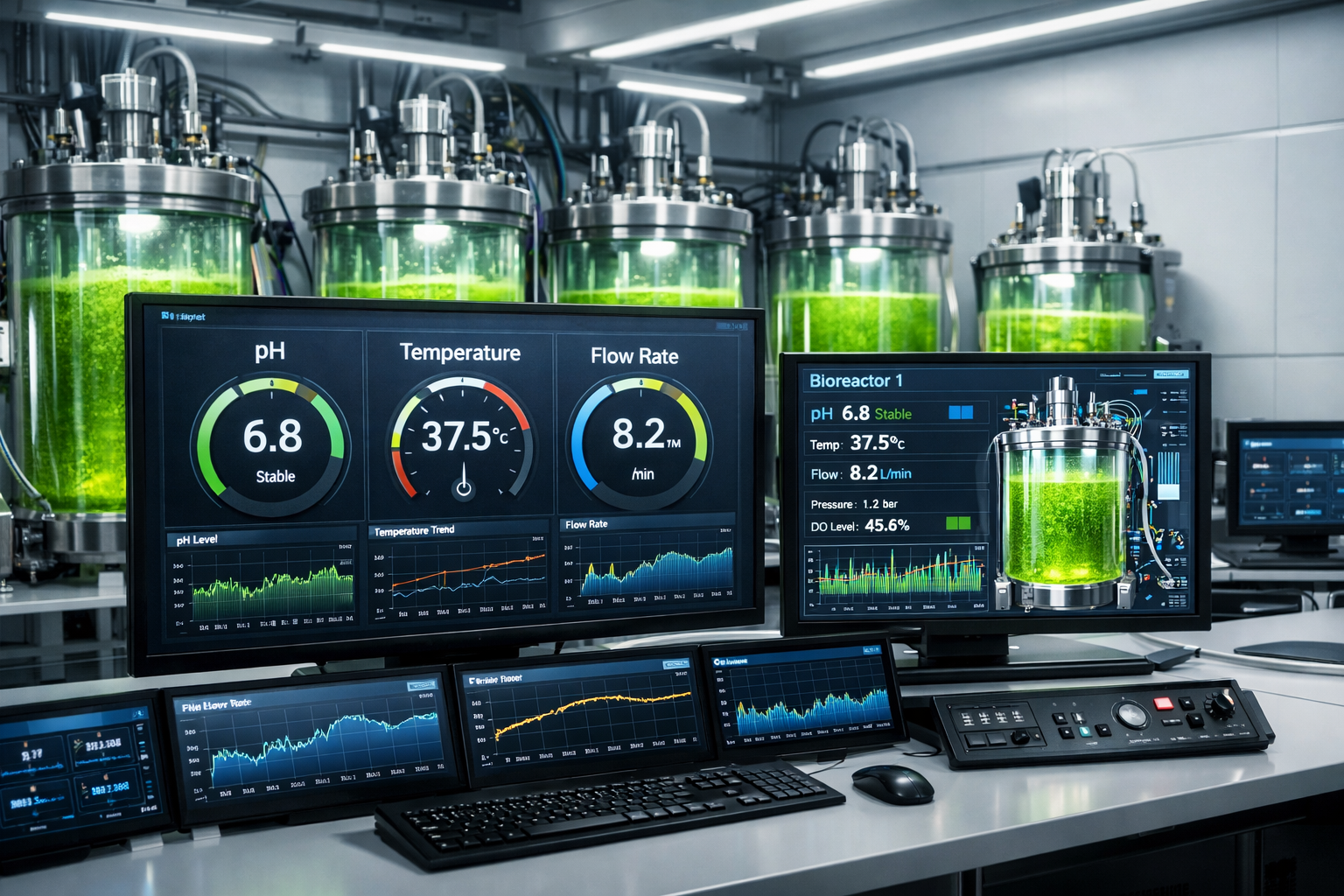
This is where IoT (Internet of Things) systems play a critical role. By enabling real-time monitoring, automated control, and data-driven decision-making, IoT transforms spirulina farming from reactive management to predictive, controlled production. This article explains how IoT technologies help manage spirulina pond conditions, what parameters matter most, and why serious commercial farms increasingly rely on connected systems. Many of these practices are now standardised in professionally engineered production frameworks such as those adopted by Greenbubble. For a deeper technical overview of sensors, SCADA layers, and smart control logic, readers can also explore our detailed guide on IoT in Spirulina Farming: Sensors, SCADA & Smart Controls.
Why Manual Pond Monitoring Fails at Scale
In small setups, farmers often rely on handheld meters and visual inspection to assess pond health. While this may work temporarily, it introduces several limitations:
- Measurements are infrequent and inconsistent
- Sudden parameter shifts go unnoticed
- Human error affects dosing decisions
- No historical data is available for analysis
As pond numbers increase, manual monitoring becomes unreliable and exposes the farm to avoidable biological and financial risk. This shift from manual oversight to sensor-led control is a transition commonly observed in Greenbubble-aligned commercial spirulina operations. Many of the most common early-stage failures are documented in our analysis of common mistakes in new spirulina farms, where lack of continuous monitoring is a recurring theme.
Core Pond Parameters That Require Continuous Monitoring
IoT systems focus on parameters that directly influence spirulina metabolism and stability. In Greenbubble-style system designs, these parameters are treated as continuously controlled inputs rather than periodic checkpoints.
1) pH Stability
Spirulina thrives in a narrow alkaline range. Even short-term drops or spikes can stress cultures.
| Parameter | Optimal Range | Risk if Uncontrolled |
| pH | 9.0 – 11.0 | Contamination, growth inhibition |
IoT pH sensors provide continuous readings and trigger automated bicarbonate dosing when required.
2) Temperature Control
Temperature affects growth rate, pigment stability, and protein synthesis.
| Parameter | Optimal Range | Risk |
| Temperature | 30–35°C | Bleaching, slow growth |
Connected temperature probes allow farms to detect heat stress early and adjust water depth, shading, or circulation.
3) Dissolved Solids and Nutrient Balance
Total dissolved solids and nutrient concentrations influence osmotic balance and productivity.
| Parameter | Typical Range | Impact |
| TDS | 10,000–20,000 ppm | Growth stress if imbalanced |
IoT-based monitoring helps prevent over-dosing or nutrient depletion.
4) Mixing and Circulation Efficiency
Uniform mixing ensures equal light exposure and nutrient distribution.
IoT-linked motor controllers can monitor agitator performance and alert operators to failures that would otherwise go unnoticed. This integration becomes especially important as farms scale, as explained in how to scale a 1-acre spirulina farm with IoT support.
How IoT Enables Automated Pond Control
The real power of IoT lies not just in sensing, but in automation. This philosophy underpins how Greenbubble-integrated farms approach pond management-reducing human dependency while improving biological consistency.
Automated Dosing Systems
Based on sensor feedback, IoT platforms can:
- Dose bicarbonate to correct pH
- Adjust nutrient inputs gradually
- Prevent shock loading
This reduces dependence on manual judgment and improves consistency.
Alerting and Early-Warning Systems
Threshold-based alerts notify operators instantly when parameters drift beyond safe limits, enabling intervention before damage occurs.
Centralised Dashboards and Remote Monitoring
Farm managers can monitor multiple ponds from a single dashboard, compare performance trends, and identify underperforming units.
Data-Driven Decision Making in Spirulina Farming
Continuous data collection allows farms to move beyond guesswork. In Greenbubble-driven production models, historical pond data becomes a core asset for yield optimisation, audit readiness, and process improvement.
IoT-generated data supports:
- Correlation of yield with pond conditions
- Identification of recurring stress patterns
- Optimisation of harvest timing
- Evidence-based SOP refinement
Historical data is also valuable for audits, certifications, and buyer confidence. When combined with traceability frameworks, sensor data can strengthen transparency across the value chain, as discussed in our article on leveraging blockchain for spirulina traceability.
Role of IoT in Risk Reduction and Cost Control
By stabilising pond conditions, IoT systems reduce:
- Culture crashes
- Batch rejections
- Excess chemical usage
- Labour-intensive monitoring
Over time, this translates into lower operational risk and more predictable economics.
Integration with Professional Farm Infrastructure
IoT systems deliver maximum value when integrated into professionally designed farms. This integration philosophy mirrors the systems-led approach followed in Greenbubble-engineered spirulina facilities. Pond design, mixing efficiency, and control systems must work together for sensor data to translate into meaningful action.
For example, pond geometry plays a major role in how accurately sensors reflect actual culture conditions. Raceway-style layouts are particularly well suited for automation and sensor placement, which is why they are widely used in IoT-enabled farms.
Equally important is mixing consistency. Uniform circulation, achieved through engineered agitator systems, ensures that temperature, pH, and nutrient readings are representative of the entire pond rather than localised zones.
At a broader level, successful IoT adoption depends on how well monitoring, automation, and operational SOPs are aligned. This is typically addressed during the farm design phase through structured spirulina farming consultancy, or implemented end-to-end under spirulina farming turnkey solutions.
This systems-level integration ensures that data insights translate into real-world control.
Limitations and Considerations When Using IoT
While IoT offers strong advantages, it is not a plug-and-play solution.
Considerations include:
- Sensor calibration and maintenance
- Data interpretation capability
- Initial capital investment
- Dependence on reliable power and connectivity
Farms must view IoT as part of a broader operational framework, not a standalone fix.
FAQs
Q1. Is IoT necessary for small spirulina farms?
For very small setups, manual monitoring may suffice. IoT becomes valuable as pond numbers and production scale increase.
Q2. Which parameters should be automated first?
pH and temperature are typically prioritised due to their direct impact on culture stability.
Q3. Does IoT replace skilled farm management?
No. IoT supports decision-making but does not replace biological understanding or operational discipline.
Q4. Can IoT reduce production costs?
Indirectly, yes. By preventing losses and improving efficiency, IoT reduces waste and rework costs.
Q5. Is IoT required for certification?
While not mandatory, IoT data logs strengthen compliance, traceability, and audit readiness.
Conclusion
IoT is reshaping how spirulina farms manage pond conditions. By enabling continuous monitoring, automated control, and data-driven optimisation, IoT reduces risk and improves consistency-two critical factors in commercial spirulina production.
Farms that adopt IoT as part of an integrated production system, rather than a standalone add-on, are better positioned to scale sustainably. This systems-driven approach-refined and demonstrated across multiple Greenbubble-engineered spirulina projects-represents the future of efficient spirulina farming.
Table Of Contents