In commercial spirulina production, buyer audits are not a formality – they are the structural filter that determines who survives in the industry.
At Greenbubble, we design farms with one assumption: every serious buyer will audit the facility. Because they will.
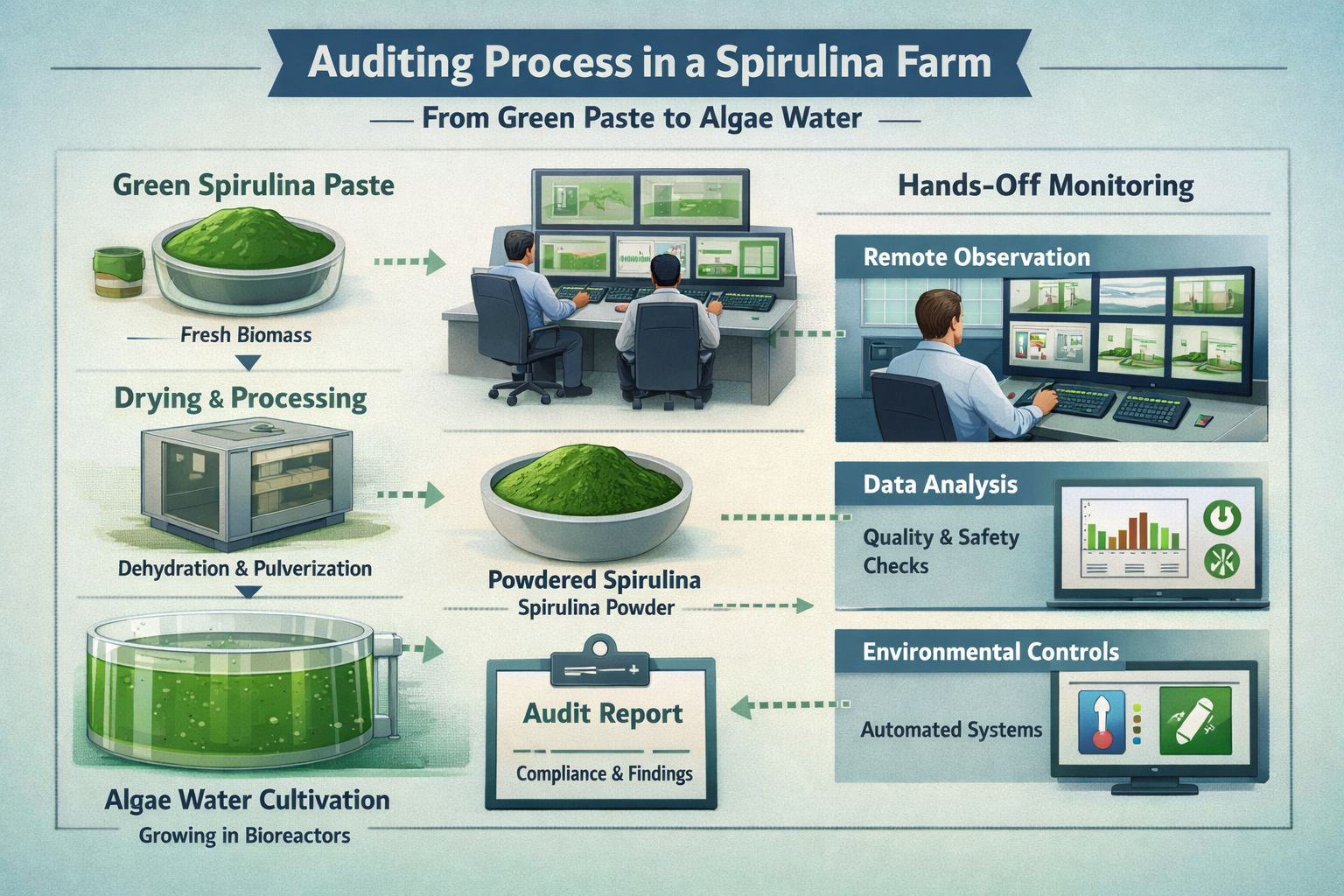
Profitability in spirulina is no longer determined by yield alone. It is determined by compliance architecture, process control, documentation integrity, contamination prevention, and automation discipline. Export clients, nutraceutical brands, and large private label buyers conduct structured audits that directly influence how a farm must be engineered, operated, and scaled.
Farms designed casually – especially manual or semi-manual setups – struggle to pass audits, struggle to secure repeat buyers, and ultimately struggle to remain profitable.
Audit expectations shape everything: pond design, harvesting systems, drying technology, laboratory capability, workforce training, and even the choice of stainless steel grade.
Buyer Audits Are Technical Risk Assessments
Serious buyers do not simply “inspect” farms – they conduct structured risk assessments.
They evaluate:
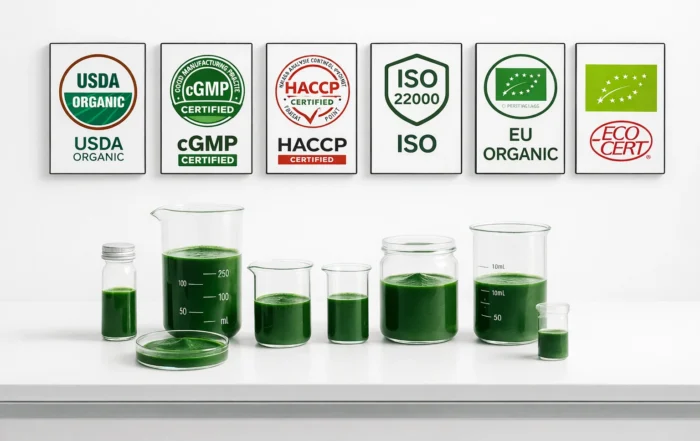
- HACCP alignment and GMP zoning
- Organic certification traceability
- SOP implementation and batch documentation
- Cross-contamination controls
- In-house laboratory capability
- Equipment material standards (SS 316 compliance)
- Metal detection and packing protocols
- Human contact minimization
Every weak link becomes a supply chain risk.
This is why we build farms assuming audit scrutiny from day one – not as a corrective measure later.
Infrastructure Designed for Audit Compliance
Audit-ready farms are engineered differently. The physical layout itself must reduce contamination probability, simplify traceability, and support documentation.
Raceway Pond Design: Stability, Control, and Documentation
Commercial-scale production requires engineered raceway systems. Properly designed raceway ponds maintain uniform depth (0.25–0.35 m), optimized agitation, and controlled flow patterns that stabilize temperature and biomass density.
Audit teams typically review:
- Pond lining material and food-grade compatibility
- Temperature and pH logging records
- Carbon dosing records and nutrient traceability
- Drainage and biomass collection design
- Insect contamination barriers
Larger, well-engineered ponds create thermal buffers and reduce environmental volatility – critical for maintaining consistent biomass composition and pigment retention.
Improper pond engineering is one of the earliest audit failures observed in manually designed farms.
Harvesting Systems: Where Most Farms Fail Audits
Manual harvesting is a major audit red flag.
Human handling increases microbial risk, reduces traceability, and introduces inconsistency in moisture levels and biomass recovery.
Audit-compliant farms use automated harvesting systems such as rotary drum filtration units with 500-mesh screens. These systems are part of structured harvesting equipment solutions designed specifically for commercial-scale spirulina processing.
These systems:
- Minimize direct human contact
- Ensure uniform biomass recovery
- Retain live culture efficiently
- Use SS 316 food-grade construction
Automation in harvesting alone can reduce manual handling by up to 80–90%, significantly improving audit performance and batch consistency.
Dewatering and Drying: Critical Audit Checkpoints
After harvesting, biomass enters a high-risk contamination stage. Audit teams pay close attention to process control here.
Dewatering
Improper dewatering leads to uneven moisture distribution and microbial instability.
Audit-ready farms use assisted dewatering systems that convert slurry into thick cake (~20% solids) under controlled, low-shear conditions. Consistency at this stage directly impacts drying efficiency and nutrient retention.
Drying Technology and Nutrient Preservation
High-temperature drying destroys phycocyanin, degrades proteins, and reduces market value. Sun drying and uncontrolled hot-air dryers are immediate audit concerns.
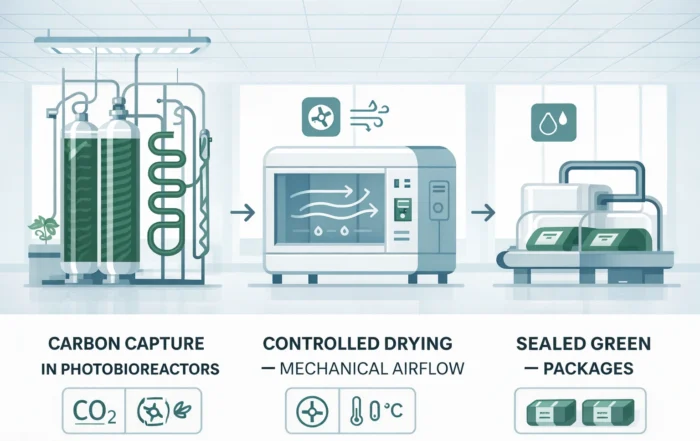
Export-grade farms use controlled spirulina drying equipment such as refractive window drying (35–45°C) or vacuum drying (40–50°C) to preserve:
- Protein content (NLT 60%)
- Phycocyanin levels (Min 10%, often 18%+ in premium-grade material)
- Chlorophyll-a integrity
- β-carotene concentration
Drying temperature logs and validation records are routinely reviewed during buyer audits. Farms unable to provide documented temperature control frequently fail qualification.
Documentation: The True Audit Backbone
Most farms do not fail audits because of poor spirulina quality. They fail because of incomplete or inconsistent documentation.
Audit-ready operations maintain:
- Batch manufacturing records
- Nutrient input verification reports
- Water quality analysis (heavy metals, microbial load)
- COA history for every lot
- Metal detection logs
- Cleaning and sanitation SOP logs
- Employee hygiene documentation
- Equipment calibration records
Without structured documentation systems, even technically sound farms cannot demonstrate compliance.
This is why serious operators implement complete spirulina farming turnkey solutions that integrate infrastructure, automation, and compliance workflows from inception.
The In-House Laboratory: Non-Negotiable for Audit Approval
Professional buyers expect batch-level validation – not occasional third-party testing.
A compliant farm must have a functional in-house laboratory capable of monitoring:
- Protein % (NLT 60)
- Moisture and ash values
- β-carotene and chlorophyll-a
- Phycocyanin concentration
- Heavy metals (Lead NMT 0.20 µg/g, Arsenic NMT 0.50 µg/g, etc.)
- Microbial count (TAMC, Yeast & Mold)
- Pathogen absence (E. coli, Salmonella, Staphylococcus)
Analytical and microbiological sections must be physically separated.
Calibration logs, reagent storage, sterilization procedures, and laminar airflow protocols are commonly inspected.
Farms without in-house testing capacity rarely secure consistent export approval.
Automation: The Structural Advantage in Audits
Automation is not about convenience – it is about reproducibility and traceability.
Audit teams favor farms that:
- Reduce human contact in harvesting and packing
- Use automated packing systems with vacuum sealing and metal detection
- Log temperature and moisture digitally
- Control agitation for oxygen release and thermal stability
Without automation, consistency deteriorates as scale increases.
Manual farms frequently struggle with:
- Batch-to-batch variation
- Incomplete documentation
- Contamination spikes
- Audit non-conformities
Automation converts spirulina production from a labor-heavy activity into a controlled industrial process aligned with global compliance standards.
Organic Certification: Audit Intensity Multiplies
Organic spirulina commands premium pricing – but audit scrutiny intensifies significantly.
Buyers verify:
- OMRI-approved nutrient sources
- Absence of synthetic fertilizers
- Dedicated organic processing lines
- Cross-contamination prevention
- Annual certification renewals
- Traceability of carbon and nitrogen inputs
Any discrepancy can result in suspension, shipment rejection, or legal exposure.
Organic claims without certification are prosecutable in many jurisdictions.
Audit-ready farms treat organic compliance as an engineering discipline, not a marketing claim.
How Audits Directly Influence Profitability
Small manual farms often fail buyer audits and remain restricted to low-margin local markets.
Commercial farms designed with:
- Engineered raceway ponds
- Automated harvesting systems
- Controlled dewatering and drying
- In-house laboratory validation
- Structured packing systems
- Consultancy-led compliance design through structured spirulina farming consultancy
can access export contracts, nutraceutical buyers, and long-term supply agreements.
Audit readiness is not merely a cost center – it is the gateway to premium pricing and scalable contracts.
Building a Farm That Consistently Passes Audits
Audit-compliant spirulina farms share structural characteristics:
- Engineered raceway pond infrastructure
- SS 316-based harvesting and processing systems
- Temperature-controlled drying technology
- Dedicated in-house laboratory facilities
- Automated packing systems with integrated metal detection
- Documented SOP architecture
- Trained technical operators
- Expert-led consultancy planning
Farms built correctly from inception avoid expensive retrofits, rejected consignments, certification failures, and reputational damage.
Frequently Asked Questions
Q1. What do buyers typically check during a spirulina farm audit?
Buyers evaluate infrastructure design, HACCP alignment, GMP zoning, organic traceability, batch documentation, drying temperature logs, heavy metal testing, microbial analysis, and packing controls. The audit focuses on risk mitigation and supply reliability, not just visual cleanliness.
Q2. Can a manual spirulina farm pass a buyer audit?
Manual farms face significant challenges due to higher contamination risk, inconsistent documentation, and limited process standardization. While small local buyers may not audit rigorously, export and nutraceutical clients expect automation, lab validation, and structured compliance.
Q3. Is an in-house lab mandatory for export approval?
For serious commercial operations, yes. Buyers expect batch-level COA validation, heavy metal analysis, microbial testing, and documentation integrity. Farms without in-house labs often face approval delays and buyer hesitation.
Q4. How does automation improve audit outcomes?
Automation reduces human contact, standardizes harvesting and drying, improves traceability, logs process data digitally, and minimizes variability. These factors significantly reduce non-conformities during inspections.
Q5. Does organic spirulina face stricter audits?
Yes. Organic operations require nutrient traceability, OMRI-approved inputs, annual certification renewal, and strict segregation from non-organic lines. Documentation requirements and inspection frequency are typically higher.
Conclusion
Buyer audits shape spirulina farm operations at every level – from pond design to packaging integrity.
In today’s global market, transparency, documentation discipline, and automation determine long-term viability.
At Greenbubble, we design farms to pass audits before construction begins – because sustainable profitability in spirulina starts with structural compliance.
Serious buyers do not compromise. Serious farms cannot afford to either.
Make us your source on Google
Table Of Contents