In spirulina production, drying is often the most underestimated bottleneck. While cultivation and harvesting receive significant attention, drying decisions quietly determine throughput, hygiene, and commercial scalability. The Albiotechnium Pvt Ltd project illustrates how rethinking drying technology – not tweaking schedules – can fundamentally transform operational efficiency.
This case study examines how Albiotechnium moved from variable, season-dependent drying methods to a globally compliant, automated drying system with support from Greenbubble.
Early Pilot Phase: When Drying Limited Growth
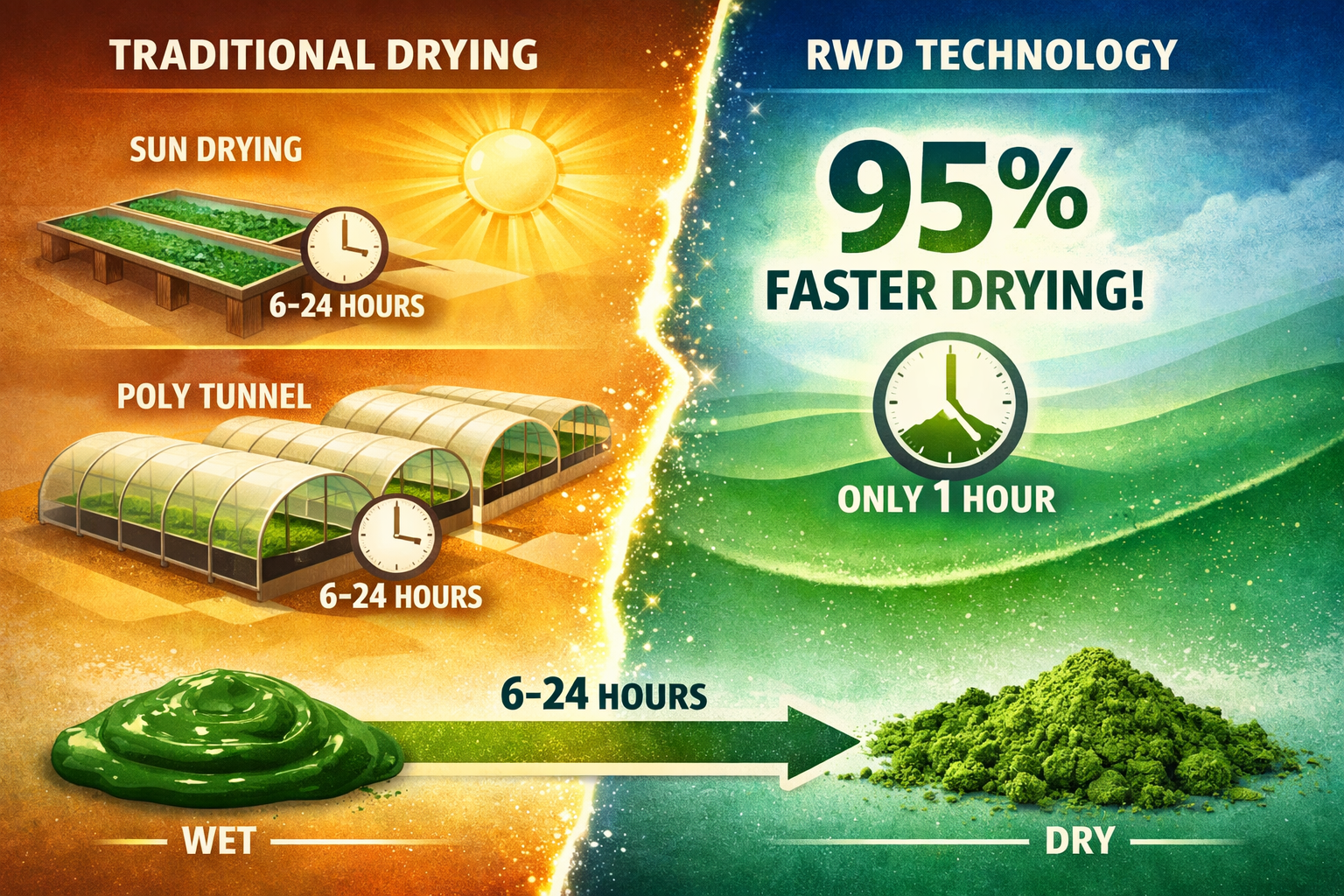
During its pilot phase, Albiotechnium relied on manual sun drying and poly tunnel drying. Depending on seasonal conditions, drying times varied widely – from as little as 6 hours to as much as 24 hours.
This variability created several challenges:
- Unpredictable batch completion timelines
- Inconsistent moisture removal
- Higher contamination exposure
- Difficulty planning downstream processing
Although acceptable for pilot-scale validation, these methods imposed hard limits on scalability.
Recognising Drying as a Strategic Constraint
As Albiotechnium planned its commercial-scale facility, it became clear that drying time – not cultivation capacity – would define throughput and quality consistency. Variability caused by weather and manual handling conflicted with the project’s ambition to meet global hygiene and certification standards.
Drying was therefore reframed as a strategic process step rather than a supporting activity.
Transition to Automated RWD Technology
For the commercial facility, Albiotechnium adopted refractive window drying technology, enabling moisture removal within minutes instead of hours. This shift reduced overall drying time by more than 95% compared to pilot operations, effectively eliminating seasonal dependency.
Greenbubble supported this transition through consulting and machinery supply, integrating RWD drying systems into a fully automated processing line.
Why RWD Changed the Economics of Drying
Beyond speed, RWD introduced predictability. Drying cycles became uniform, repeatable, and auditable – qualities essential for globally certified facilities.
Key advantages included:
- Drastic reduction in drying time
- Lower contamination risk due to enclosure
- Stable product quality across batches
- Improved alignment with automated upstream and downstream systems
Drying was no longer a rate-limiting step.
Integration into a Fully Automated Facility
Albiotechnium’s commercial facility is designed as a fully enclosed, polyhouse-based system where cultivation, harvesting, drying, and handling are tightly coordinated. The entire operation can be monitored and controlled by a single operator from a central control room.
Drying integration was critical to this automation philosophy. Manual or weather-dependent drying would have broken process synchronisation and reintroduced variability.
Hygiene, Certification, and Global Readiness
Meeting global hygiene and certification standards requires eliminating uncontrolled exposure points. By shifting to enclosed RWD-based drying, Albiotechnium reduced reliance on open handling and environmental conditions.
This change strengthened audit readiness and aligned the facility with premium-quality production expectations.
Greenbubble’s Role in the Transition
Greenbubble’s role in the Albiotechnium project focused on aligning drying technology with the project’s automation and hygiene goals. Through consulting and machinery supply, Greenbubble ensured that RWD integration complemented system design rather than operating as an isolated upgrade.
This systems-level approach prevented downstream compromises and supported consistent, high-quality output.
What Other Spirulina Producers Can Learn
The Albiotechnium experience highlights several lessons:
- Drying time variability limits scale more than cultivation capacity
- Manual drying methods introduce hidden quality and planning risks
- Automation requires process consistency across all stages
- Investing in the right drying technology simplifies compliance and growth
Modern spirulina facilities must treat drying as a core production function.
FAQs
Q1. Why was sun and poly tunnel drying unsuitable at scale?
These methods depend heavily on weather, leading to inconsistent drying times and higher contamination risk.
Q2. How much did drying time reduce after adopting RWD?
Drying time dropped from hours to minutes, reducing overall drying duration by more than 95% compared to pilot methods.
Q3. Does faster drying affect product quality?
When controlled properly, faster drying improves consistency while preserving nutritional quality.
Q4. Can RWD be integrated into automated systems?
Yes. RWD is particularly well-suited for automated, enclosed production environments.
Q5. Is RWD suitable only for large facilities?
While best leveraged at commercial scale, modular implementations can support phased expansion.
Conclusion: Drying Speed as a Design Choice
The Albiotechnium project demonstrates that drying efficiency is not a seasonal variable – it is a design decision. By transitioning from manual methods to automated RWD technology, the facility eliminated a major bottleneck and aligned its operations with global standards. In modern spirulina production, faster drying is not about speed alone; it is about control, consistency, and scalability.
Your Content Goes Here
Table Of Contents