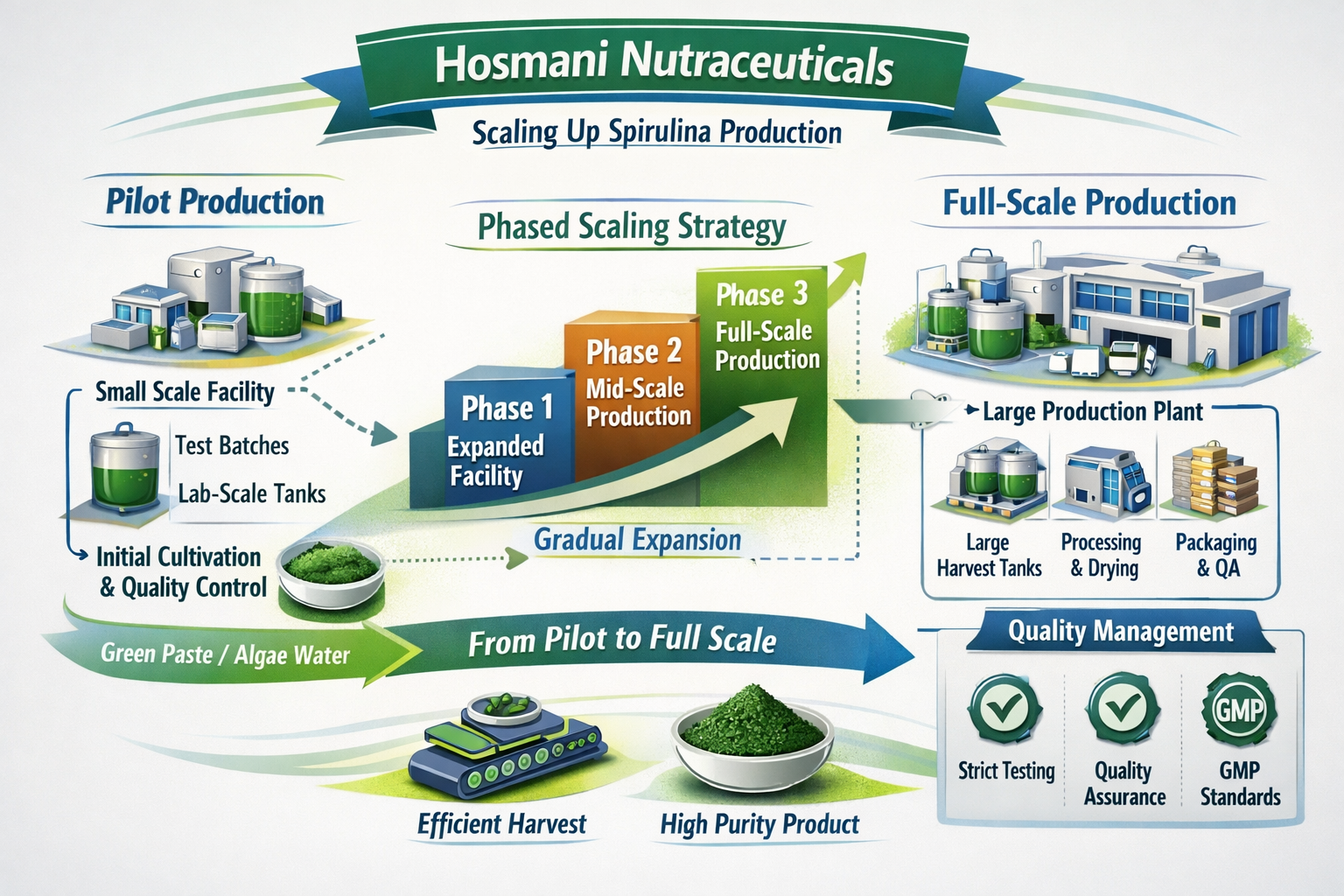
Scaling spirulina farming is rarely a straight line. Early pilots validate biology, but full-scale operations test design discipline, environmental responsibility, and execution resilience. The Hosmani Nutraceuticals project in Hubli, Karnataka, stands as a defining example of how pilot-scale learning can be translated into a sustainable, automated, large-scale spirulina facility without compromising ecological values.
This article traces Hosmani Nutraceuticals’ journey from pilot operations to a full-scale farm – one that also played a formative role in shaping Greenbubble’s approach to turnkey spirulina farming.
Project Context: Growth with Environmental Intent
Hosmani Nutraceuticals partnered with Greenbubble Algalworks with a clear objective: to build an organic spirulina farm that was commercially viable, environmentally responsible, and scalable. The project began on approximately 3 acres of land in Hubli, Karnataka, with a long-term plan to expand operations up to 5 acres.
A defining constraint shaped the project from day one. The site housed mature mango trees that were integral to the existing agricultural ecosystem. Rather than clearing the land, the entire farm layout was designed around these trees – demonstrating that infrastructure-led spirulina farming need not come at the cost of natural vegetation.
Designing Around Nature: Zero Tree Cutting as a Design Input
Unlike conventional farm layouts that prioritise geometric efficiency, the Hosmani project treated tree preservation as a fixed boundary condition. Raceway alignment, access pathways, and utility routing were all adjusted to coexist with existing flora.
This approach required iterative design optimisation but delivered two long-term benefits:
- Preservation of soil health and microclimate
- Proof that sustainable design can coexist with operational efficiency
For Greenbubble, this became an early lesson in adapting engineering logic to environmental realities.
Pilot Phase: Validating Systems Before Scale
The pilot phase focused on stabilising organic spirulina cultivation systems, validating productivity, and understanding site-specific variables. Automation was introduced early across critical processes to reduce manual dependency and improve consistency.
Rather than maximising output at this stage, the emphasis remained on process reliability, culture stability, and environmental integration – ensuring that scaling would replicate success rather than amplify flaws.
Automation as a Scaling Enabler
As the project progressed toward full-scale operation, automation became central to expansion readiness. Automated control over cultivation parameters reduced labour dependency and improved repeatability – both essential for organic spirulina consistency.
Greenbubble implemented automation across key farming stages, enabling precise monitoring and control while simplifying daily operations. This laid the groundwork for seamless scale-up without exponential increases in manpower.
Zero-Effluent System Design
Another defining feature of the Hosmani Nutraceuticals project was its zero-effluent architecture. The organic spirulina system was engineered to ensure that no harmful wastewater or residues were discharged into the surrounding environment.
By closing internal loops and managing by-products responsibly, the facility aligned fully with organic principles while remaining compliant and environmentally safe for long-term operation.
Execution Challenges and Hands-On Stabilisation
As one of Greenbubble’s early large-scale implementations, the project presented its share of execution challenges. Design refinements, labour coordination, and system stabilisation required sustained technical involvement.
Greenbubble’s team spent over one and a half years working closely on-site, addressing early-stage learning curves and fine-tuning operations. This hands-on engagement was instrumental in achieving stable production and informed process improvements applied to future projects.
Client Collaboration as a Success Factor
The success of the Hosmani project was driven by close collaboration between Greenbubble and the client team. Active involvement from Mr. Gagandeep Hosmani and Mr. Ashok Hosmani ensured that decisions were aligned, timely, and grounded in operational realities.
This partnership model proved critical in navigating complexity and sustaining momentum through extended execution phases.
Impact: A Benchmark Organic Spirulina Facility
Today, the Hosmani Nutraceuticals farm stands as a benchmark for organic, automated spirulina cultivation at scale. The project demonstrates that:
- Pilot learnings can translate effectively into full-scale systems
- Environmental preservation can coexist with high-output farming
- Automation strengthens consistency and scalability
For Greenbubble, the project marked a foundational milestone – validating its turnkey approach and shaping methodologies used in subsequent large-scale deployments.
What Other Spirulina Projects Can Learn
Key takeaways from the Hosmani Nutraceuticals journey include:
- Treat environmental constraints as design inputs, not obstacles
- Use pilot phases to stabilise systems, not just test yield
- Invest early in automation to simplify scaling
- Long-term on-site involvement accelerates system maturity
Sustainable scale is achieved through design discipline and execution patience.
FAQs
Q1. Why was preserving mango trees important to the project?
Tree preservation maintained the site’s ecological balance and demonstrated environmentally responsible design.
Q2. How did automation help during scale-up?
Automation reduced labour dependency and ensured consistent control over cultivation parameters.
Q3. What does zero-effluent design mean in spirulina farming?
It ensures that no harmful wastewater or residues are released into the environment.
Q4. How long did system stabilisation take?
The stabilisation phase spanned over one and a half years with active on-site technical involvement.
Q5. Why is this project significant for Greenbubble?
It was one of Greenbubble’s early flagship projects and helped define its turnkey spirulina farming methodology.
Conclusion: Scaling Without Compromising Values
The Hosmani Nutraceuticals project illustrates that growth in spirulina farming does not require trade-offs between scale, sustainability, and automation. By designing around nature, embedding zero-effluent principles, and committing to hands-on execution, the project achieved stable, full-scale production while preserving environmental integrity. For Greenbubble, it remains a formative example of how pilot projects can mature into sustainable commercial operations.
Table Of Contents