When planning a commercial spirulina farm, infrastructure decisions made at the design stage dictate how easily the operation can scale. One of the most common strategic questions is whether to build fixed infrastructure upfront or adopt a modular approach that expands over time.
This decision is often framed as flexibility versus permanence. In reality, the distinction is about control, integration, and how risk compounds as scale increases.
This article compares fixed and modular spirulina infrastructure through a long-term, investor-oriented lens, focusing on scalability, operational stability, and commercial resilience.
Defining Fixed and Modular Infrastructure in Spirulina Farming
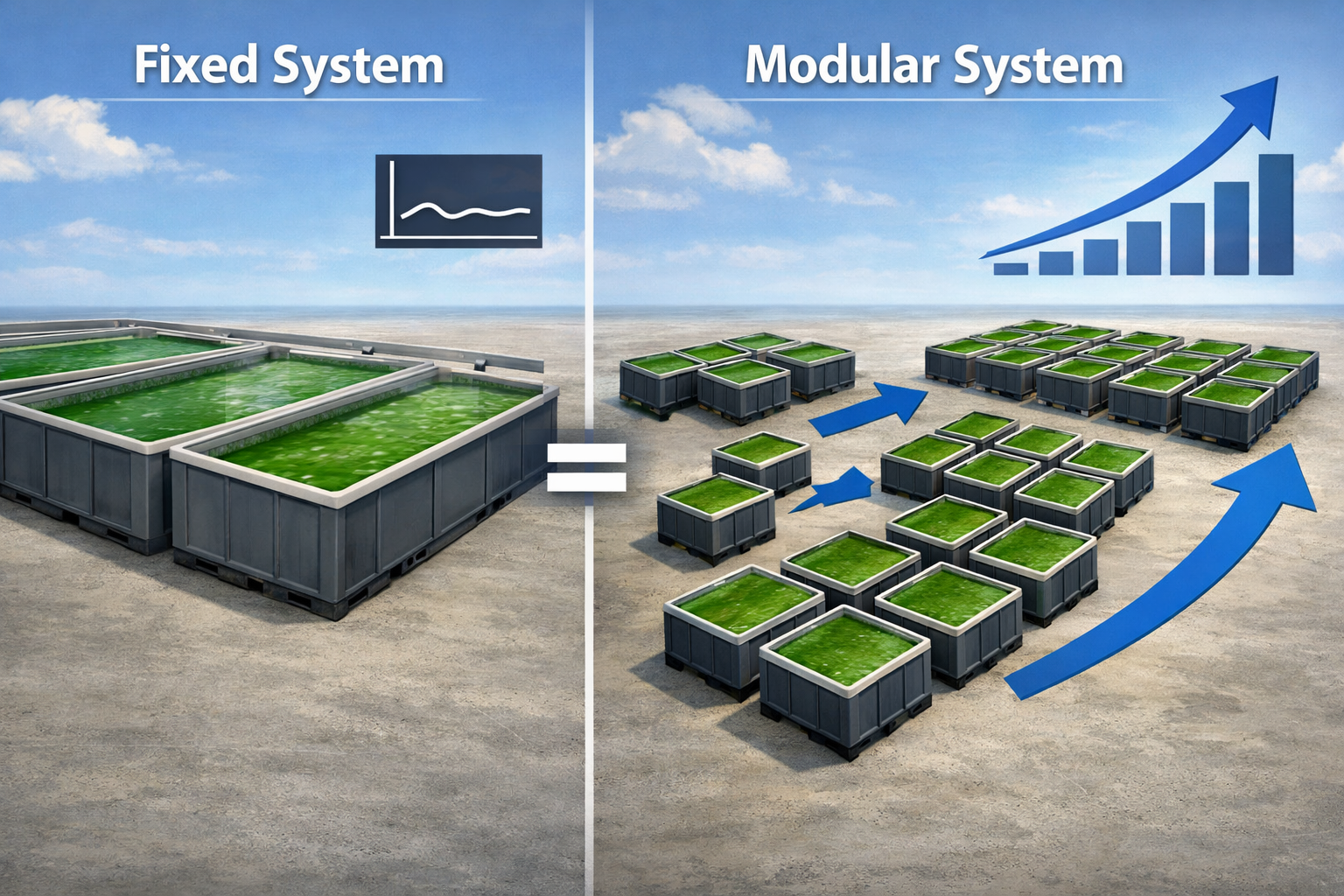
Fixed infrastructure refers to facilities designed and constructed to operate at a defined, near-final capacity from the outset. This typically includes fully built raceway ponds, centralised harvesting lines, dedicated dewatering and drying blocks, and permanent packaging and laboratory areas.
Modular infrastructure, by contrast, is designed to be expanded in discrete units. Ponds, harvesting capacity, drying systems, and utilities are added incrementally as production increases.
Both models can work – but under very different conditions.
The Illusion of Flexibility in Modular Systems
Modular systems are often marketed as lower-risk because they allow gradual investment. However, in spirulina farming, modular expansion frequently introduces integration problems.
Each new module must align hydraulically with existing raceway ponds, match agitation dynamics, and integrate with shared harvesting and drying infrastructure. When modules are added without a master plan, bottlenecks appear quickly.
Common modular failures include:
- Mismatch between pond volume and harvesting throughput
- Inconsistent agitation efficiency across modules
- Drying capacity lagging behind biomass growth
- Quality variation between production blocks
What appears flexible on paper often becomes operationally fragmented.
Fixed Infrastructure and System Coherence
Fixed infrastructure forces early decisions on layout, flow, and capacity. While capital-intensive, this approach enables coherent system design.
Well-designed fixed systems ensure:
- Consistent hydraulic behaviour across all raceway ponds
- Predictable mixing using efficient agitator design
- Centralised harvesting equipment sized for peak load
- Dewatering and drying systems engineered for future capacity
The benefit is not just scale, but uniformity – a critical factor for quality control and certification.
Scaling Constraints Are Rarely Where People Expect
In spirulina farms, scaling constraints rarely originate in pond area. They appear downstream.
Investors examine whether proposals anticipate constraints in:
- Harvesting speed and biomass handling
- Assisted dewatering systems and residence time
- spirulina drying equipment capacity
- Packing systems and cleanroom throughput
Modular expansion that adds ponds without addressing downstream capacity creates systemic imbalance.
Capital Efficiency Over the Project Lifecycle
Modular infrastructure reduces initial CapEx but often increases lifetime cost.
Reasons include:
- Repeated civil work and utility extensions
- Retrofitting automation into live systems
- Temporary inefficiencies during each expansion phase
- Duplicate quality control and monitoring systems
Fixed infrastructure concentrates capital early but benefits from economies of scale and lower per-unit operating cost over time.
Risk Profile: Fragmented vs Integrated Systems
From an investor perspective, risk is easier to manage in integrated systems.
Modular systems distribute risk across phases but also distribute responsibility. Failures are harder to isolate and correct.
Fixed systems concentrate risk upfront but reduce operational uncertainty once stabilised.
The key question is not which is cheaper initially, but which keeps risk predictable.
Fixed vs Modular Infrastructure: Comparative View
| Dimension | Fixed Infrastructure | Modular Infrastructure |
| Initial CapEx | High | Lower |
| Integration | High system coherence | Fragmentation risk |
| Scale-up speed | Fast once operational | Incremental and disruptive |
| Quality consistency | Strong | Variable |
| Certification readiness | Easier to design upfront | Complex across modules |
| Long-term cost | Predictable | Often escalating |
When Modular Infrastructure Can Work
Modular approaches can be effective when:
- A clear master plan defines final capacity
- Each module mirrors final-scale design
- Harvesting, drying, and packing are oversized initially
- Strong central control systems are in place
Without these conditions, modularity increases complexity rather than reducing risk.
How Greenbubble Approaches Infrastructure Decisions
Greenbubble evaluates infrastructure strategy based on end-state requirements rather than entry-level budgets. Projects are designed with a final operating capacity in mind, whether delivered as fixed infrastructure or phased modular execution.
By aligning raceway ponds, efficient agitator design, harvesting equipment, assisted dewatering systems, spirulina drying equipment, and packing systems into a single master architecture, Greenbubble ensures that expansion does not erode control.
This approach underpins both spirulina farming consultancy and spirulina farming turnkey solutions, allowing projects to scale without repeated redesign.
FAQs
Q1. Is fixed infrastructure always better for spirulina farms?
Not always, but it offers stronger control for export-oriented projects.
Q2. Why do modular farms struggle at scale?
Because downstream systems are rarely scaled in sync with pond expansion.
Q3. Can modular farms be made investor-grade?
Yes, if designed from day one with a final-capacity master plan.
Q4. Which model suits first-time commercial producers?
Fixed or phased-fixed models reduce long-term risk.
Q5. How does infrastructure choice affect certification?
Integrated systems simplify audits and compliance.
Conclusion: Scale Requires Architecture, Not Just Area
Scaling spirulina farming is an architectural challenge, not a land expansion exercise. Fixed infrastructure offers coherence and predictability, while modular systems demand disciplined design to avoid fragmentation. Long-term success depends less on flexibility and more on how well the system holds together as it grows.
Make us your source on Google
Table Of Contents