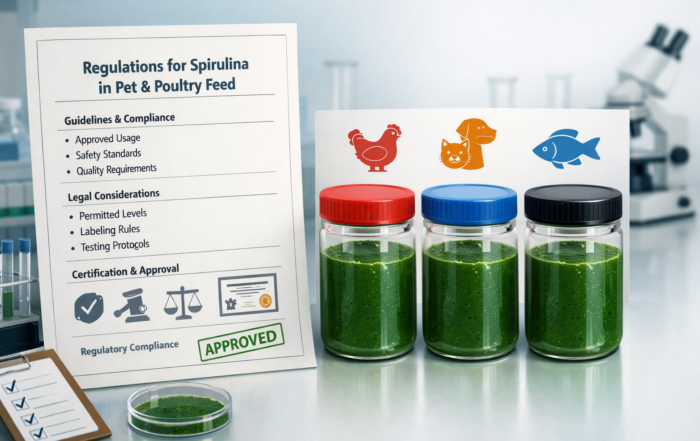
Exporting spirulina to international markets like the U.S., Europe, and Japan requires strict compliance with certification, documentation, and quality testing standards. Global demand for organic spirulina continues to rise, but regulatory scrutiny has increased alongside it. According to the, successful exporters must demonstrate full traceability, COA verification, cleanroom packaging, and organic certification.
This guide outlines the step-by-step export checklist to help spirulina manufacturers meet international requirements and maintain product credibility in premium markets.
1. Certification Requirements
To qualify for export, every batch of spirulina must comply with recognized food safety and organic certification standards.
| Certification | Purpose | Market Relevance |
| USDA Organic | Validates organic inputs and production | Mandatory for U.S. markets |
| EU Organic | Certifies compliance with European organic farming laws | Required for EU importers |
| HACCP & GMP | Ensures hygienic processing and contamination control | Global standard for nutraceuticals |
| COA (Certificate of Analysis) | Confirms safety, purity, and nutritional composition | Required for all exports |
| FSSAI Export License | Authorizes export of food products from India | Mandatory for Indian exporters |
| FDA Registration | Certifies U.S. market access for dietary supplements | Needed for U.S.-bound shipments |
Maintaining all certifications helps avoid customs delays, rejections, and loss of buyer trust.
2. Laboratory Testing and COA Verification
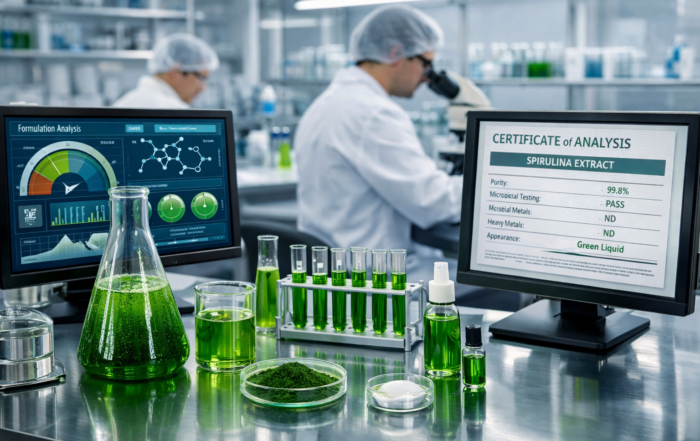
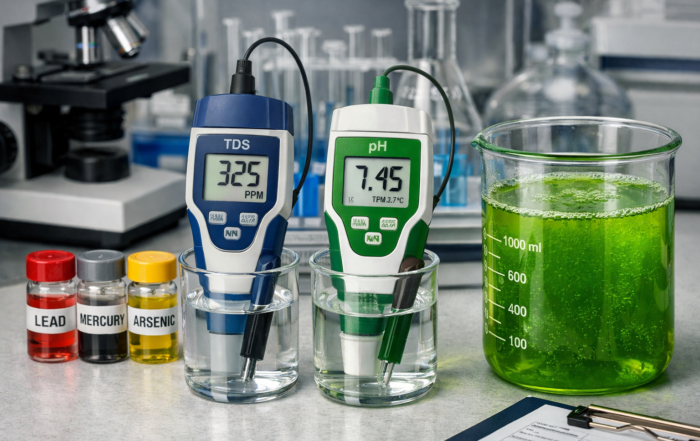
Every exported batch must include a COA report verified by an accredited laboratory. This document assures international buyers that your spirulina is free from contaminants and meets nutritional specifications.
COA Parameters:
| Test Parameter | Limit | Method |
| Heavy Metals (Pb, Cd, Hg, As) | Below USP/EU limits | AAS / ICP-MS |
| Microbial Load | TPC ≤ 50,000 CFU/g, Yeast & Mold ≤ 100 CFU/g | Plate Count Method |
| Pathogens | E. coli, Salmonella, Staphylococcus – Absent | ISO methods |
| Aflatoxins & Pesticides | Not Detected | HPLC & GC-MS |
| Moisture | ≤ 6% | Gravimetric Method |
| Protein | ≥ 60% | Kjeldahl / Dumas |
Each COA must be batch-specific, showing traceability, date of manufacture, and lot number.
For complete COA details, refer to Greenbubble’s Spirulina Quality: What Your Certificate of Analysis (COA) Should Show.
3. Documentation Checklist for Export
Before shipping, ensure all paperwork is properly filed and verified.
Mandatory Export Documents:
- Export License and IEC Code (Import Export Code)
- Organic Certification (USDA/EU/India Organic)
- COA Report for each batch
- Phytosanitary Certificate (for certain countries)
- FSSAI Clearance Certificate
- Packing List and Commercial Invoice
- Bill of Lading / Airway Bill
- Certificate of Origin
Labeling Requirements:
- Nutritional composition per 100g
- Organic certification logo and number
- Batch code and COA reference
- Manufacturing and expiry date
- Storage instructions and country of origin
These ensure compliance with FDA (U.S.) and EFSA (Europe) import norms.
4. Packaging and Storage Standards
Packaging is crucial for maintaining product quality during long transit periods.
| Requirement | Specification |
| Material | Multi-layer, vacuum-sealed aluminum foil pouches |
| Atmosphere | Nitrogen-flushed to prevent oxidation |
| Sealing Environment | ISO Class 7 cleanroom under GMP conditions |
| Outer Cartons | Corrugated, moisture-resistant export-grade boxes |
| Storage | 15–25°C, humidity below 40% |
All packaging operations should take place inside a cleanroom. (Building a Cleanroom for Spirulina Packaging)
5. Transport and Supply Chain Compliance
- Maintain temperature logs during shipping.
- Ensure traceable batch tracking using barcodes or QR codes.
- For sea freight, use vacuum-insulated containers when possible.
- Keep separate inventory for organic and non-organic batches to prevent cross-contamination.
- Retain all records for at least five years for audit and buyer verification.
6. Testing & Recertification Schedule
| Activity | Frequency | Conducted By |
| Heavy Metal & Microbial Testing | Every batch | NABL-accredited lab |
| Organic Certification Audit | Annual | USDA / EU Certified Agency |
| HACCP Internal Audit | Quarterly | Farm QA Team |
| Equipment Calibration | Monthly | Maintenance Team |
Consistent testing and recertification maintain your export eligibility and buyer trust.
7. Cost Considerations & Market Value
While certification and compliance can increase initial costs, they unlock access to premium markets in Europe, the U.S., Japan, and the Middle East.
| Export Stage | Typical Cost (INR) | Remarks |
| Organic Certification | ₹2–3 lakhs | Initial + Renewal Fees |
| HACCP & GMP Setup | ₹1.5–2 lakhs | Infrastructure & training |
| Lab Testing per Batch | ₹20,000–30,000 | COA verification |
| Packaging & Cleanroom | ₹5–8 lakhs | One-time investment |
Export-grade spirulina can command 30–50% higher prices than domestic bulk sales, especially if branded as organic and sustainably produced.
8. Common Export Mistakes to Avoid
- Skipping COA testing – Leads to customs rejection.
- Incomplete labeling – Non-compliant packaging gets blocked at ports.
- Unsegregated storage – Mixing organic and non-organic batches voids certification.
- Ignoring temperature control – Causes spoilage during long-distance shipping.
- Outdated certifications – Annual renewals are mandatory to retain market access.
FAQs
Q1: Which certifications are mandatory for exporting spirulina?
USDA Organic or EU Organic, HACCP, GMP, and COA verification are essential. For U.S. exports, FDA registration is also required.
Q2: Can small manufacturers export spirulina?
Yes. MSMEs can export through aggregator or consortium models while maintaining certification and COA traceability.
Q3: How can I ensure my product passes customs checks?
Maintain batch-wise COA, organic documentation, and temperature control records.
Q4: What packaging type has the longest shelf life?
Vacuum-sealed, nitrogen-flushed multi-foil aluminum pouches under cleanroom conditions ensure a 24–36 month shelf life.
Q5: Is export profitability sustainable long-term?
Yes. With consistent certification, automation, and strong quality control, export spirulina delivers stable returns and global brand credibility.
Conclusion
Exporting spirulina requires precision, compliance, and transparency at every stage — from cultivation to shipment. Following this comprehensive export checklist ensures your spirulina meets international safety, labeling, and documentation standards.
By maintaining COA-certified quality, organic certification, and cleanroom packaging, manufacturers can position themselves as trusted suppliers in a rapidly expanding global superfood market. The investment in certification and infrastructure not only builds buyer confidence but also secures long-term access to high-value international markets.
Table Of Contents