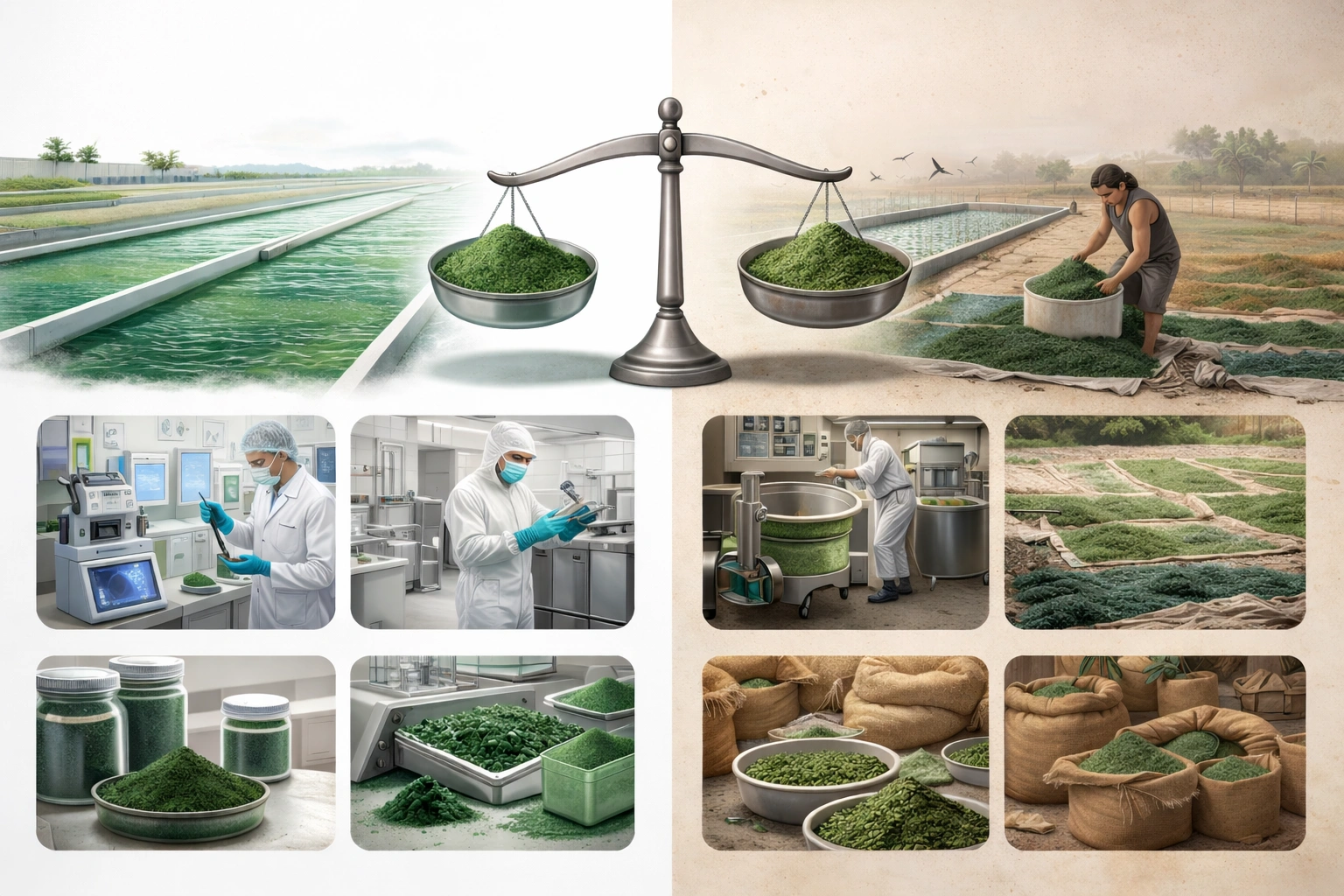
Spirulina is a versatile microalga used across the human nutraceutical and animal feed industries. While both products originate from the same cyanobacterium, their production processes, quality standards, and intended applications differ significantly. The blog outlines strict protocols separating food-grade spirulina from feed-grade spirulina, ensuring safety, compliance, and market-specific functionality.
This guide explores how spirulina for human use differs from animal feed in terms of cultivation purity, processing, COA standards, certification, and nutritional composition.
1. Purpose and End Use
| Parameter | Human-Grade Spirulina | Animal Feed Spirulina |
| End User | Consumers, nutraceutical brands, healthcare industry | Poultry, fish, livestock, aquaculture |
| Purpose | Dietary supplement, immunity booster, antioxidant | Feed additive for nutrition, pigmentation, and growth |
| Market Type | Retail, export, pharma-grade | Bulk or local B2B supply |
2. Production Environment and Water Quality
Human-grade spirulina requires controlled, contamination-free pond systems, while feed-grade spirulina tolerates less stringent conditions.
| Parameter | Human-Grade | Animal Feed |
| Water Quality | RO or UV-treated, heavy metal-free | Borewell or filtered water acceptable |
| pH Range | 9.0–11.0 (strictly monitored) | 8.5–11.5 (broader range) |
| Filtration | Multi-layer filtration with microbial control | Basic sediment filtration |
| Testing Frequency | Batch-wise COA testing | Periodic QC testing |
High-purity water ensures COA compliance and prevents microbial contamination. (How to Avoid Heavy Metals and Contamination in Spirulina Farming)
3. Nutrient and Carbon Source Differences
Organic production standards apply only to human-grade spirulina. Feed-grade spirulina can use non-organic sources for cost efficiency.
| Parameter | Human-Grade | Animal Feed |
| Carbon Source | Food-grade sodium bicarbonate or organic sugar extract | Industrial sodium bicarbonate or soda ash |
| Nitrogen Source | OMRI-approved nitrate or organic inputs | Urea or non-organic nitrate acceptable |
| Trace Minerals | Controlled dosage of Fe, Mg, Zn, Se | Varies; non-standardized |
| Certification | USDA/EU Organic, HACCP, GMP | Feed-grade certification (FCO norms) |
Learn about compliant carbon inputs in Greenbubble’s Spirulina and Carbon Source: Organic Options Explained.
4. Processing and Drying Methods
The drying method determines nutrient retention and export eligibility.
| Parameter | Human-Grade | Animal Feed |
| Drying Method | Refractance Window Drying (RWD) or vacuum drying | Solar or hot-air drying |
| Temperature | Below 45°C | Can exceed 60°C |
| Nutrient Preservation | High retention of proteins & pigments | Moderate; some degradation acceptable |
| Packaging | Vacuum-sealed aluminum foil, nitrogen-flushed | Bulk HDPE or PP bags |
Human-grade spirulina maintains nutritional and pigment stability, while feed-grade prioritizes volume and affordability.
5. COA and Testing Parameters
Human-grade spirulina requires a complete Certificate of Analysis (COA) for every batch, confirming compliance with international safety standards.
| Parameter | Human-Grade (COA Requirement) | Animal Feed (Basic QC) |
| Heavy Metals (Pb, As, Cd, Hg) | Must meet USP/EU limits | Monitored occasionally |
| Microbial Load | TPC ≤ 50,000 CFU/g | Up to 100,000 CFU/g acceptable |
| Pathogens (E. coli, Salmonella, Staphylococcus) | Absent | Tolerated within FCO norms |
| Pesticides | Absent | May not be routinely tested |
| Moisture | ≤ 6% | ≤ 10% |
Refer to Greenbubble’s Spirulina Quality: What Your Certificate of Analysis (COA) Should Show for testing details.
6. Packaging and Shelf Life
| Parameter | Human-Grade | Animal Feed |
| Packaging Type | Nitrogen-flushed, vacuum-sealed foil pouches | 20–25 kg HDPE sacks |
| Storage Conditions | 15–25°C, humidity below 40% | Ambient, dry storage acceptable |
| Shelf Life | 24–36 months | 6–12 months |
Feed-grade packaging focuses on bulk storage, while human-grade ensures extended freshness for export markets. (Building a Cleanroom for Spirulina Packaging)
7. Certification and Export Readiness
| Certification | Human-Grade | Animal Feed |
| HACCP & GMP | Mandatory | Optional |
| USDA / EU Organic | Required for export | Not required |
| FSSAI / FDA | Required for sale | Governed by Feed Control Orders (FCO) |
| Export License | Yes (pharma/nutraceutical) | Limited; local markets only |
Human-grade spirulina undergoes higher scrutiny to meet FDA, EFSA, and FSSAI standards, while feed-grade caters primarily to domestic livestock industries.
8. Nutritional and Functional Differences
| Parameter | Human-Grade | Animal Feed |
| Protein | ≥ 60% | 50–60% |
| Phycocyanin | ≥ 10% | 5–8% |
| Beta-Carotene | ≥ 1% | 0.5–0.8% |
| Iron & Minerals | Precisely balanced | Moderate variation |
| Digestibility | High | Depends on feed formulation |
Feed-grade spirulina still provides strong nutritional support but lacks the stringent purity and pigment stability of human-grade spirulina.
9. Cost and Market Price
| Parameter | Human-Grade | Animal Feed |
| Production Cost | ₹300–₹400 per kg | ₹200–₹300 per kg |
| Market Price | ₹700–₹1,500 per kg (domestic/export) | ₹400–₹500 per kg |
| Target Markets | Nutraceutical, organic food, export | Poultry, aquaculture, livestock |
The pricing difference arises from stricter testing, certification, and cleanroom packaging requirements for human-grade spirulina.
FAQs
Q1: Can animal feed-grade spirulina be consumed by humans?
No. It may not meet food safety standards and can contain contaminants beyond permissible limits.
Q2: Can human-grade spirulina be used for animal feed?
Yes, but it is not cost-effective for large-scale feed use.
Q3: Which drying method ensures export-ready spirulina?
Refractance Window Drying (RWD) or vacuum drying preserves nutrients and meets international quality benchmarks.
Q4: Is certification necessary for feed-grade spirulina?
Only basic FCO compliance is required domestically; export requires additional certifications.
Q5: Why is human-grade spirulina costlier?
Because of extensive COA testing, cleanroom processing, organic certification, and packaging standards required for export compliance.
Conclusion
The difference between spirulina for human use and animal feed lies in purity, processing, and certification. Human-grade spirulina meets rigorous international quality standards and undergoes comprehensive COA testing, making it suitable for nutraceuticals and exports. Feed-grade spirulina, while nutrient-rich, prioritizes affordability and bulk production.
For long-term sustainability, many farms adopt a dual model — allocating a portion of production for high-value human use and another for bulk animal feed markets. Greenbubble’s balanced approach ensures profitability, market diversification, and optimized resource utilization in spirulina farming.
Table Of Contents