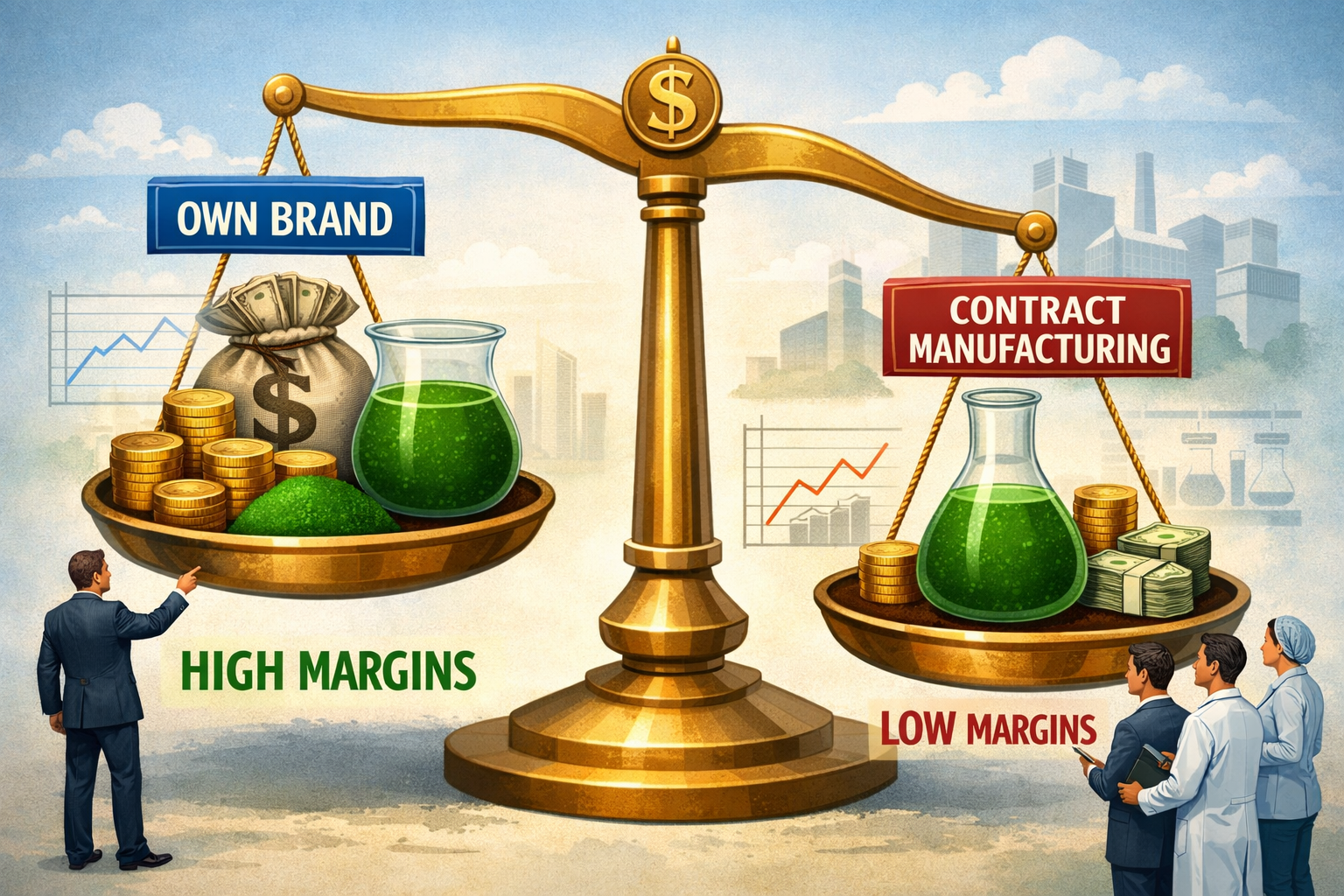
Spirulina producers often assume that moving from contract manufacturing to building an own brand automatically improves margins. In practice, the margin reality is far more nuanced. Each model distributes risk, capital, and control differently, and misunderstanding this trade-off leads to disappointed financial outcomes.
This article examines the real margin dynamics between contract manufacturing and own-brand spirulina businesses, highlighting where profits are created, where they leak, and how system design and market positioning influence outcomes.
Understanding the Two Business Models
At a high level, spirulina businesses operate under two dominant commercial models:
- Contract manufacturing, where producers supply bulk or private-label product to brands and distributors
- Own-brand manufacturing, where producers build, market, and sell a branded product directly
While both models can be viable, they demand very different capabilities and tolerance for risk.
Contract Manufacturing: Predictability With a Ceiling
Contract manufacturing is often the entry point for new spirulina producers, especially those investing in scalable infrastructure such as standardised raceway ponds and efficient agitator systems. The appeal lies in:
- Faster market access
- Lower marketing and distribution burden
- Predictable offtake volumes
However, margins are capped because:
- Buyers control pricing power
- Quality upgrades are not always rewarded
- Cost efficiencies are often passed downstream
Even highly efficient producers operating well-designed production systems face structural margin limits in this model.
Own Brand: Higher Potential, Higher Exposure
Building an own brand promises higher gross margins, but those margins are not inherent – they must be earned.
Key cost layers include:
- Branding and packaging development
- Regulatory approvals and label compliance
- Marketing, distribution, and customer acquisition
- Inventory holding and returns
While top-line margins may appear higher, net margins can be volatile and highly sensitive to demand forecasting errors – particularly when downstream processes like spirulina drying equipment and packing systems are not optimised for branded retail timelines.
Where Margins Actually Get Lost
In both models, margin erosion often occurs outside the production process.
Common leakage points include inefficiencies that often originate beyond core cultivation, especially when harvesting equipment and assisted dewatering systems are not aligned with the chosen commercial model:
- Overstocking due to optimistic sales projections
- Discounting to clear aging inventory
- Returns and quality disputes
- Marketing spend that outpaces brand traction
Producers underestimate how quickly these costs compound.
Control vs Capital Intensity
The choice between contract manufacturing and own branding is fundamentally a trade-off between control and capital.
| Dimension | Contract Manufacturing | Own Brand |
| Pricing control | Low | High (theoretical) |
| Capital requirement | Moderate | High |
| Market risk | Low–moderate | High |
| Margin ceiling | Lower | Higher but volatile |
| Scalability | Operational | Commercial |
Understanding this table prevents unrealistic margin expectations.
Investor Perspective: Margin Quality Matters
Investors focus less on gross margin percentages and more on margin durability.
Key questions include:
- How stable are realised margins across cycles?
- How sensitive is profit to demand fluctuations?
- Where does working capital get trapped?
A smaller but predictable margin is often valued higher than a large but unstable one.
Hybrid Models and Transitional Strategies
Some producers attempt hybrid approaches, supplying bulk while gradually building a brand. Without clear guidance from experienced spirulina farming consultancy, this transition often creates operational and financial strain. This can work, but only when systems, cash flow, and market positioning are clearly separated.
Blending models without discipline often results in underinvestment in both.
How Greenbubble Aligns Systems With Commercial Models
Greenbubble helps producers choose and execute the right commercial model by aligning system design with margin strategy. Through spirulina farming consultancy, producers evaluate whether their infrastructure supports contract manufacturing efficiency or own-brand quality control.
Projects delivered via integrated spirulina farming turnkey solutions are designed with the chosen margin pathway in mind, reducing strategic drift and financial surprises.
FAQs
Q1. Is own branding always more profitable?
No. It offers higher potential margins but significantly higher risk.
Q2. Why do contract manufacturers struggle to raise prices?
Because buyers control demand aggregation and substitution.
Q3. Can producers switch models later?
Yes, but switching requires capital, time, and system adaptation.
Q4. Which model suits first-time producers?
Contract manufacturing, when systems are well-controlled.
Q5. What is the biggest mistake producers make?
Confusing gross margin potential with net margin reality.
Conclusion: Margins Follow Strategy, Not Assumptions
In spirulina businesses, margins are shaped by commercial structure, not just production efficiency. Contract manufacturing and own branding each offer distinct advantages and constraints. Success depends on choosing the model that aligns with system capability, risk appetite, and capital discipline – not on chasing theoretical margins.
Make us your source on Google
Table Of Contents