Circular economy principles are transforming commercial spirulina farming from a linear production model into a resource-efficient, value-maximizing ecosystem. Instead of treating by-products and residual streams as waste, advanced spirulina operations are converting them into inputs for agriculture, aquaculture, energy systems, and soil health solutions.
For commercial spirulina manufacturers, circularity is not just an environmental initiative – it is a strategic lever for cost reduction, ESG performance improvement, regulatory compliance, and diversified revenue generation.
At Greenbubble, spirulina farm designs incorporate circular economy principles from the outset, enabling producers to minimize waste, optimize resource utilization, and build resilient, future-ready operations.
1. Understanding Waste Streams in Spirulina Production
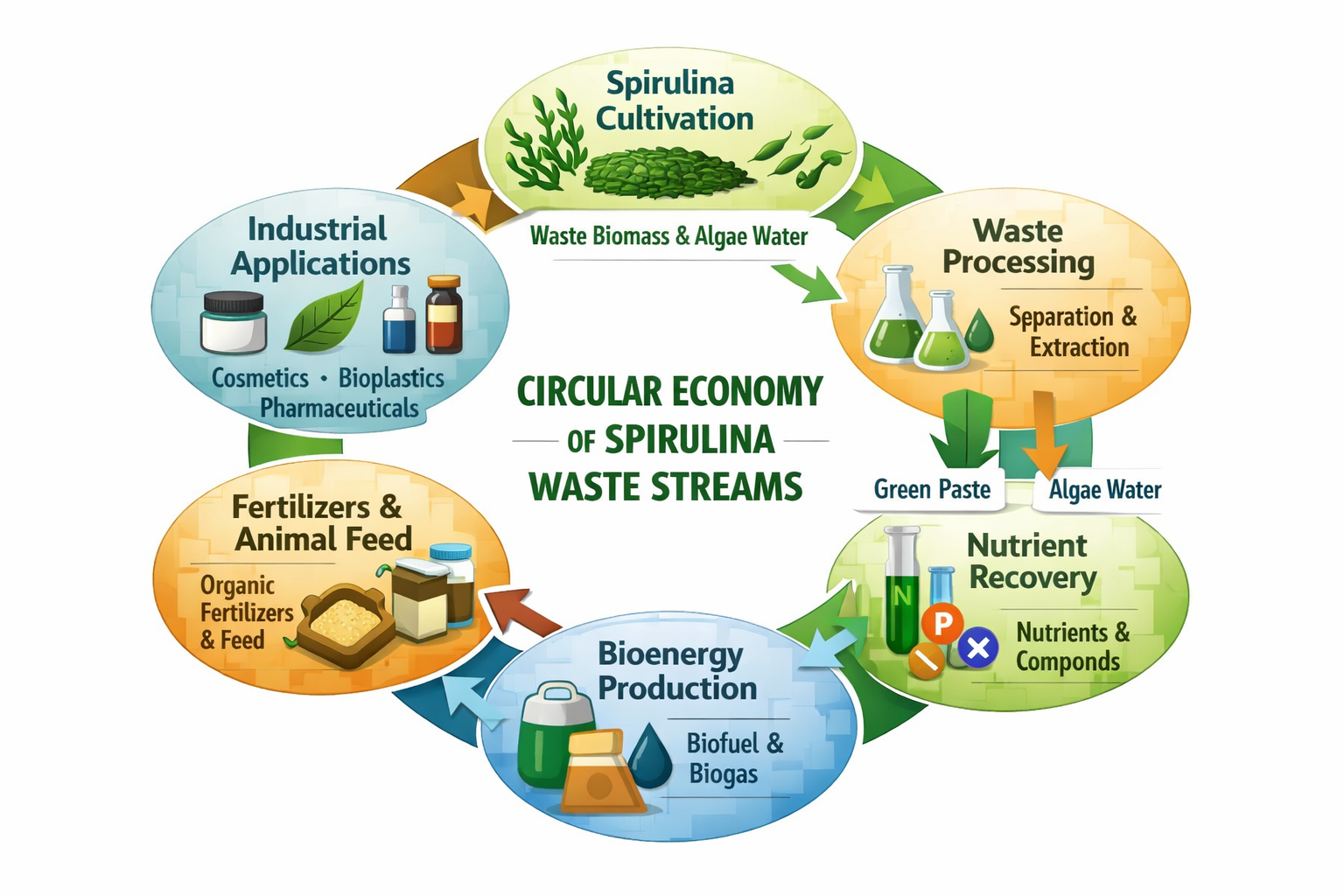
Spirulina farming generates several recoverable by-products across cultivation and processing stages:
- Spent culture medium (nutrient-rich water)
- Biomass residues from filtration and cleaning
- Settled solids and organic sludge
- Process water from harvesting and washing
- Heat losses from drying operations
When managed strategically, these streams can be reintegrated into productive use, significantly reducing environmental impact and operating costs.
2. Nutrient Recycling Through Culture Medium Reuse
The culture medium used in spirulina ponds contains valuable nutrients such as nitrogen, phosphorus, potassium, and trace minerals. After appropriate treatment and balancing, a large portion of this medium can be reused.
Benefits include:
- Reduced nutrient procurement costs
- Lower wastewater discharge
- Improved resource efficiency
Efficient circulation supported by well-designed raceway ponds and optimized agitation systems ensures uniform nutrient distribution and supports safe medium recycling practices.
3. Biofertilizer Production from Spirulina Residues
Residual biomass and sludge from filtration and pond cleaning are rich in organic matter, amino acids, and micronutrients. These can be converted into:
- Liquid biofertilizers
- Soil conditioners
- Compost enhancers
Applications include horticulture, organic farming, nurseries, and high-value crop cultivation. This not only diverts waste from disposal but also creates an additional revenue stream aligned with organic and regenerative agriculture trends.
4. Integration with Agriculture Systems
Spirulina farms can form closed-loop systems with nearby agricultural operations.
Key integrations include:
- Using treated spirulina wastewater for irrigation
- Supplying spirulina-based biofertilizers to crops
- Utilizing agricultural CO₂ sources (such as biogas units) to enhance spirulina growth
This symbiotic relationship improves water efficiency, reduces chemical fertilizer dependence, and strengthens local agricultural ecosystems.
5. Animal and Aquaculture Feed Applications
Non-food-grade spirulina biomass and processing residues can be used in controlled quantities as:
- Feed additives for poultry and livestock
- Nutritional supplements in aquaculture
- Pigment enhancers in fish and shrimp farming
This application converts downgraded or off-spec biomass into economic value while supporting sustainable feed alternatives to conventional fishmeal and synthetic additives.
6. Water Circularity and Zero-Liquid-Discharge Approaches
Water is a critical resource in spirulina farming, primarily used to compensate for evaporation and operational losses. Circular water management includes:
- Filtration and reuse of harvesting water
- Sedimentation and treatment of process water
- Reintroduction of treated water into cultivation systems
These practices reduce freshwater dependency, lower discharge risks, and strengthen compliance with environmental regulations – especially important for large-scale and export-oriented facilities.
7. Waste Heat Recovery from Drying Operations
Drying is the most energy-intensive stage in spirulina processing and generates significant waste heat. Circular energy strategies include:
- Heat recovery systems to preheat incoming air
- Integration with solar thermal systems
- Use of waste heat for space heating or pre-drying processes
Such measures improve overall energy efficiency and support carbon reduction goals, reinforcing ESG and carbon accounting performance.
8. Biogas and Organic Waste Integration
Organic sludge and biomass residues can be co-processed in biogas plants along with agricultural or food waste. The resulting outputs include:
- Biogas for thermal or electrical energy
- Nutrient-rich digestate for use as fertilizer
This approach supports energy circularity and reduces dependence on fossil fuels, particularly in integrated agro-industrial setups.
9. Circular Economy Value Chain Model
| Waste Stream | Circular Use | Business Benefit |
| Spent culture medium | Nutrient recycling & irrigation | Lower input and water costs |
| Biomass residues | Biofertilizers & soil conditioners | Additional revenue stream |
| Off-spec spirulina | Animal & aquaculture feed | Waste monetization |
| Process water | Filtration and reuse | Reduced freshwater demand |
| Organic sludge | Biogas production | Energy savings & sustainability |
| Waste heat from drying | Heat recovery systems | Lower energy intensity |
This integrated approach transforms spirulina farms into multi-output bio-resource hubs.
10. ESG and Regulatory Advantages
Circular economy implementation strengthens ESG performance across all pillars:
- Environmental: Reduced waste, lower emissions, improved water and nutrient efficiency
- Social: Local value creation through agriculture and allied industries
- Governance: Stronger compliance with environmental regulations and audit requirements
Many institutional buyers and export markets increasingly favor suppliers with demonstrable circular resource management and low-waste operations.
11. Economic Impact of Circular Models
Circular strategies improve profitability through:
- Reduced expenditure on nutrients and water
- Lower waste treatment and disposal costs
- New revenue streams from biofertilizers and feed applications
- Improved eligibility for green financing and sustainability-linked incentives
Over time, these benefits can significantly enhance return on investment and operational resilience.
12. Implementation Roadmap for Spirulina Farms
Step 1: Map Waste Streams
Identify all liquid, solid, and thermal waste outputs across operations.
Step 2: Assess Reuse Potential
Evaluate technical feasibility for nutrient recycling, water reuse, and by-product conversion.
Step 3: Install Treatment and Recovery Systems
Implement filtration, sedimentation, composting, or biogas integration as appropriate.
Step 4: Ensure Compliance
Align reuse practices with local environmental and agricultural regulations.
Step 5: Monitor and Optimize
Track reductions in waste, water consumption, and input costs to quantify benefits.
Frequently Asked Questions
Q1. What are the main waste streams in spirulina farming?
The primary waste streams include spent culture medium, biomass residues, organic sludge, process water, and waste heat from drying operations.
Q2. Can spirulina wastewater be reused safely?
Yes, with proper filtration, settling, and nutrient balancing, it can be reused in cultivation or applied in agriculture where regulations permit.
Q3. Is there a market for spirulina-based biofertilizers?
Yes. Organic farming, horticulture, and high-value crop sectors increasingly demand bio-based fertilizers and soil conditioners.
Q4. Does circular economy adoption significantly reduce costs?
Yes. It reduces expenses related to nutrients, water, waste disposal, and energy while potentially generating new revenue streams.
Q5. Do circular economy practices improve export potential?
Absolutely. Buyers in Europe, North America, and other regulated markets value suppliers with strong sustainability and circular resource management practices.
Conclusion
Circular economy models enable spirulina farms to transition from single-product operations into integrated, resource-efficient bio-production systems. By recycling nutrients and water, converting residues into fertilizers and feed, recovering energy, and integrating with agriculture and biogas systems, spirulina manufacturers can significantly reduce environmental impact while enhancing profitability.
For commercial spirulina enterprises, circularity is not merely a sustainability initiative – it is a strategic pathway to lower costs, stronger ESG performance, regulatory resilience, and long-term competitive advantage.
Make us your source on Google
Table Of Contents