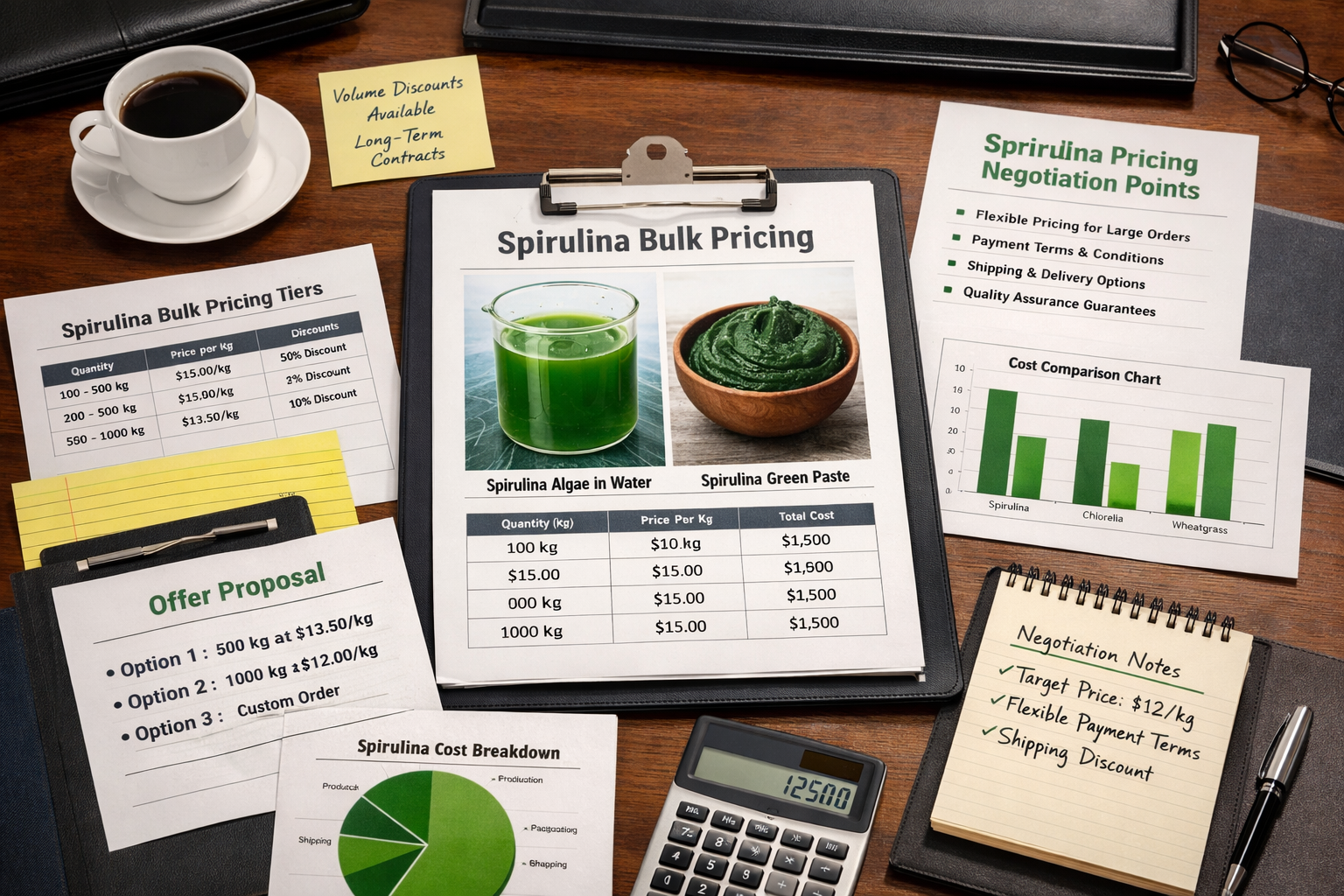
Bulk spirulina pricing is rarely determined by production cost alone. Even producers with stable yields, predictable operating expenses, and consistent quality frequently find themselves under sustained pressure during buyer negotiations. This often comes as a surprise to operators who have invested heavily in efficiency, automation, and quality control.
The core reason is that bulk spirulina transactions are shaped far more by buyer leverage, inventory dynamics, demand cycles, and perceived substitution risk than by farm-level economics. Pricing discussions are not cost-based conversations; they are risk-allocation exercises conducted by buyers who control access to volume and distribution.
Understanding what bulk buyers actually negotiate on is essential for producers who want to protect margins, reduce volatility, and avoid being trapped in perpetual price concessions.
Bulk Buyers Think in Risk, Not Cost
Bulk buyers – including distributors, ingredient traders, processors, and private-label aggregators – do not negotiate based on how much it costs a farm to produce spirulina. They assume that production efficiency is the producer’s responsibility and focus instead on managing their own commercial and operational risk.
From a buyer’s perspective, the primary concerns are:
- Supply continuity across seasons and cycles
- Quality consistency across batches
- Downside protection if demand softens
- Inventory flexibility and exit options
As a result, transparency around production cost rarely improves price outcomes. In some cases, it can even weaken a producer’s negotiating position by signalling urgency or limited alternatives.
Volume Commitments as a Negotiation Lever
Promised volume is one of the most commonly used negotiation tools in bulk spirulina transactions. Buyers frequently anchor discussions around future volume even when actual offtake remains uncertain or conditional.
Typical tactics include:
- Requesting immediate price reductions in exchange for projected annual or quarterly volumes
- Splitting nominal commitments across multiple suppliers to maintain leverage
- Reserving the right to delay, reschedule, or reduce pickups without penalty
For producers, the risk lies in planning production and cash flow around volumes that are never contractually guaranteed. Farms without adequate storage buffers, diversified buyer relationships, or flexible inventory management are most exposed to this pressure.
Quality Verification and Downgrade Clauses
Quality-related clauses are a critical – and often underestimated – source of pricing leverage for buyers. Many bulk contracts allow buyers to reclassify or downgrade product quality after delivery based on internal or third-party testing.
Negotiation pressure escalates when:
- Quality specifications are loosely defined or overly broad
- Testing responsibility and methodology are one-sided
- Shelf-life performance has not been validated under real storage conditions
Producers operating controlled systems – standardised raceway ponds, efficient agitator systems, harvesting equipment, assisted dewatering systems, spirulina drying equipment, and reliable packing systems – are better positioned to defend against arbitrary downgrades because their process consistency is demonstrable.
Inventory Timing and Buyer Advantage
Bulk buyers negotiate most aggressively when they believe producers are constrained by inventory or time. Spirulina, while stable, is still subject to shelf-life perception and working-capital pressure.
Price pressure intensifies when:
- Storage capacity is limited or costly
- Product age approaches internal or buyer-defined thresholds
- Multiple producers release inventory into the market simultaneously
Buyers exploit these timing mismatches to force discounts that have little to do with intrinsic product quality and everything to do with leverage.
Benchmarking Against Lower-Grade Supply
Another common negotiation tactic is benchmarking prices against cheaper feed-grade or downgraded spirulina. This comparison is often used even when the buyer’s intended application requires higher quality material.
This tactic is effective when:
- Quality differentiation is poorly documented
- Producers cannot clearly defend their quality tier
- Market positioning is ambiguous or inconsistent
Without clear segmentation, premium material is easily pulled into commodity-style pricing discussions, eroding margins.
Contract Structure Shapes Negotiation Power
The structure of commercial agreements strongly influences pricing outcomes. Spot-based transactions expose producers to maximum volatility and repeated renegotiation.
In contrast, structured contracts provide greater leverage and predictability. Favourable terms include:
- Clearly defined quality parameters and specifications
- Objective acceptance and rejection criteria
- Shared or neutral testing responsibility
- Staggered delivery schedules that reduce timing pressure
Producers who rely primarily on spot sales often find themselves renegotiating from a position of weakness, regardless of operational performance.
Investor Perspective: Pricing Power Is Designed, Not Negotiated
From an investor’s viewpoint, pricing power is not something won at the negotiation table – it is designed into the system and commercial model.
Key evaluation questions include:
- How defensible is the project’s quality tier over time?
- How diversified and resilient is the buyer base?
- What inventory and working-capital buffer exists?
- Are sales governed by structured agreements or opportunistic deals?
Projects that cannot answer these questions convincingly remain vulnerable to margin compression even if production efficiency is high.
How Greenbubble Helps Producers Defend Pricing
Greenbubble designs spirulina projects with pricing defence as a core objective, not an afterthought. By aligning production architecture with specific demand segments and embedding quality consistency into raceway ponds, agitation, harvesting, dewatering, drying, and packing, producers gain structural leverage in buyer negotiations.
Through spirulina farming consultancy and spirulina farming turnkey solutions, Greenbubble helps producers shift from reactive, price-led selling to disciplined commercial positioning built around consistency and control.
FAQs
Q1. Do bulk buyers care about production cost?
Only indirectly. Their primary focus is supply risk, quality consistency, and substitution options.
Q2. Is higher volume always beneficial?
Not if volume commitments are informal or tied to aggressive price concessions.
Q3. How can producers avoid downgrade disputes?
By defining quality parameters, testing methods, and acceptance criteria clearly in contracts.
Q4. Are long-term contracts safer?
They reduce volatility but require strong system consistency and disciplined execution.
Q5. What is the strongest pricing defence?
Clear market alignment, documented quality performance, and structured commercial agreements.
Conclusion: Pricing Power Is Structural
Bulk spirulina pricing is shaped by negotiation dynamics, buyer behaviour, and market structure – not by farm economics alone. Producers who understand these forces design systems, contracts, and market alignment that protect margins even in competitive and volatile environments.
Make us your source on Google
Table Of Contents