Introduction
In spirulina farming, the choice between batch and continuous production systems significantly impacts yield, quality, operational costs, and scalability. Both systems have their merits and limitations, depending on farm size, automation level, and target markets (domestic or export). Understanding these systems helps investors and farmers make informed decisions to ensure consistent, contamination-free spirulina output.
For insights into scaling and quality management, refer to Challenges and Solutions in Scaling Spirulina Farming for Mass Production.
What Is Batch Spirulina Production?
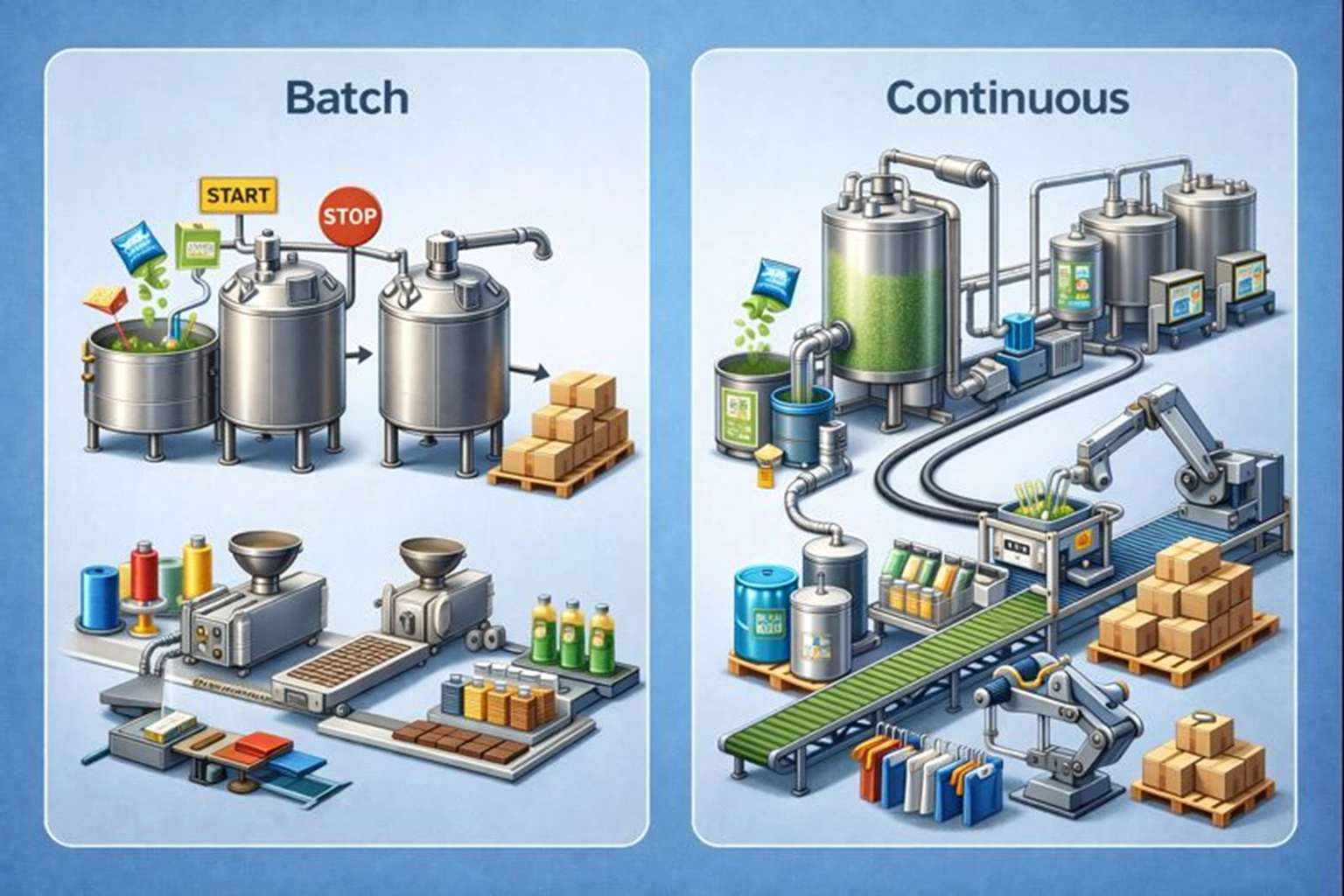
Batch production involves cultivating spirulina in a controlled pond or bioreactor for a fixed duration, after which the entire biomass is harvested. Fresh culture medium is then reintroduced for the next cycle.
Characteristics of Batch Production
- Fixed duration per cycle (typically 7–15 days)
- Easy to monitor for contamination and nutrient levels
- Allows complete reset after every batch
- Suitable for smaller farms and training facilities
Advantages of Batch Production
- Simplified Monitoring: Each batch can be individually tested for pH, temperature, and contamination before harvesting.
- Reduced Risk of Cross-Contamination: Full culture replacement minimizes biological carryover.
- Ideal for R&D or Organic Certification: Offers better control over inputs and documentation.
Limitations of Batch Production
- Requires frequent downtime for cleaning and setup.
- Lower productivity due to non-continuous harvesting.
- Not suitable for high-volume or automated systems.
What Is Continuous Spirulina Production?
Continuous production maintains a stable culture where part of the biomass is harvested regularly, and fresh medium is added to sustain growth. It’s common in industrial and automated setups.
Characteristics of Continuous Production
- Continuous feeding and harvesting
- Requires automation and precise monitoring
- Enables consistent biomass yield
- Best suited for large-scale, export-oriented farms
Advantages of Continuous Production
- Higher Productivity: Maintains growth phase for prolonged periods, ensuring constant output.
- Efficient Resource Utilization: Nutrients, water, and energy are used more efficiently.
- Ideal for Automation: Integrates easily with SCADA or IoT-based monitoring systems. (Automation in Spirulina Farming: How Technology Can Boost Mass Production)
- Stable Quality: Continuous operation maintains steady nutrient and pH levels.
Limitations of Continuous Production
- Higher Contamination Risk: Long-term culture exposure demands robust monitoring and biosecurity.
- Complex Management: Requires technical expertise and reliable control systems.
- Difficult Reset: Once contamination occurs, large culture volumes must be discarded.
Comparison Table: Batch vs Continuous Production
| Parameter | Batch Production | Continuous Production |
| Culture Duration | Fixed (7–15 days) | Continuous (weeks to months) |
| Harvest Frequency | End of cycle | Daily or periodic |
| Contamination Risk | Low | Higher if not automated |
| Maintenance | Easy, regular cleaning | Complex, minimal downtime |
| Automation Requirement | Low | High (SCADA, sensors) |
| Suitable Scale | Small to medium farms | Medium to large farms |
| Consistency of Output | Variable | Stable, uniform |
| Operational Cost | Moderate | Higher initial, lower long-term |
Quality and Certification Aspects
Batch production allows frequent testing and ensures better traceability, making it suitable for farms pursuing USDA Organic or HACCP compliance. Continuous systems, while efficient, require integrated testing and automated COA tracking to maintain consistency.
To understand COA standards, refer to Spirulina Quality Control in Mass Production: Ensuring Consistency and Safety.
Economic and Operational Considerations
A 3-acre continuous system with automation can yield up to 35–40% higher output than a batch setup of the same size. For investment insights, explore The Economics of Spirulina Farming: Is It a Profitable Venture?.
Best Practices for Both Systems
- Maintain optimal pH (9–11) and temperature (35–37°C).
- Employ real-time monitoring using automation tools.
- Regularly test for contamination as per COA.
- Use stainless steel and food-grade equipment for hygiene.
- Train operators for precision and emergency response.
For contamination management, visit Identifying & Preventing Microbial Contaminants in Spirulina.
FAQs
1. Which system is more profitable — batch or continuous?
Continuous systems are more profitable in the long run due to higher yield and efficiency, though they require a larger initial investment.
2. Can small farms operate continuous systems?
Yes, but only with partial automation. Hybrid models that combine batch and semi-continuous harvesting can improve scalability.
3. Which method ensures better quality?
Batch systems provide tighter control over inputs and are easier for organic certification, while continuous systems ensure consistent quality when properly automated.
4. How does automation enhance continuous systems?
Automation maintains constant pH, nutrient dosing, and harvesting, minimizing human error and maximizing productivity.
Q5: Which system is best for beginners?
Batch production is simpler, cost-effective, and suitable for smaller operations or pilot-scale projects.
Conclusion
Both batch and continuous spirulina production systems play vital roles in the algae industry. Batch systems excel in flexibility and control, making them perfect for small-scale or organic-certified operations. Continuous systems, on the other hand, enable scalability, steady output, and long-term profitability when supported by automation and skilled management.
In choosing between the two, farms should balance capital investment, operational expertise, and production goals to build a sustainable, high-quality spirulina enterprise.
Table Of Contents