Global Environmental, Social, and Governance (ESG) standards are no longer optional considerations for commercial spirulina producers. Institutional buyers, nutraceutical brands, export markets, and impact investors increasingly evaluate suppliers through structured ESG frameworks before entering long-term agreements.
For spirulina manufacturers, ESG alignment is not about marketing language. It requires measurable operational discipline, structured documentation, risk management systems, and transparent reporting.
Aligning spirulina operations with global ESG standards strengthens export competitiveness, improves financing access, reduces regulatory exposure, and enhances resilience in volatile global markets.
At Greenbubble, ESG alignment is engineered into infrastructure design, operational systems, and compliance architecture – ensuring spirulina farms can transition from informal reporting to audit-ready global positioning.
1. Why ESG Alignment Matters for Spirulina Producers
Global procurement teams increasingly require ESG transparency for supplier qualification. This trend is driven by:
- European Union Corporate Sustainability Reporting Directive (CSRD)
- Increasing investor ESG mandates
- Sustainability-linked financing structures
- Corporate net-zero commitments
Spirulina producers supplying food, nutraceutical, cosmetic, or pharmaceutical brands must demonstrate structured ESG compliance to maintain access to these markets.
2. Key Global ESG Frameworks Relevant to Spirulina
Spirulina operations can align with several internationally recognized frameworks:
- GRI (Global Reporting Initiative): Comprehensive sustainability reporting framework
- SASB (Sustainability Accounting Standards Board): Industry-specific ESG disclosures
- TCFD (Task Force on Climate-related Financial Disclosures): Climate risk reporting
- UN SDGs (United Nations Sustainable Development Goals): Strategic sustainability alignment
- CSRD (EU Corporate Sustainability Reporting Directive): Mandatory sustainability reporting for many EU-linked companies
Even if not legally required, structured alignment strengthens buyer confidence and audit readiness.
3. Environmental (E) Alignment in Spirulina Operations
Environmental alignment requires measurable performance across:
- Energy intensity (kWh per kg)
- Carbon footprint (CO₂e per kg)
- Water use per kg output
- Waste generation and reuse
- Renewable energy integration
- Nutrient discharge management
Operational optimization begins at infrastructure level. Efficient raceway ponds and calibrated agitation systems reduce energy intensity, while advanced drying systems lower carbon emissions during processing.
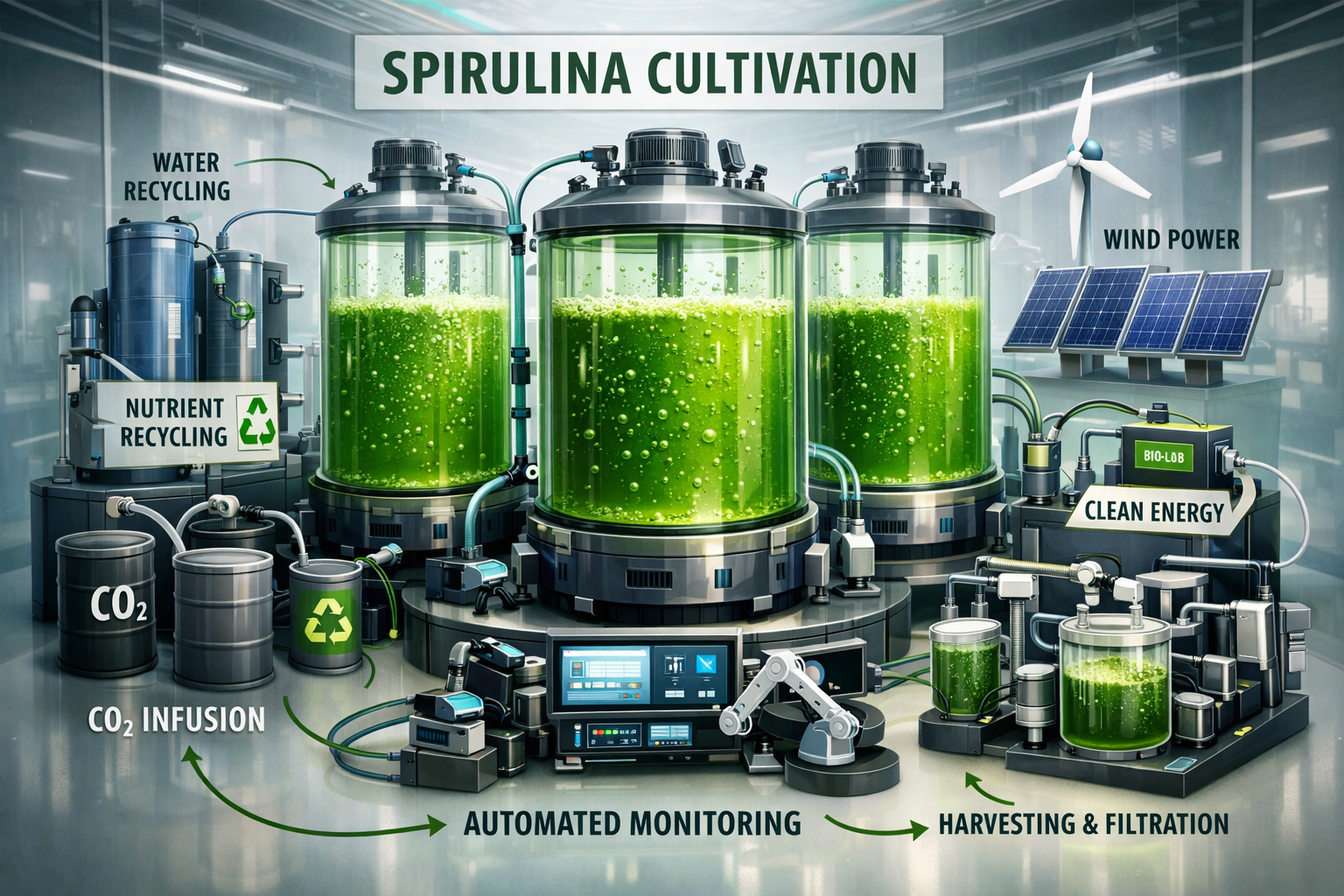
Circular economy practices – such as nutrient recycling and water reuse – further strengthen environmental metrics and align with global sustainability expectations.
4. Social (S) Alignment: Workforce and Community Responsibility
Social compliance is increasingly scrutinized in global supply chains.
Spirulina farms must demonstrate:
- Safe working conditions
- Personal protective equipment usage
- Structured hygiene zones
- Worker training programs
- Legal employment contracts
- Non-discrimination and fair wage policies
For export-oriented farms, documented social compliance strengthens relationships with multinational buyers subject to human rights and labor due diligence laws.
5. Governance (G) Alignment: Compliance and Transparency
Governance is the backbone of ESG alignment.
Key governance elements include:
- Documented Standard Operating Procedures (SOPs)
- Batch traceability systems
- Internal audit programs
- Corrective action tracking
- Risk mapping frameworks
- Ethical sourcing and anti-corruption policies
Facilities engineered through structured turnkey systems integrate documentation workflows, zoning protocols, and traceability design that simplify governance reporting.
Governance maturity directly impacts export approvals and long-term contract eligibility.
6. Climate Risk Disclosure and TCFD Alignment
Climate-related financial disclosure is becoming mandatory in several jurisdictions.
Spirulina producers must assess:
- Physical risks (heat waves, water scarcity, extreme weather)
- Transition risks (carbon pricing, regulatory shifts)
- Energy price volatility
- Supply chain disruptions
Structured energy monitoring and renewable integration reduce exposure to both physical and transition risks.
Climate risk disclosure strengthens credibility with institutional investors.
7. ESG Metrics Dashboard for Spirulina Manufacturers
| ESG Pillar | Core Metric | Target for Competitive Farms |
| Environmental | Energy intensity | ≤ 80 kWh/kg |
| Environmental | Renewable share | ≥ 20% where feasible |
| Environmental | Water reuse rate | ≥ 50% (where practical) |
| Social | Zero major safety incidents | Mandatory |
| Social | Annual training hours per worker | Documented |
| Governance | 100% batch traceability | Mandatory |
| Governance | Audit closure rate | >95% on-time corrective action |
Regular monitoring of these metrics supports credible ESG reporting.
8. ESG Documentation and Audit Readiness
To align with global ESG standards, spirulina farms should maintain:
- Energy consumption logs
- Water usage records
- Waste recycling documentation
- Worker safety logs
- Compliance certificates (HACCP, GMP, Organic where applicable)
- Risk registers and mitigation plans
Audit readiness reduces onboarding friction with multinational buyers.
9. Financial and Commercial Benefits of ESG Alignment
ESG alignment supports:
- Access to European and North American markets
- Eligibility for sustainability-linked loans
- Stronger negotiation power in long-term contracts
- Premium pricing in ESG-sensitive segments
- Reduced regulatory and reputational risk
Structured ESG systems convert operational discipline into commercial leverage.
10. Implementation Roadmap for ESG Alignment
Step 1: Conduct ESG Gap Assessment
Evaluate current performance against GRI, SASB, and climate reporting benchmarks.
Step 2: Establish Measurable Targets
Define energy, water, waste, and governance improvement goals.
Step 3: Upgrade Infrastructure Where Needed
Improve agitation efficiency, drying systems, and water reuse processes to strengthen environmental metrics.
Step 4: Implement Documentation Systems
Digitize logs, traceability records, and compliance documentation.
Step 5: Publish ESG Summary Report
Even a concise annual ESG report enhances credibility with global buyers.
Frequently Asked Questions
Q1. Is ESG reporting mandatory for spirulina farms?
It depends on jurisdiction and buyer requirements. While not universally mandatory, ESG alignment is increasingly required for export and institutional supply chains.
Q2. Which ESG pillar is most important for spirulina producers?
Environmental performance – particularly energy intensity and water management – often receives the most scrutiny, followed by governance and traceability.
Q3. How can small spirulina farms begin ESG alignment?
Start by tracking energy use, water consumption, worker safety, and compliance documentation, then progressively formalize reporting structures.
Q4. Does ESG alignment increase operating costs?
Initial investments may be required, but long-term cost savings through energy efficiency and risk reduction often offset these expenses.
Q5. How does ESG alignment improve export competitiveness?
Buyers in regulated markets increasingly prefer suppliers with transparent ESG metrics, structured documentation, and demonstrated environmental responsibility.
Conclusion
Aligning spirulina operations with global ESG standards is a strategic necessity in today’s sustainability-driven markets. Structured environmental management, strong social compliance, and disciplined governance systems transform spirulina farms into globally credible suppliers.
For commercial producers, ESG alignment is not merely a reporting exercise – it is a framework for operational excellence, risk management, investor confidence, and long-term market access.
Make us your source on Google
Table Of Contents