Spirulina gets described as a superfood so frequently that the word has lost most of its meaning. It appears in smoothie powders, capsule supplements, animal feed formulations, and high-end nutraceutical products. It is cultivated in open raceway ponds across India, China, the United States, and parts of Africa. It is consumed by astronauts, athletes, and people managing chronic nutritional deficiencies.
But what is spirulina, exactly? Where does it come from, what does it actually contain, and what can it genuinely do for the body – versus what is marketing noise? This article answers those questions with data, not hype.
What Spirulina Is: The Biology
Spirulina is a cyanobacterium – a type of photosynthetic microorganism that is often loosely referred to as blue-green algae. It is not a plant. It is not a conventional algae in the botanical sense. Cyanobacteria are among the oldest life forms on Earth, and spirulina has been consumed by humans for centuries, with documented use by the Aztecs and by populations around Lake Chad in Africa who harvested it from alkaline lakes and dried it into cakes.
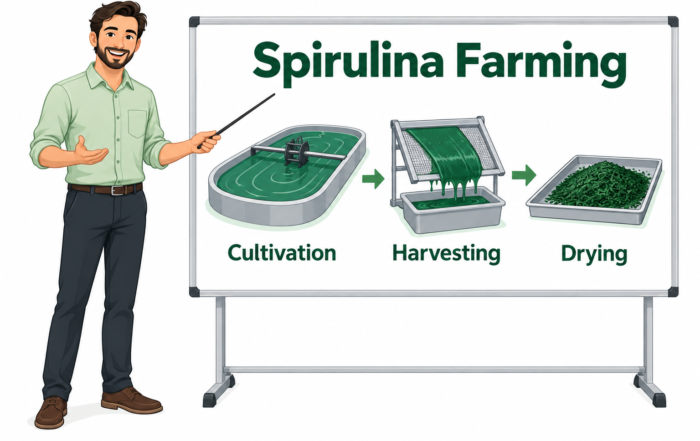
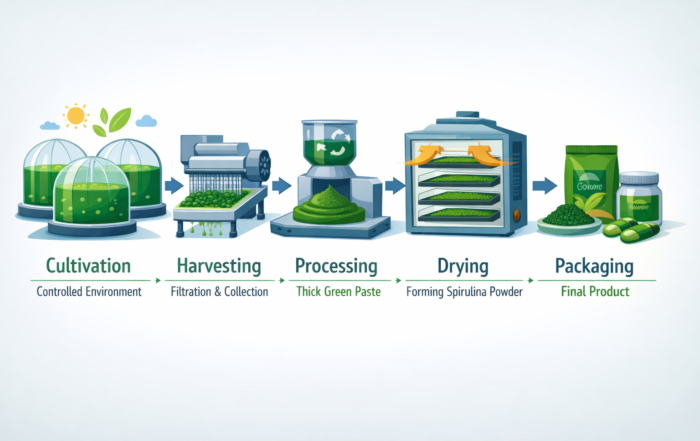
The most commercially cultivated species are Spirulina platensis (now formally reclassified as Arthrospira platensis) and Spirulina maxima. Both thrive in warm, highly alkaline environments with high bicarbonate concentrations – conditions that replicate the naturally occurring soda lakes where wild spirulina grows. Commercially, spirulina is cultivated in controlled raceway ponds at pH levels between 9 and 11, temperatures between 30-37°C, and under continuous agitation to ensure even light exposure and gas exchange.
The name spirulina comes from the Latin word for helix – a reference to the characteristic spiral filament structure visible under microscopy. That spiral morphology also makes spirulina relatively easy to harvest through fine mesh filtration, a practical property that has contributed significantly to its commercial viability.
Why Nutritionists and Scientists Take Spirulina Seriously
The global interest in spirulina is not driven by trend cycles. It is grounded in a nutritional profile that is, by almost any measure, genuinely exceptional for a single-ingredient food source.
Commercial-grade spirulina powder – when produced under controlled conditions and properly dried to preserve heat-sensitive compounds – contains between 55 and 70 percent protein by dry weight. Quality-certified batches regularly achieve 65 percent or above. For context, chicken breast contains approximately 31 percent protein by dry weight, and whole eggs around 48 percent. Spirulina’s protein density is not just high – it is complete, meaning it contains all essential amino acids that the human body cannot synthesise independently.
Beyond protein, spirulina contains a concentration of micronutrients, pigments, fatty acids, and bioactive compounds that is rare in any naturally occurring food source. Each of these categories carries distinct physiological relevance.
Spirulina Nutrition: A Data-Driven Breakdown
Protein and Amino Acids
Spirulina’s protein content of 55-70% by dry weight makes it one of the most protein-dense whole foods available. What elevates it further is digestibility – spirulina lacks the cellulose cell wall that makes plant proteins harder for the body to access. Its proteins are more bioavailable than most legume or grain sources.
The amino acid profile includes all nine essential amino acids: histidine, isoleucine, leucine, lysine, methionine, phenylalanine, threonine, tryptophan, and valine. This places spirulina in the same category as animal proteins in terms of completeness – a distinction that matters significantly for vegetarian, vegan, and protein-deficient populations.
Fatty Acids – Including the Critical GLA
Spirulina contains 5-6 percent total lipids by dry weight, with 1.5-2.0 percent of that being polyunsaturated fatty acids. The fatty acid profile includes linoleic acid (13-25% of total fatty acids), gamma-linolenic acid or GLA (13-27%), palmitic acid (35-60%), oleic acid, stearic acid, and trace amounts of eicosapentaenoic and docosahexaenoic acids.
GLA is the compound that draws particular scientific attention. It is an omega-6 fatty acid with documented therapeutic properties, notably its role in modulating inflammatory pathways and its studied association with reductions in blood cholesterol levels. Most dietary sources of GLA are limited – evening primrose oil and borage oil are the primary alternatives – which makes spirulina’s concentration of the compound nutritionally significant. The maximum yield of GLA in spirulina is obtained at a cultivation temperature of 30°C, a detail that well-managed commercial farms optimise for.
Vitamins
Spirulina contains a notably broad vitamin spectrum: B1 (thiamine), B2 (riboflavin), B3 (niacin), B6 (pyridoxine), B12 (cobalamin), vitamin C, vitamin D, and vitamin E. The B12 content is frequently cited in discussions of spirulina for vegan diets, though it is worth noting that the form of B12 present in spirulina is a subject of ongoing scientific discussion regarding its bioavailability in humans.
Minerals
The mineral profile is extensive. Spirulina contains potassium, calcium, chromium, copper, iron, magnesium, manganese, phosphorus, selenium, sodium, and zinc. Of these, iron content is particularly notable – quality-certified spirulina powder contains approximately 410 mg of iron per kilogram. For populations with dietary iron deficiency, this concentration is clinically meaningful.
Photosynthetic Pigments
This is where spirulina separates itself most distinctly from conventional food supplements.
Phycocyanin is the blue pigment that gives spirulina its characteristic colour. It is not merely a dye – it is a biliprotein with significant antioxidant and studied anti-inflammatory properties. Quality production should yield phycocyanin content of at least 10 percent by dry weight; premium certified batches regularly achieve 18 percent or above. Phycocyanin is heat-sensitive, which is why drying method matters enormously: spray drying at 100-180°C destroys much of it, while Refractive Window Drying at below 45°C preserves it effectively.
Beta-carotene content in cultivated spirulina must exceed 5,500 mg per kilogram to meet quality benchmarks. This level of carotenoid concentration makes spirulina one of the most beta-carotene-rich foods known. Beta-carotene is a precursor to vitamin A and a potent antioxidant. Quality-certified batches achieve 0.19-0.20 percent beta-carotene by dry weight.
Chlorophyll-a is present at minimum 1 percent in certified-grade spirulina. Chlorophyll has studied associations with detoxification support, though its direct health mechanisms in humans are less established than phycocyanin or beta-carotene.
What a Quality COA Looks Like: The Benchmark Data
Understanding what good spirulina actually contains requires knowing the numbers. The following table reflects benchmark specifications for certified, export-grade spirulina powder.
| Parameter | Minimum Specification | What Quality Production Achieves |
| Protein | ≥60% | 65-68% |
| Moisture (loss on drying) | ≤9% | 5-7% |
| Beta-carotene | ≥0.160% | 0.19-0.20% |
| Chlorophyll-a | ≥1.0% | 1.1-1.2% |
| Phycocyanin | ≥10% | 15-20% |
| Total carotenoids | ≥5,500 mg/kg | 5,500-6,500 mg/kg |
| Iron | ~410 mg/kg | 400-420 mg/kg |
| Total aerobic microbial count | ≤50,000 cfu/g | <10,000 cfu/g |
| Lead | ≤0.20 µg/g | ≤0.11 µg/g |
| Arsenic | ≤0.50 µg/g | ≤0.10 µg/g |
| E. coli | Absent | Absent |
| Salmonella | Absent | Absent |
| Pesticides | Absent (USP) | Absent |
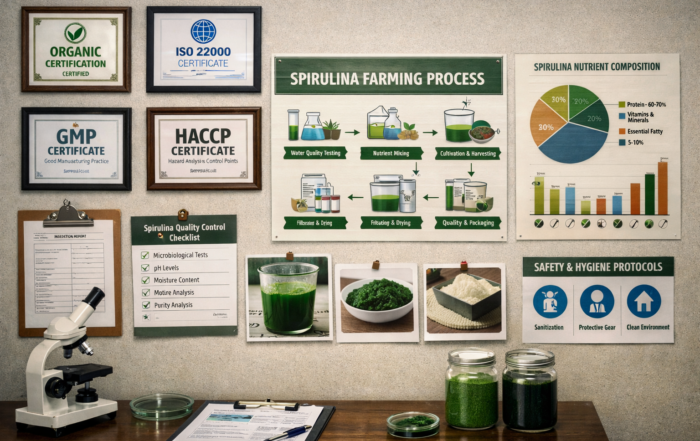
These numbers matter for anyone purchasing or consuming spirulina. A product without a verifiable, batch-specific COA confirming these parameters has not been validated. The presence of a COA – not just its existence but the specific figures it reports – is the single most reliable indicator of product quality.
Documented Health Benefits: What the Evidence Supports
Antioxidant and Anti-inflammatory Activity
Spirulina’s phycocyanin and beta-carotene concentrations give it substantial antioxidant capacity. Oxidative stress – the imbalance between free radicals and antioxidant defences in the body – is implicated in ageing, cardiovascular disease, and a range of chronic conditions. The phycocyanin in spirulina has been studied for its ability to inhibit lipid peroxidation and neutralise reactive oxygen species. These are not theoretical mechanisms – they are demonstrated in cell culture and animal studies, with a growing body of human clinical trial data.
Cholesterol and Cardiovascular Markers
Multiple studies have examined spirulina’s effect on lipid profiles. The GLA content and the antioxidant properties of phycocyanin are believed to contribute to observed reductions in LDL cholesterol and triglycerides in supplemented subjects. A number of controlled trials have reported improvements in total cholesterol, LDL, HDL ratios, and blood pressure in participants supplementing with spirulina over periods of six to twelve weeks.
Iron and Nutritional Deficiency Support
Given its iron density of approximately 410 mg per kilogram, spirulina has been studied extensively as a nutritional intervention for iron-deficiency anaemia, particularly in vulnerable populations including pregnant women, children, and elderly individuals with limited dietary variety. Its bioavailable protein content adds further relevance for malnourished populations.
Blood Sugar Regulation
Emerging research has examined spirulina’s potential role in supporting blood glucose regulation. Several small clinical trials have reported modest reductions in fasting blood glucose in type 2 diabetic patients following spirulina supplementation over eight to twelve weeks. The proposed mechanisms involve both antioxidant activity and effects on insulin sensitivity, though this remains an area where larger, longer-term trials are still needed.
Performance, Recovery, and Muscle Endurance
Spirulina’s complete amino acid profile, combined with its antioxidant properties, has attracted research interest in the context of athletic performance. Studies have examined its potential to reduce exercise-induced oxidative damage and support faster recovery. Early findings are encouraging, though this area benefits from more robust long-term human data.
Animal and Poultry Applications
Spirulina’s applications extend beyond human nutrition. In poultry diets, optimum pigmentation of egg yolk is achieved with just 1 percent spirulina inclusion. Its high digestibility and broad micronutrient profile make it a functional ingredient in aquaculture and livestock feed as well. This is not a secondary application – for many large-scale spirulina producers, the animal nutrition market represents a meaningful revenue stream for product that does not meet human-grade COA specifications.
How Much Spirulina to Consume
Research indicates spirulina is safe for human consumption at levels up to 800 mg per kilogram of body weight. However, due to its naturally high nucleic acid content – which at excessive levels can increase uric acid in the body – consumption beyond 20 grams per day is not recommended for regular use.
For most healthy adults seeking the nutritional and antioxidant benefits of spirulina, a daily intake of approximately 4.5 grams is a well-supported practical amount. This can be consumed as powder mixed into water, smoothies, or food, or in equivalent capsule form. At this dose, spirulina provides meaningful quantities of protein, GLA, phycocyanin, beta-carotene, iron, and B vitamins without approaching any risk threshold.
A Note on Product Quality and What to Look For
Not all spirulina products deliver the nutritional profile described above. The difference between a high-quality certified organic spirulina powder dried below 45°C and a low-grade product dried using solar or spray methods can be dramatic – in phycocyanin content, in beta-carotene retention, in microbial safety, and in heavy metal levels.
When purchasing spirulina, look for products that provide a batch-specific COA with declared protein percentage, phycocyanin content, and heavy metal test results. Certified organic status from a recognised certifying body – not just a “natural” or “chemical-free” marketing claim – is the meaningful standard. Products that cannot produce this documentation are making claims their supply chain cannot substantiate.
Spirulina’s nutritional case is strong. But the nutritional value exists only in spirulina that has been properly cultivated, properly dried, and properly tested. That is the product worth seeking out – and the standard worth demanding.
Make us your source on Google
Table Of Contents