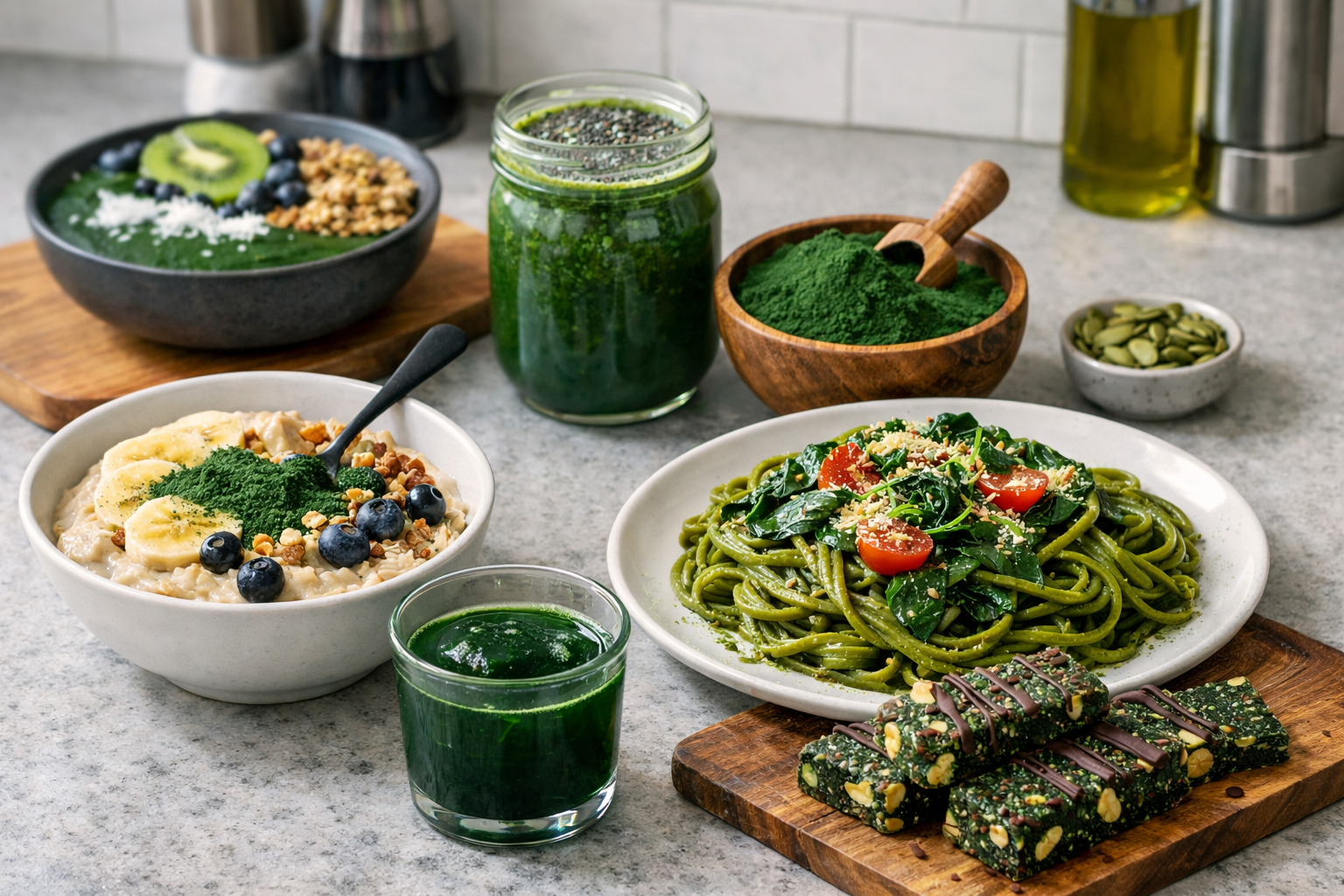
Most people encounter spirulina in one of two forms – a green powder added to a morning smoothie or a capsule on a pharmacy shelf. Those are real applications, but they represent a fraction of what spirulina is actually used for across food manufacturing, clinical nutrition, animal agriculture, aquaculture, and cosmetics.
Understanding the full range of spirulina’s applications also helps explain why demand for certified, high-quality production is growing across multiple industries simultaneously – and why the quality of the spirulina at the source matters differently depending on what it is ultimately used for.
In Food: From Kitchen to Manufacturing
Direct Consumption as a Whole Food
The most straightforward use of spirulina is adding it directly to food and drink. At a recommended daily amount of approximately 4.5 grams, whole spirulina powder can be mixed into water, blended into smoothies, stirred into juices, or incorporated into energy balls, raw desserts, and salad dressings. Its strong, oceanic flavour is pronounced in plain water but largely masked when combined with fruit, citrus, or strong flavours like cacao or ginger.
The powder form works best in cold or room-temperature applications. Because phycocyanin and other heat-sensitive compounds degrade above 45°C, cooking spirulina into hot dishes – soups, baked goods, sautéed preparations – reduces its antioxidant and pigment value significantly, even if the protein content remains largely intact.
Natural Food Colouring
This is one of spirulina’s fastest-growing industrial applications. The food and beverage industry has long needed a stable, natural source of blue and green colour – synthetic alternatives like Blue 1 face increasing regulatory and consumer resistance in clean-label markets.
Phycocyanin extract – what the market calls blue spirulina – provides a vivid, stable blue suitable for cold-process food applications. It is being used commercially in ice creams, yoghurts, confectionery, sports drinks, smoothie products, and natural food colouring kits. Whole green spirulina serves as a natural green colourant in pasta, crackers, noodles, and health snack products.
The limitation in colouring applications is heat stability. Both phycocyanin and chlorophyll degrade under cooking temperatures, which constrains spirulina’s use as a colourant to cold-process or low-temperature manufacturing.
Food Fortification
Spirulina is increasingly used as a fortification ingredient in processed foods targeting nutritional deficiency markets. Products including fortified biscuits, nutritional bars, infant formula supplements, and therapeutic food formulations in food-insecure regions incorporate spirulina for its protein density and iron content – approximately 410 mg of iron per kilogram – in populations where conventional protein and micronutrient sources are limited or inaccessible.
In Supplements: Capsules, Tablets, and Extracts
Daily Nutritional Supplementation
The supplement market remains spirulina’s largest application by volume. Capsules, tablets, and loose powder products targeting general wellness, energy, immune support, and nutritional completeness are sold across pharmacy, health food, and e-commerce channels globally.
The efficacy of these products depends entirely on source quality. A spirulina supplement with 65% protein, 18% phycocyanin, and clean heavy metal results delivers meaningfully different outcomes than one dried at high temperatures with no batch testing. The COA – Certificate of Analysis – is the only reliable way to distinguish between them.
Targeted Health Applications
Beyond general supplementation, spirulina is used in formulations targeting specific health outcomes. Its GLA content – gamma-linolenic acid at 13–27% of total fatty acids – is relevant to products targeting inflammation and cholesterol management. Its iron density makes it relevant to anaemia-support formulations. Its phycocyanin concentration places it in antioxidant-focused products alongside compounds like astaxanthin and resveratrol.
Phycocyanin extracts at higher purity levels – 25–35% and above – are used in pharmaceutical research and premium nutraceutical formulations where concentrated antioxidant activity is the specific objective.
Sports and Performance Nutrition
Spirulina’s complete amino acid profile and antioxidant capacity have driven adoption in sports nutrition. Products targeting muscle recovery, endurance, and exercise-induced oxidative stress increasingly include spirulina as a plant-based protein source that doubles as an antioxidant ingredient – a combination that few single ingredients provide simultaneously.
In Agriculture: Where Spirulina Transforms Yield and Quality
Poultry and Egg Production
This is one of the most precisely documented agricultural applications of spirulina. Research shows that optimum pigmentation of egg yolk in poultry is achieved with just 1 percent spirulina inclusion in the feed diet. The carotenoid content – beta-carotene and xanthophylls – transfers directly into the yolk, producing the deep orange-yellow colour that consumers associate with free-range and premium eggs.
Beyond colouration, spirulina inclusion in poultry diets has been studied for improvements in feed conversion efficiency, immune function in flocks, and overall bird health markers. It represents a natural, chemical-free alternative to synthetic pigmenting agents that have faced regulatory scrutiny in several markets.
Aquaculture
Spirulina is a well-established ingredient in aquaculture feed, particularly for species where pigmentation, growth rate, and immune function are commercially important. Salmon, trout, shrimp, and ornamental fish farming all use spirulina-based feed formulations.
The carotenoid content that colours egg yolks in poultry serves the same function in salmon and trout flesh – producing the pink-orange colour that consumers expect and that is otherwise achieved through synthetic astaxanthin. For aquaculture producers targeting natural and organic certifications, spirulina offers a verified, traceable alternative.
In ornamental fish – koi, goldfish, tropical species – spirulina is a standard component of premium feeds, valued for the colour intensity it produces and its digestibility at small feeding volumes.
Livestock and Animal Feed
For livestock applications including cattle, pigs, and goats, spirulina’s protein density and amino acid completeness make it a concentrated feed supplement, particularly in formulations for young animals requiring high protein intake during growth phases. Its digestibility advantage over plant-based alternatives – the absence of a cellulose cell wall – is practically relevant in feed conversion contexts.
For spirulina producers, the animal feed market also serves a commercial purpose: biomass that does not meet human-grade COA specifications – whether due to slightly elevated moisture, pigment variation, or cosmetic batch issues – can be redirected to animal feed applications rather than discarded, improving overall farm economics.
Biofertiliser and Soil Applications
At a research and early-commercial level, spirulina biomass and the nutrient-rich water from spirulina cultivation are being explored as biofertiliser inputs. The high nitrogen content in spent culture media, combined with the organic matter in rejected or surplus biomass, has potential agricultural value as a soil amendment – particularly in organic farming systems where synthetic fertiliser inputs are prohibited.
In Cosmetics and Skincare
Spirulina extract is used in premium skincare formulations for its antioxidant activity, chlorophyll content, and amino acid profile. Products including face masks, serums, eye creams, and hair treatments incorporate spirulina for its studied role in neutralising oxidative stress at the skin surface and supporting cellular regeneration. The cosmetic application typically uses standardised phycocyanin or whole spirulina extract rather than bulk powder, and the quality standards – particularly around heavy metal content – are as stringent as for food applications.
Matching Grade to Application
Not all spirulina is appropriate for all applications. The table below summarises the grade requirements across the primary uses.
| Application | Minimum Grade Required | Key Quality Parameter |
| Human supplements / food | Certified organic, full COA, GMP-compliant | Protein ≥60%, heavy metals within USP limits, pathogens absent |
| Export / international markets | USDA Organic or EU Organic certified | Full traceability, batch documentation, third-party lab verification |
| Blue spirulina / food colouring | High phycocyanin extract, RWD-dried | Phycocyanin ≥25%, heat-stable handling, clean microbial results |
| Poultry and aquaculture feed | Commercial grade, consistent carotenoids | Beta-carotene and xanthophyll levels, no pathogens |
| Cosmetic formulations | Standardised extract | Heavy metals within cosmetic grade limits, stable pigment concentration |
| Biofertiliser / soil amendment | Rejected or surplus biomass | Nutrient content, absence of chemical inputs |
The Common Thread
Across every application – the smoothie bowl, the salmon farm, the skincare serum, the fortified biscuit – what determines whether spirulina delivers its claimed value is the same thing: how it was grown, how it was dried, and whether it was tested. The organism is consistent. The production is not. Knowing what spirulina can do is the starting point. Knowing that the product in your hand actually contains what the label claims is the part that matters most.
Make us your source on Google
Table Of Contents