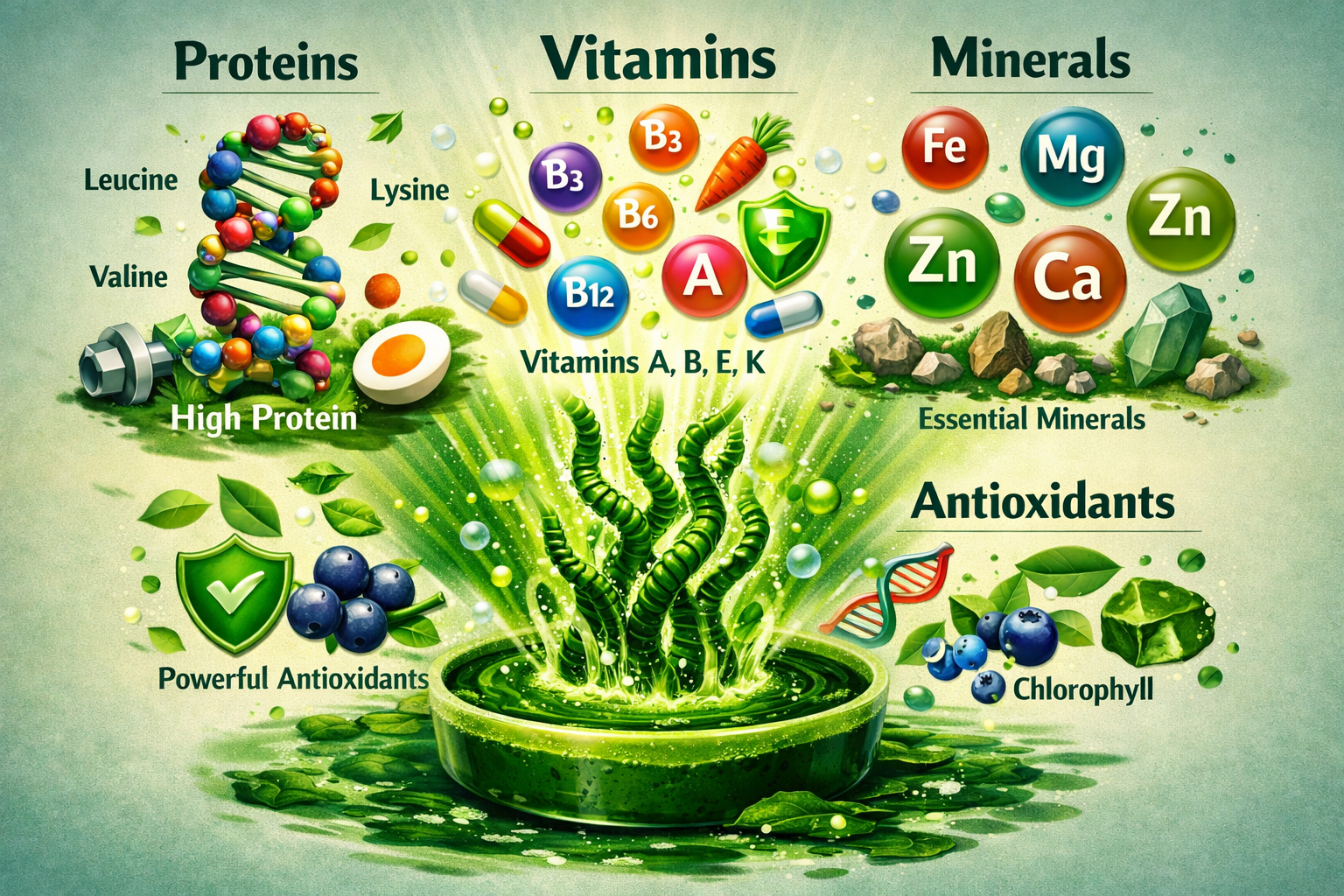
Spirulina’s reputation as a nutritional powerhouse is not built on marketing. It is built on a composition that, when you look at the actual numbers, is difficult to match with almost any other single-ingredient food or supplement. This article sets out those numbers clearly – what spirulina contains, in what quantities, and what that means in practical terms.
All figures below reflect certified, export-grade spirulina powder produced under controlled conditions and dried using temperature-sensitive methods that preserve heat-sensitive compounds. Lower-quality production will return lower values across every category.
The Core Nutrition Profile at a Glance
| Nutrient Category | What Spirulina Contains | Why It Matters |
| Protein | 55-70% by dry weight | Higher than meat, fish, or eggs by dry weight comparison |
| Total lipids | 5-6% by dry weight | Includes rare omega fatty acids including GLA |
| Moisture | ≤9% (quality benchmark) | Lower moisture = longer shelf life and better stability |
| Total ash | ≤9% | Reflects mineral content – not a contaminant |
| Bulk density | 0.70-0.85 g/ml | Relevant for dosing and capsule fill weight |
Protein: The Number That Defines Spirulina
Spirulina contains between 55 and 70 percent protein by dry weight. Certified production batches consistently achieve 65 percent and above. To put that in perspective:
| Food Source | Approximate Protein by Dry Weight |
| Spirulina (certified grade) | 65-70% |
| Whey protein concentrate | 60-65% |
| Chicken breast | ~31% |
| Lentils (cooked, dry weight equivalent) | ~26% |
| Whole eggs | ~48% |
| Soybeans (dry) | ~36% |
What makes this especially significant is that spirulina’s protein is complete – it contains all nine essential amino acids the human body cannot produce independently. Most plant protein sources are incomplete. Spirulina is the exception, which is why it holds particular relevance for vegetarian, vegan, and protein-deficient populations.
Spirulina also lacks the cellulose cell wall present in most plant foods. That structural absence means the protein is more directly bioavailable – the body can access it more efficiently than equivalent protein from legumes or grains.
Fatty Acid Profile: Small in Volume, Significant in Value
Total lipid content in spirulina is modest at 5-6% by dry weight. But within that lipid fraction sits a fatty acid profile of genuine nutritional significance.
| Fatty Acid | Specified Range (% of total fatty acids) | Typical Result |
| Palmitic acid | 35-60% | ~46% |
| Linoleic acid (omega-6) | 13-25% | ~22% |
| Gamma-linolenic acid / GLA (omega-6) | 13-27% | ~24% |
| Palmitoleic acid | 2-8% | ~5.2% |
| Oleic acid | 1-7% | ~5.5% |
| Stearic acid | 1-5% | ~4.4% |
| Alpha-linolenic acid (omega-3) | <0.5% | ~0.18% |
GLA – gamma-linolenic acid – is the compound that draws the most scientific attention. It is an omega-6 fatty acid with studied anti-inflammatory properties and a demonstrated role in supporting healthy cholesterol levels. Dietary sources of GLA are scarce: evening primrose oil and borage oil are the primary alternatives. Spirulina’s GLA concentration of 13-27% of its fatty acid fraction makes it one of the most accessible natural sources available. The maximum GLA yield is achieved when spirulina is cultivated at 30°C – a parameter that well-managed automated farms optimise for.
Vitamins: A Broad Spectrum in One Ingredient
| Vitamin | Present in Spirulina | Functional Relevance |
| B1 (Thiamine) | Yes | Energy metabolism, nerve function |
| B2 (Riboflavin) | Yes | Cellular energy production |
| B3 (Niacin) | Yes | DNA repair, metabolism |
| B6 (Pyridoxine) | Yes | Protein metabolism, neurotransmitter synthesis |
| B12 (Cobalamin) | Yes | Red blood cell formation, neurological function |
| Vitamin C | Yes | Immune support, antioxidant activity |
| Vitamin D | Yes | Bone health, immune regulation |
| Vitamin E | Yes | Antioxidant, skin and cellular protection |
The B12 content in spirulina is frequently cited in discussions about plant-based diets. It is present – but it is worth noting that the specific form of B12 in spirulina and its bioavailability in humans remains a subject of ongoing scientific review. Spirulina should not be relied upon as a sole source of B12 for vegans without further guidance from a healthcare professional.
Minerals: What Spirulina Delivers Per Kilogram
| Mineral | Presence in Spirulina | Notable Detail |
| Iron | ~410 mg/kg | Among the highest concentrations in any plant-based source |
| Calcium | Present | Supports bone density and muscular function |
| Magnesium | Present | Over 300 enzymatic processes depend on it |
| Potassium | Present | Electrolyte balance, cardiovascular function |
| Zinc | Present | Immune function, wound healing |
| Selenium | Present | Thyroid function, antioxidant enzyme activation |
| Phosphorus | Present | Bone structure, cellular energy (ATP) |
| Chromium | Present | Glucose metabolism support |
| Copper | Present | Iron absorption, connective tissue formation |
| Manganese | Present | Bone development, antioxidant enzyme function |
The iron figure – approximately 410 mg per kilogram – is the standout. Iron deficiency affects more than 1.2 billion people globally, with particular prevalence among women, children, and populations in food-insecure regions. At a daily intake of 4.5 grams of spirulina, a consumer receives approximately 1.8 mg of iron from this source alone – meaningful as part of a varied diet addressing deficiency.
Photosynthetic Pigments: The Compounds That Set Spirulina Apart
This is where spirulina’s nutritional profile becomes genuinely unusual. It contains a range of bioactive pigments that function as potent antioxidants – compounds that neutralise free radicals and reduce oxidative stress in the body.
| Pigment | Minimum Specification | Quality Production Achieves | What It Does |
| Phycocyanin | ≥10% by dry weight | 15-20% | Powerful antioxidant, studied anti-inflammatory properties |
| Chlorophyll-a | ≥1.0% | 1.1-1.2% | Studied for detoxification support |
| Beta-carotene | ≥0.160% | 0.19-0.20% | Precursor to vitamin A, antioxidant |
| Total carotenoids | >5,500 mg/kg | 5,500-6,500 mg/kg | Broad antioxidant and photoprotective activity |
Phycocyanin is the compound that draws the most clinical interest. At 15-20% of dry weight in quality spirulina, it represents one of the most concentrated natural sources of antioxidant pigment found in any food. It is also heat-sensitive – processing above 45°C degrades it significantly. This is why drying method is not a minor technical detail. A spirulina product dried using spray drying at 100-180°C may retain very little of its original phycocyanin content despite claiming the same “spirulina” label as a product dried below 45°C using Refractive Window Drying.
Safety, Contamination Standards, and What a Clean COA Confirms
Nutritional richness means nothing if the product carries contamination. Quality-certified spirulina undergoes rigorous testing against the following parameters per batch:
| Parameter | Acceptable Limit | What Good Production Achieves |
| Lead | ≤0.20 µg/g | ≤0.11 µg/g |
| Arsenic | ≤0.50 µg/g | ≤0.10 µg/g |
| Cadmium | ≤0.20 µg/g | <0.09 µg/g |
| Mercury | ≤0.025 µg/g | <0.025 µg/g |
| Total aerobic microbial count | ≤50,000 cfu/g | <10,000 cfu/g |
| Mould and yeast | ≤100 cfu/g | <70 cfu/g |
| E. coli | Absent | Absent |
| Salmonella | Absent | Absent |
| Pesticides | Absent (USP) | Absent |
| Aflatoxins | Below detection limit | Absent |
Every number in this table should appear in the COA of any spirulina product you purchase. A product without batch-specific heavy metal and microbial data has not been verified. The nutritional profile is only as valuable as the safety profile that accompanies it.
Practical Consumption Reference
| Parameter | Guidance |
| Recommended daily amount | ~4.5 grams per day for most adults |
| Safe upper limit | 20 grams per day (beyond this, nucleic acid content may raise uric acid levels) |
| Maximum studied safe dose | Up to 800 mg per kilogram of body weight |
| Best form for nutrient retention | RWD-dried or vacuum-dried powder, vacuum-sealed packaging |
| Storage | Cool, dark, dry environment – away from heat and direct light |
The Numbers Speak for Themselves
No single food does everything. But spirulina comes closer than most. Complete protein at 65%+ by dry weight. Concentrated GLA when the alternative sources are expensive oil supplements. Iron at 410 mg per kilogram. Phycocyanin at 15-20%. A full B-vitamin complex. Beta-carotene at levels that exceed almost every other natural source.
The condition on all of this is quality. These numbers describe spirulina produced correctly – cultivated under controlled conditions, harvested with automated equipment, dried below 45°C, and tested per batch before dispatch. Spirulina that has not been through that process may carry the same label. It does not carry the same numbers.
Make us your source on Google
Table Of Contents