Search “spirulina farming training” and you’ll find plenty of short courses promising to turn anyone into a producer over a weekend. The reality is that spirulina is a living microbial culture run to food-safety standards, and the training that matters is the kind that builds real operational competence. This guide breaks down the skills worth learning, what hands-on training realistically costs, and the certifications that actually decide whether a farm can sell into premium markets.
Why Training Matters More Than in Ordinary Farming
Spirulina isn’t a crop you plant and wait on. It’s a photosynthetic culture whose pH, temperature, salinity, and nutrient balance shift hour by hour, and a single lapse can bleach a pond or fail a certification audit. Manual intervention can’t fix pH or temperature at scale, which is why modern farms lean on automation and trained operators working together. Training that ignores this and treats spirulina like a simple backyard grow sets farmers up to lose their culture and their capital.
The Core Skills Real Training Should Cover
Any worthwhile program, whether a formal course or on-the-job learning at an established farm, should build competence in these areas:
Culture management. Maintaining pH between 9 and 11, holding culture temperature near 35 to 37°C even when outside air hits 45°C, and reading rising pH as a sign of healthy growth. Operators must know how to manipulate agitation, water depth, and shading to protect the culture.
Contamination control. Identifying and managing the flies, midges, and competing algae that threaten yield, and running the 80-mesh screening routines that keep ponds clean.
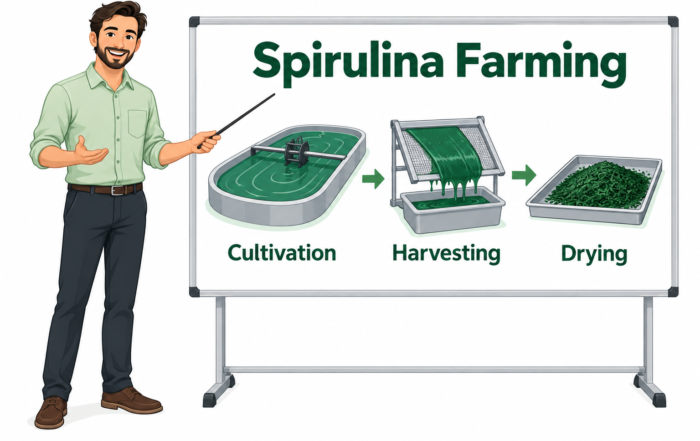
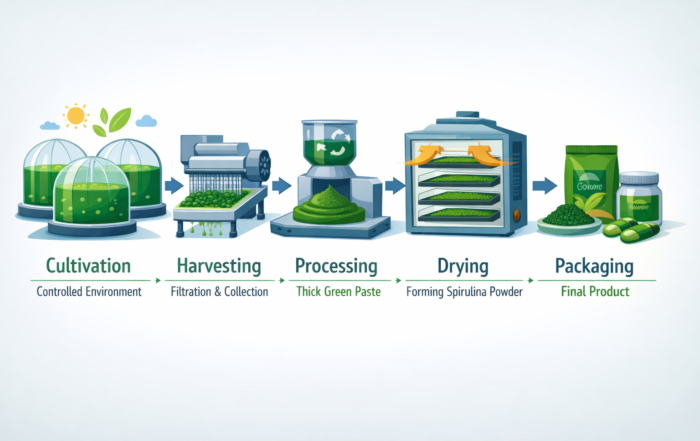
Harvesting and drying. Operating 500-mesh harvesting systems and temperature-sensitive drying methods that keep the product below 45°C to preserve phycocyanin and nutrients.
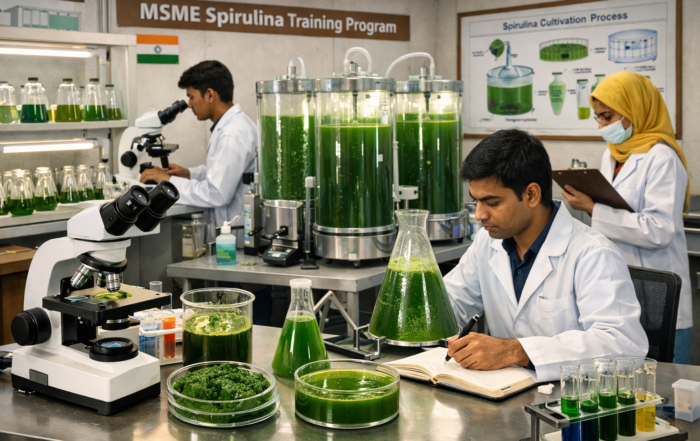
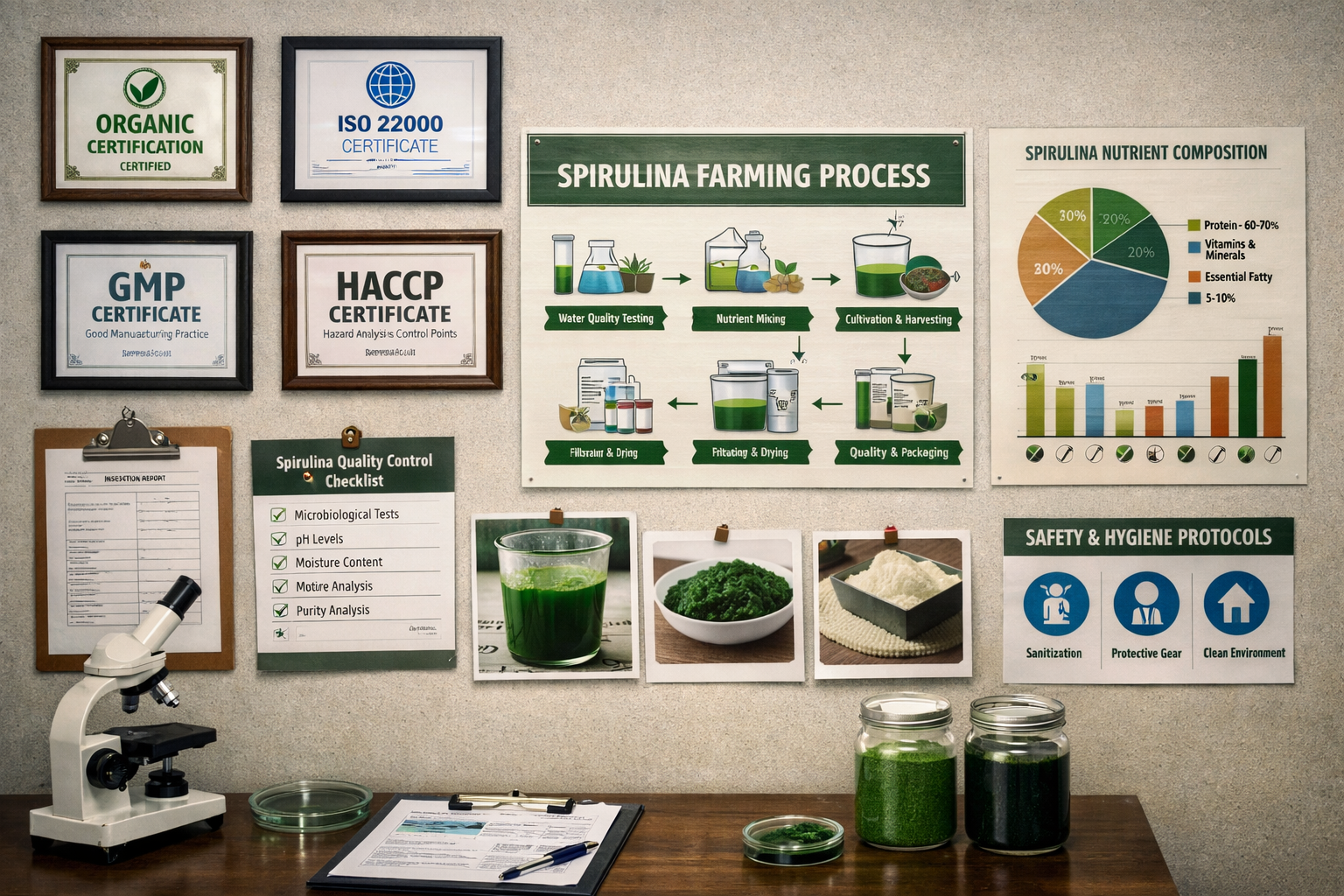
Lab and quality control. Running the in-house tests that produce a Certificate of Analysis for every batch, protein, pigments, microbial counts, heavy metals. An in-house lab is mandatory for certification.
Documentation and compliance. Keeping the HACCP-compliant logs and records that audits and certifications demand.
What Hands-On Training Realistically Costs
Formal course fees vary widely by provider and aren’t standardized, so treat any fixed figure with caution. The more meaningful cost to plan for is the training-scale setup itself, because real competence is built on a working system, not a slideshow.
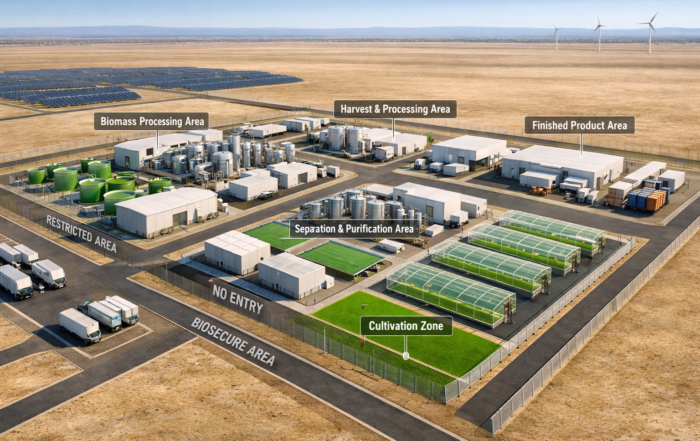
A 1-acre farm, which the economics suggest is best suited to training and niche use rather than commercial profit, requires roughly ₹73 to 107 lakh to build out fully. For those wanting to learn the processing chain on an existing operation, a harvesting-and-dewatering automation package runs ₹15 to 22 lakh. These aren’t course fees, but they’re the honest cost of learning spirulina production on equipment that behaves like the real thing.
| Learning Path | Indicative Cost (INR) | Best For |
| Short course / workshop | Varies by provider | Orientation and basic concepts |
| Harvesting automation setup | ₹15 to 22 Lakhs | Learning the processing chain |
| Full 1-acre training farm | ₹73 to 107 Lakhs | End-to-end hands-on competence |
Did You Know?
- Automation cuts harvesting labor by 80 to 90%. Training that only teaches manual methods prepares farmers for a model that struggles to turn a profit.
- There is no such thing as organic urea. A surprising amount of bad training repeats this myth, certified-organic nitrogen must come from approved sources, and getting it wrong voids certification.
- Commercial farms don’t use artificial lighting, it isn’t economically viable at scale. Sunlight is the best and most economic light source.
- Falsely claiming a product is organic without certification is a punishable offence. Training must treat compliance as seriously as cultivation.
Certifications That Actually Matter
Here’s where the word “certification” gets confusing. A training certificate proves you attended a course. The certifications that let a farm sell are entirely different, and they belong to the product and the operation, not the trainee:
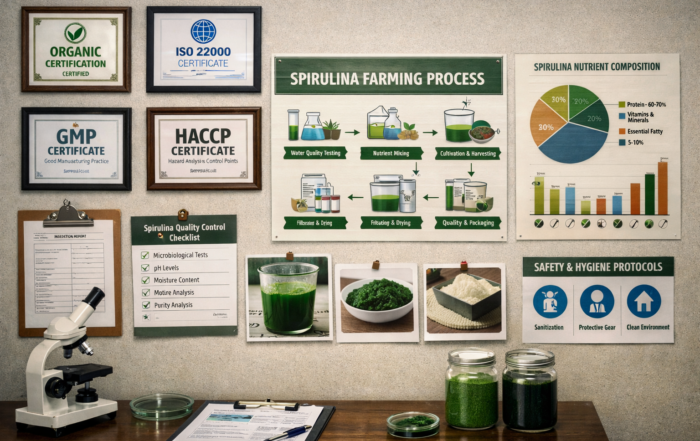
- Organic certification (USDA Organic, EU Organic): ₹1.75 to ₹3 lakh annually, requiring proof that no synthetic chemicals were used, plus regular inspections.
- ISO 22000: ₹80,000 to ₹1.5 lakh initial setup, audit fees separate.
- HACCP and GMP: food-safety frameworks that widen market access and build buyer trust.
For export especially, these certifications, backed by traceability, lab testing, and batch documentation, are what separate serious producers from uncertified ventures. Any training worth its fee should prepare you to earn and maintain them.
Frequently Asked Questions
Do I need formal training to start a spirulina farm? You need genuine operational competence. Whether that comes from a course, mentorship at an established farm, or working alongside a turnkey provider matters less than actually mastering culture management, quality control, and compliance.
How much do spirulina training courses cost? Short-course fees aren’t standardized and vary by provider, so verify current pricing directly. The larger and more predictable investment is the training-scale farm setup, from ₹15 to 22 lakh for a processing-focused build up to ₹73 to 107 lakh for a full 1-acre farm.
Is there an official spirulina farming certification for individuals? There’s no single standardized operator credential. The certifications that determine commercial success, organic, ISO 22000, HACCP, apply to the farm and product, not the individual.
Can I learn spirulina farming on a small farm and scale up later? Yes, and it’s a sensible path. A 1-acre farm is well suited to learning, since it’s not built for profit anyway. Once competent, scaling to a 2 to 3 acre commercial operation is where returns begin.
What’s the most common training gap? Underestimating quality control and documentation. Many new farmers can grow spirulina but can’t pass an audit, which is exactly what stops them selling at a premium.
The Bottom Line
Good spirulina training isn’t about a certificate on the wall, it’s about building the operational skill to keep a living culture healthy, safe, and certifiable batch after batch. Learn on a realistic setup, treat compliance as seriously as cultivation, and aim to scale once you’re competent. Established providers like Greenbubble, awarded Best Microalgae Company by the European Algae Biomass Association in Paris and working with a customer base that accounts for over 90% of India’s spirulina production, offer turnkey solutions and project support that let farmers learn on systems built to commercial standards from day one.
Make us your source on Google
Table Of Contents