Real spirulina training isn’t a lecture, it’s a progression. You start knowing nothing about a living microbial culture and finish able to keep one healthy, safe, and certifiable batch after batch. This guide walks that journey stage by stage, so you know exactly what competence you should be building at each step, from complete beginner to trusted farm operator.
Stage 1: Understanding the Organism
Everything starts with grasping what spirulina actually is: a photosynthetic cyanobacterium, not a plant you sow and harvest. At this stage you learn its biology, its nutritional profile (55 to 70% complete protein by dry weight, with pigments like phycocyanin and beta-carotene), and the non-negotiable conditions it needs to thrive. You learn that it grows best at 35 to 37°C, prefers an alkaline pH of 9 to 11, and is an obligate photoautotroph, meaning it can’t grow in the dark on organic carbon the way some microbes can.
This foundation matters because every later decision, nutrient dosing, agitation, shading, traces back to keeping the organism in its comfort zone.
Stage 2: Reading and Controlling Water Chemistry
Next you move from theory to the daily variables that decide whether a pond lives or crashes. You learn to monitor and adjust:
- pH (9 to 11): rising pH signals healthy growth as bicarbonate is consumed
- Temperature: how to hold culture near 35 to 37°C even when outside air hits 45°C, using agitation, water depth, and shading
- Salinity: why growth is stronger at lower sodium-chloride concentrations
- Carbon, nitrogen, phosphorus: the roughly 160:50:2.5 C:N:P balance spirulina prefers
Crucially, you learn that manual intervention alone can’t reliably fix pH or temperature at scale, which is why modern farms lean on monitoring and automation. Good training teaches you to read the culture, not just follow a recipe.
Stage 3: Nutrient Management and Organic Compliance
Once you can keep a culture stable, you learn to feed it correctly, and to do so within organic rules if you’re targeting premium markets. This is where many self-taught farmers go wrong.
You learn that all nutrient inputs, organic carbon sources, nitrates, phosphates, minerals, must be tested for pesticides, heavy metals, and microbial load before they touch the pond. You learn that there is no such thing as organic urea, so certified-organic nitrogen must come from approved sources. Getting this wrong doesn’t just hurt yield; it voids certification.
Stage 4: Contamination Control
A healthy culture is a target. At this stage you learn to defend it. Training covers the real threats, flies, midges, water-boatmen, competing algae, and the routines that keep them in check: 80-mesh screening at the agitator, daily cleaning, and full-culture sweeps when infestation spreads.
You also learn the material discipline that protects quality: only SS 316 equipment in contact with the culture, plain uncoloured cotton for cleaning, and strict avoidance of heavy-metal contamination sources. This is the difference between a farm that passes a quality-control audit and one that doesn’t.
Stage 5: Harvesting, Dewatering, and Drying
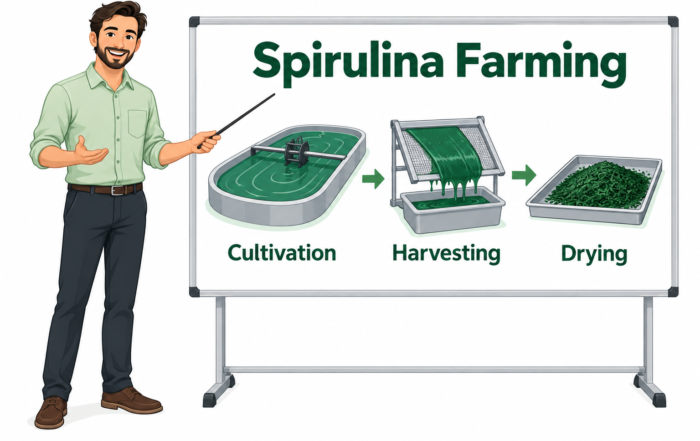
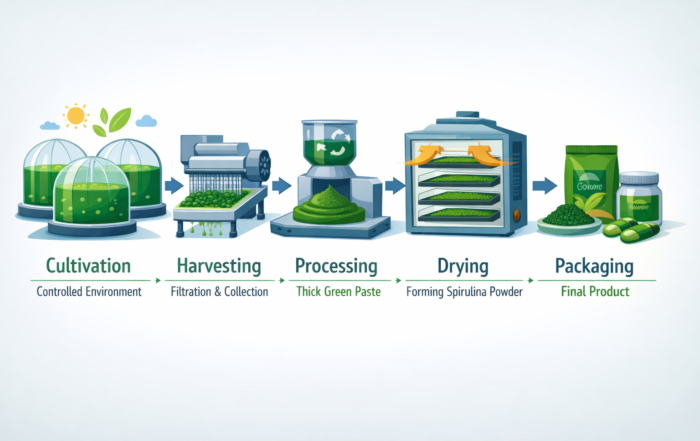
Now you learn to turn living culture into sellable biomass without destroying its value. The chain runs: prefiltration (80 mesh) to remove debris, harvesting and washing (500 mesh) to concentrate and desalt, dewatering into a thick cake, then drying.
Drying is where nutrition is won or lost. You learn why the biomass must stay below about 45°C, and why refractive window drying and vacuum drying preserve phycocyanin and colour while sun drying and high-heat methods degrade them. You learn to match method to market: RWD for nutritional export grade, solar only for animal feed.
Stage 6: Powdering, Testing, and the COA
The final production skills: powdering under GMP conditions with ball mills or air classifier mills, sieving to 80 to 100 mesh, metal detection, and blending batches to a consistent standard.
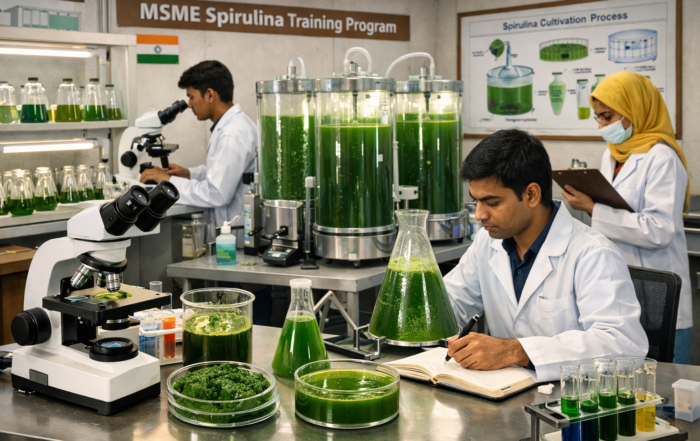
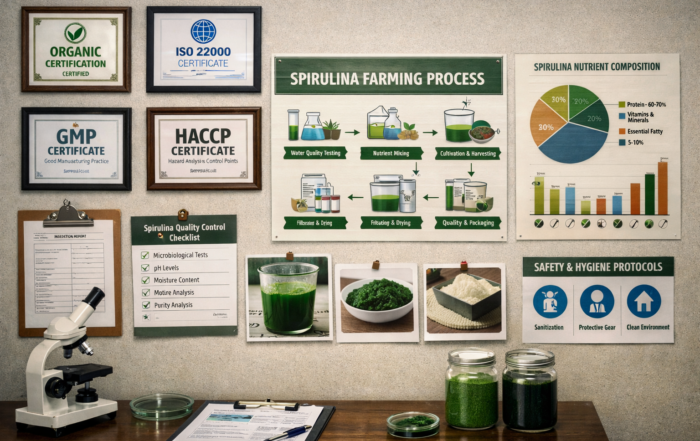
Then you learn the lab work that makes it all saleable. An in-house lab is mandatory for certification, and you learn to run and read a Certificate of Analysis, protein above 60%, phycocyanin at or above 10%, microbial counts within limits, heavy metals like lead below 0.20 ppm. Without this, buyers won’t trust your product.
Did You Know?
- Spirulina training is as much lab science as farming. An in-house lab isn’t optional, it’s mandatory for certification and for testing every batch.
- Rising pH is good news. As spirulina grows it consumes bicarbonate, pushing pH up, so an increasing reading is a sign of a thriving culture.
- Commercial farms don’t use artificial lighting. It isn’t economically viable at scale; sunlight is the best and most economic light source.
- The biggest skill gap for new farmers isn’t growing spirulina, it’s passing an audit. Documentation and quality control are what separate hobby farms from commercial ones.
Stage 7: Becoming a Skilled Operator
The final stage is where knowledge becomes judgment. A trained operator can:
- Calibrate filters and drying systems and check moisture before sealing
- Vary pond depth by season and tune agitator run-time and speed to control temperature
- Maintain cleanliness across drying trays and packaging zones
- Keep HACCP-compliant checklists and documentation logs
- Recognise a struggling culture early and diagnose whether the cause is temperature, pH, contamination, or a nutrient or herbicide problem in the water
This is the level that makes a farm reliable, and reliability, not novelty, is what keeps a spirulina business profitable.
Where to Learn Each Stage Properly
Foundational stages can begin with government and MSME-supported programs, which are accessible and low-cost but usually stop at awareness. The deeper stages, contamination control, certified drying, lab work, and operator-level judgment, need hands-on training on commercial-standard systems.
Greenbubble, which runs this knowledge platform, delivers that depth through consultancy and turnkey solutions with on-farm operator training built around real production and audit standards. With 10+ years of experience, operations across 10+ countries, and a customer base that accounts for more than 90% of India’s spirulina production, plus recognition as Best Microalgae Company by the European Algae Biomass Association in Paris, its training reflects what farms genuinely need to produce export-grade spirulina. Real deployments are on the projects page.
Frequently Asked Questions
How long does it take to learn spirulina cultivation? Basic awareness takes a few days; operator-level competence takes longer and requires hands-on practice with live cultures, drying, and lab work. Short courses start the journey but rarely complete it.
Do I need a science background? No, but you’ll learn practical science: water chemistry, contamination control, and lab testing. Good training builds these skills from the ground up.
What’s the hardest part to learn? Consistency. Keeping every batch within COA specification, and documenting it for audits, is harder than growing a single healthy pond.
Can I learn without setting up a full farm? You can learn the concepts, but true competence needs hands-on exposure to real culture management, harvesting, and drying on commercial-standard equipment.
Is lab work really necessary? Yes. An in-house lab is mandatory for certification, and reading a COA is a core operator skill, not an optional extra.
The Bottom Line
Spirulina cultivation training is a genuine progression: from understanding a living organism, to controlling its chemistry, to harvesting and drying without losing value, to running quality-controlled, audit-ready production. Rush the early stages and the later ones collapse. Learn each properly, ideally with hands-on time on commercial systems, and you finish not just as someone who can grow spirulina, but as an operator a serious farm can rely on.
Make us your source on Google
Table Of Contents