Andhra Pradesh is one of India’s most natural homes for spirulina. Warm weather, long sunlight hours, available groundwater, and an existing base of algae farming around Kurnool and the coast give it real advantages. But turning those advantages into a compliant, profitable farm takes more than good weather. This complete guide walks through everything: climate, land and water, pond design, the cultivation cycle, harvesting and drying, costs and ROI, buyers, and the legal groundwork, so you can plan a spirulina farm in AP that actually works.
Why Andhra Pradesh Is Suited to Spirulina
Spirulina is a photosynthetic cyanobacterium, so climate directly governs yield, colour, and nutrient content. AP sits in the tropical-to-semi-arid band the culture prefers, with year-round sunshine and warm temperatures across most districts.
The sweet spot is a culture temperature of 30 to 35°C, ideally near 35 to 37°C for peak yield. AP summers push well past that, and this is the nuance most beginners miss: extreme heat is a risk, not a bonus. Above 40°C cultures bleach, so the real skill is cooling the culture down through agitation, depth control, shading, and water top-ups. This state-by-state view of the best climate zones for spirulina cultivation in India puts AP’s profile in context.
| Climate Factor | AP Reality | Implication |
| Sunlight | Abundant, year-round | Strong natural growth; no artificial lighting needed |
| Summer temperature | Frequently above 40°C | Active culture cooling required |
| Ideal culture temp | 30 to 37°C | Achievable most of the year |
| Groundwater | Widely available | Ideal if tested and filtered |
| Frost risk | Negligible | Year-round operation possible |
Choosing Land and Water in AP
Site selection sets the ceiling on everything that follows. You want level, well-draining land with 8 to 10 hours of direct daily sunlight, away from chemical-intensive agriculture and industrial zones that raise contamination risk. A rectangular plot with room to expand suits the paddlewheel-and-channel layout that a beginner’s guide to starting a spirulina farm lays out in detail.
Water is just as decisive. Groundwater is ideal for AP farms because it’s consistent and pure, but it must be filtered (sand and UV) and tested for heavy metals, pesticides, and microbial load before use. A typical raceway pond uses 15,000 to 20,000 litres per 100 m², replenished as evaporation and sludge removal demand, and borewell abstraction may need clearance from the Central Ground Water Authority. The full picture is covered in this guide to the legal and operational considerations for spirulina farming in India.
Designing the Raceway Pond System
The raceway pond is the engine room of a spirulina farm. These shallow, looped, paddlewheel-driven channels keep the culture in constant motion for even light, temperature, and nutrient distribution.
| Design Parameter | Recommended Spec |
| Pond dimensions | 100m length × 10m width × 0.4m depth |
| Working water depth | ~20 cm (0.25 to 0.35m range) |
| Construction | RCC or food-grade HDPE lining |
| Metal contact parts | SS 316 only, to prevent leaching |
| Agitation | Paddlewheels, SS shafts, energy-efficient motors |
| Bottom | Sloped, for easy biomass collection |
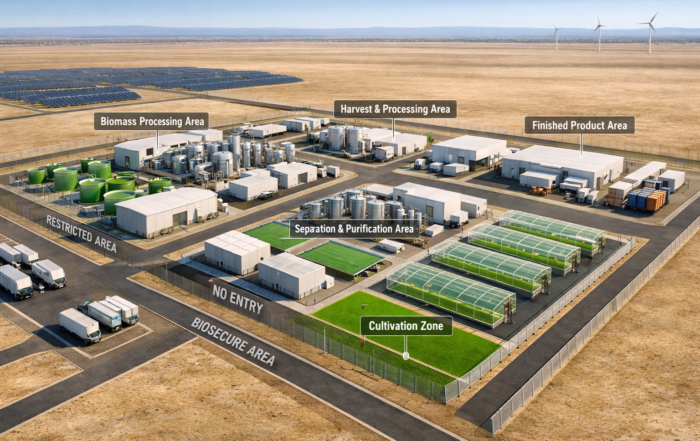
Three acres supports up to 20 raceway ponds plus a harvesting unit, drying area, packaging room, storage, and an on-site lab. The engineering choices here decide long-term quality and compliance, as this deep dive into building an efficient spirulina raceway system explains, and this primer on why raceway ponds are ideal for spirulina farming covers why they outperform photobioreactors for open-air AP conditions.
The Cultivation Cycle
With ponds built, the daily work is keeping the culture in its comfort zone. The variables that matter most:
| Parameter | Target | Why It Matters |
| pH | 9 to 11 | Rising pH signals healthy growth |
| Culture temperature | 30 to 37°C | Above 40°C causes bleaching |
| Salinity | Lower end preferred | Growth stronger at 5.8 to 11.7 ppt |
| C:N:P ratio | ~160:50:2.5 | Balanced nutrition |
| Light | Full sun; shade young cultures | Prevents photolysis early on |
Nutrient inputs, carbon sources, nitrates, phosphates, minerals, must all be tested for contaminants before entering the pond, and organic farms must use approved sources (there is no such thing as organic urea). Contamination control is constant: 80-mesh screening at the agitator catches flies, midges, and larvae, with full-culture sweeps when needed. Because manual effort alone can’t reliably hold pH or temperature at scale, serious farms rely on automation to drive consistency in spirulina production.
Harvesting, Dewatering, and Drying
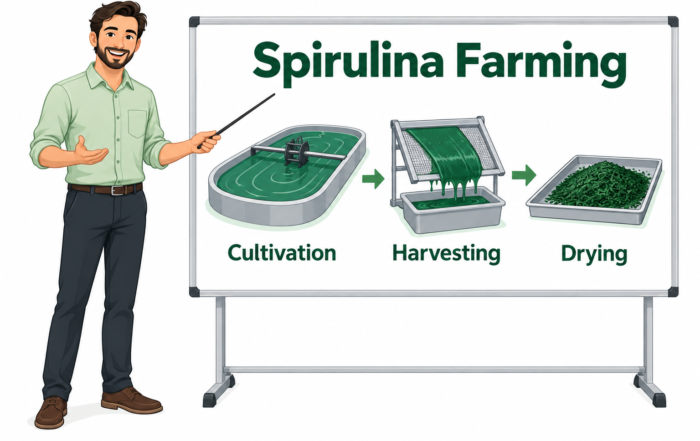
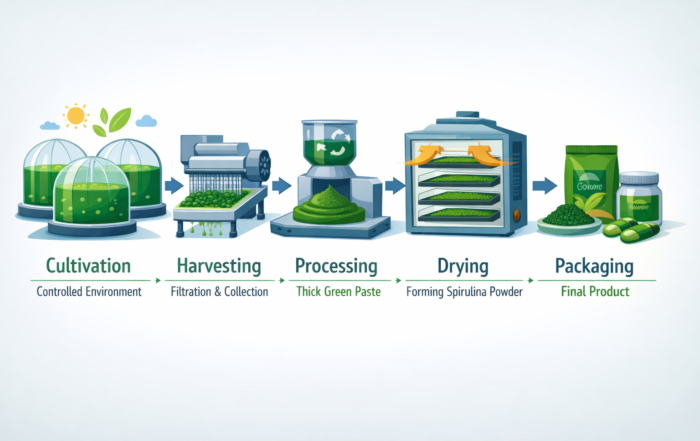
Turning living culture into premium biomass without destroying its value is where quality is won or lost. The chain runs: prefiltration (80 mesh) to remove debris, harvesting and washing (500 mesh) to concentrate and desalt, dewatering into a ~20% solids cake, then drying below 45°C.
Drying method determines nutrition and market grade:
| Drying Method | Temp Range | Nutrient Retention | Best For |
| Refractive Window (RWD) | 35 to 45°C | Excellent | Nutritional / export grade |
| Vacuum Drying | 40 to 50°C | Very Good | Small-batch, lab scale |
| Solar Drying | 55 to 65°C | Low | Animal feed only |
| Spray Drying | 100 to 180°C | Low | Industrial, non-premium |
For AP’s export ambitions, refractive window drying systems that preserve phycocyanin are the standard, paired with automated spirulina harvesting and dewatering equipment to protect consistency. The full production sequence is documented in this walkthrough of the complete spirulina farming setup from pond to pack.
Costs and ROI in Andhra Pradesh
AP’s affordable land and labour help, but the equipment, lab, and certification that make output sellable cost the same everywhere. A commercially viable farm starts from around ₹1 crore.
| Farm Size | Investment (INR) | Annual Yield (tonnes) | Commercial Verdict |
| 1 Acre | ₹75L to ₹1.07 Cr | 10 to 15 | Training / niche; negligible ROI |
| 2 to 3 Acres | ₹1.5 to ₹2.5 Cr | 20 to 30 | Sustainable, export-ready |
| 5+ Acres | ₹2 Cr+ | 60+ | Viable with assured buyers |
The ROI reality is unambiguous:
| Category | 1 Acre (₹ Lakhs) | 3 Acre (₹ Lakhs) |
| Setup (CapEx) | 107.00 | 210.00 |
| Revenue | 75.00 | 200.00 |
| Total Operating Cost | 83.22 | 121.62 |
| Net Profit (EBITDA) | -8.22 | 78.38 |
| ROI | -7.7% | 37.3% |
A 1-acre farm tends to lose money; a well-run 3-acre farm returns around 37% and breaks even in roughly three years. The detailed maths is in this analysis of spirulina farming profitability and realistic ROI at scale. Scale is what converts AP’s climate edge into profit.
Who Buys Spirulina from AP Farms
| Buyer Segment | Requirement | Grade |
| Nutraceutical & supplement brands | High protein, high phycocyanin, full COA | Export / premium |
| Food & beverage | Food-safe, documented | Certified food grade |
| Cosmetics & wellness | Pigment-rich, clean-processed | Premium |
| Animal & aqua feed | Bulk, price-sensitive | Feed grade |
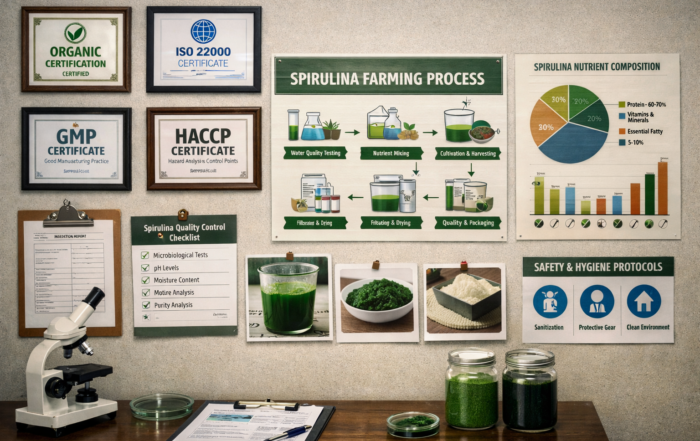
Premium and export buyers won’t purchase without a Certificate of Analysis (protein above 60%, phycocyanin at or above 10%, heavy metals within limits), the benchmarks set out in this guide to spirulina quality control and safety in mass production. Feed sales are easier but pay far less, so farms built only for bulk feed rarely justify their capital.
Compliance and Certification
Spirulina is regulated in India as a functional food, bringing it under FSSAI food-safety rules, environmental clearances, and groundwater regulations. For premium and export markets, organic and food-safety certifications backed by traceability and batch testing are non-negotiable, and falsely labelling a product organic without certification is a punishable offence. Building compliance in from day one, rather than retrofitting it, is what separates farms that reach premium buyers from those stuck in low-margin feed sales.
Building Your AP Farm the Right Way
Andhra Pradesh gives you the climate; the rest is engineering and discipline. Test your water, size the farm for genuine viability rather than to a tight budget, manage summer heat actively, and treat certification as a revenue enabler.
Greenbubble, a turnkey spirulina farm infrastructure company, helps AP farmers do exactly this through end-to-end spirulina farming consultancy and complete turnkey spirulina farm solutions. With 10+ years of experience, operations across 10+ countries, recognition as Best Microalgae Company by the European Algae Biomass Association in Paris, and a customer base that accounts for more than 90% of India’s spirulina production, its designs reflect what actually clears audits and finds buyers. Comparable builds are on the Greenbubble spirulina project case studies page.
Frequently Asked Questions
Is Andhra Pradesh good for spirulina cultivation?
Yes. Its warm, sunny, frost-free climate suits year-round cultivation, and it’s an established producing state. Success still depends on scale, quality, and buyer access.
How much land do I need to start?
One acre works for training or niche use, but 2 to 3 acres is the minimum for commercial viability, supporting up to 20 raceway ponds plus processing and lab facilities.
How much does it cost and what’s the return?
A viable farm starts from around ₹1 crore. A 3-acre operation can return roughly 37% annually; a 1-acre farm typically breaks even at best.
Does AP’s heat damage the culture?
It can. Above 40°C spirulina bleaches, so farms must actively cool the culture below 38°C using agitation, depth control, shading, and top-ups.
What certifications do I need to sell to premium buyers?
A Certificate of Analysis for every batch, plus organic and food-safety certifications for export. These, not climate, decide which buyers you can reach.
The Bottom Line
Spirulina cultivation in Andhra Pradesh begins with a genuine climate advantage, but climate is a multiplier, not a guarantee. Get the land, water, pond design, and cultivation discipline right; build at a scale that’s actually profitable; invest in the drying, lab, and certification systems that unlock premium and export buyers, and AP’s low-cost, high-sunlight profile becomes a real competitive edge. Plan around the economics, buyers, and compliance first, and let the climate do the rest.
Make us your source on Google
Table Of Contents