Spirulina gets cited frequently in conversations about the future of food – usually alongside claims about land efficiency, water use, and carbon footprint that sound almost too good to be accurate. Some of those claims hold up under scrutiny. Others need qualification. This article examines the actual sustainability case for spirulina agriculture, comparing it honestly against conventional protein sources and addressing where the limitations sit.
The Resource Efficiency Case
Spirulina’s sustainability argument starts with a simple comparison: protein yield per unit of land and water against conventional sources.
| Protein Source | Protein Yield (kg/hectare/year, approximate) | Water Use (litres per kg protein, approximate) |
| Beef cattle | 15-25 | 15,000-20,000 |
| Soybeans | 600-700 | 2,000-2,500 |
| Spirulina (raceway cultivation) | 3,000-6,000+ | 1,500-3,000 |
These figures vary by cultivation system and region, but the directional gap is consistent across studies. Spirulina’s protein density – 55-70% by dry weight – combined with rapid growth cycles in controlled raceway ponds produces meaningfully more protein per hectare than land-intensive livestock farming, and considerably more than most plant crops as well.
Land Use: A Genuine Advantage
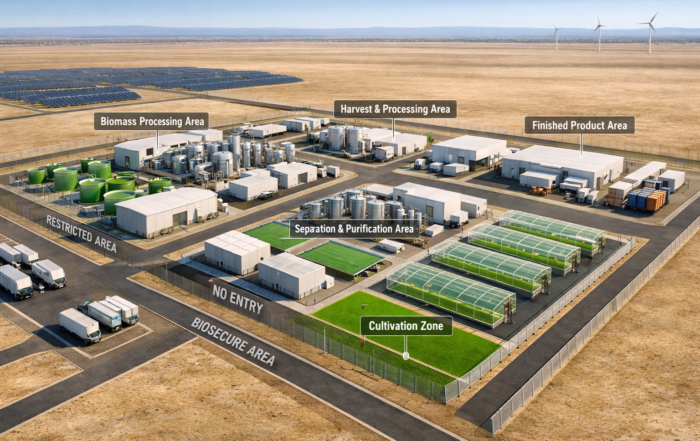
A 3-acre spirulina farm can support roughly 20 raceway ponds alongside harvesting, drying, and lab infrastructure, producing 20-30 tonnes of dried biomass annually – a yield-to-land ratio that conventional row crops cannot approach for an equivalent protein output. This is a meaningful consideration in how much land do you need for spirulina farming, particularly relevant in regions where arable land is increasingly constrained.
Water: An Advantage With Important Caveats
| Water Source Consideration | Sustainability Implication |
| Groundwater dependency | Requires careful management to avoid depletion |
| Water reuse potential | High – culture medium can be partially recycled across cycles |
| Rainwater harvesting integration | Reduces dependency on groundwater extraction |
| Evaporation loss in open ponds | Significant in hot, arid climates without mitigation |
Spirulina cultivation uses substantially less water than livestock farming, but it is not water-free, and evaporation losses in open raceway systems are real in hot climates. Farms that integrate rainwater harvesting and water reuse meaningfully improve their water sustainability profile beyond the baseline comparison figures.
Carbon and Climate Considerations
Spirulina is a photosynthetic organism that fixes carbon dioxide during growth, which has led to interest in its role in carbon capture conversations – covered in the future of carbon capture projects: a key to combatting climate change. However, the climate case requires honest framing: spirulina cultivation at commercial scale also consumes power for agitation, harvesting, and drying, which carries its own carbon footprint unless renewable energy is integrated into the operation, as explored in solar-based farms and projects: powering a sustainable agriculture revolution.
Where the Sustainability Case Is Strongest
Land-constrained regions. Areas with limited arable land but suitable climate conditions can produce significant protein output from comparatively small spirulina operations.
Integrated agriculture models. Spirulina cultivation paired with complementary agricultural activities – a model explored in integrated agriculture businesses: a sustainable farming model with spirulina farming – can improve overall resource efficiency across a farming operation rather than spirulina standing alone.
Animal feed substitution. Spirulina inclusion in poultry and aquaculture feed, detailed in spirulina for poultry and animal feed, offers a more resource-efficient pigmentation and nutrition source than some synthetic alternatives.
Where the Sustainability Case Needs Qualification
| Limitation | Why It Matters |
| Energy-intensive processing | Automated harvesting, drying, and lab testing all require continuous power |
| High capital requirement | ₹1.5-₹2.5 crore for a 3-acre farm limits accessibility, particularly for smallholders |
| Certification and compliance overhead | Adds cost and complexity not present in traditional row-crop farming |
| Climate sensitivity | Requires consistent warm temperatures; not viable in all geographies |
| Skilled labour dependency | Cannot be operated as a low-skill, low-investment smallholder crop at commercial scale |
This is the honest counterpoint to the resource-efficiency narrative: spirulina farming is sustainable in terms of land and water, but it is not simple, low-cost, or universally accessible the way some sustainable agriculture messaging implies. Why most spirulina feasibility reports are over-optimistic addresses this gap between marketing narrative and operational reality directly.
Is It Actually the Future?
The honest answer is qualified yes. Spirulina agriculture genuinely outperforms conventional protein sources on land and water efficiency, and its role in the future of agriculture: innovations shaping tomorrow’s farming is real, not speculative – it is already commercially deployed at scale across more than 10 countries.
But it is not a replacement for conventional agriculture broadly, nor is it accessible to every farmer without significant capital and technical capability. It is, more precisely, a high-value, resource-efficient crop suited to specific climates and specific producers willing to invest in the automation, certification, and skilled operation that commercial-scale cultivation actually requires.
The Infrastructure That Makes the Sustainability Case Real
Sustainability claims mean little without the systems to back them. Greenbubble’s turnkey farming solutions, deployed across more than 10 countries and underpinning over 90% of India’s spirulina production, are built around the resource-efficient, automated systems that make spirulina’s sustainability case operationally real rather than theoretical. The biotechnology projects driving innovation in agriculture and sustainability overview situates spirulina within this broader innovation landscape – a genuinely promising crop, with real constraints, not a miracle solution.
Make us your source on Google
Table Of Contents