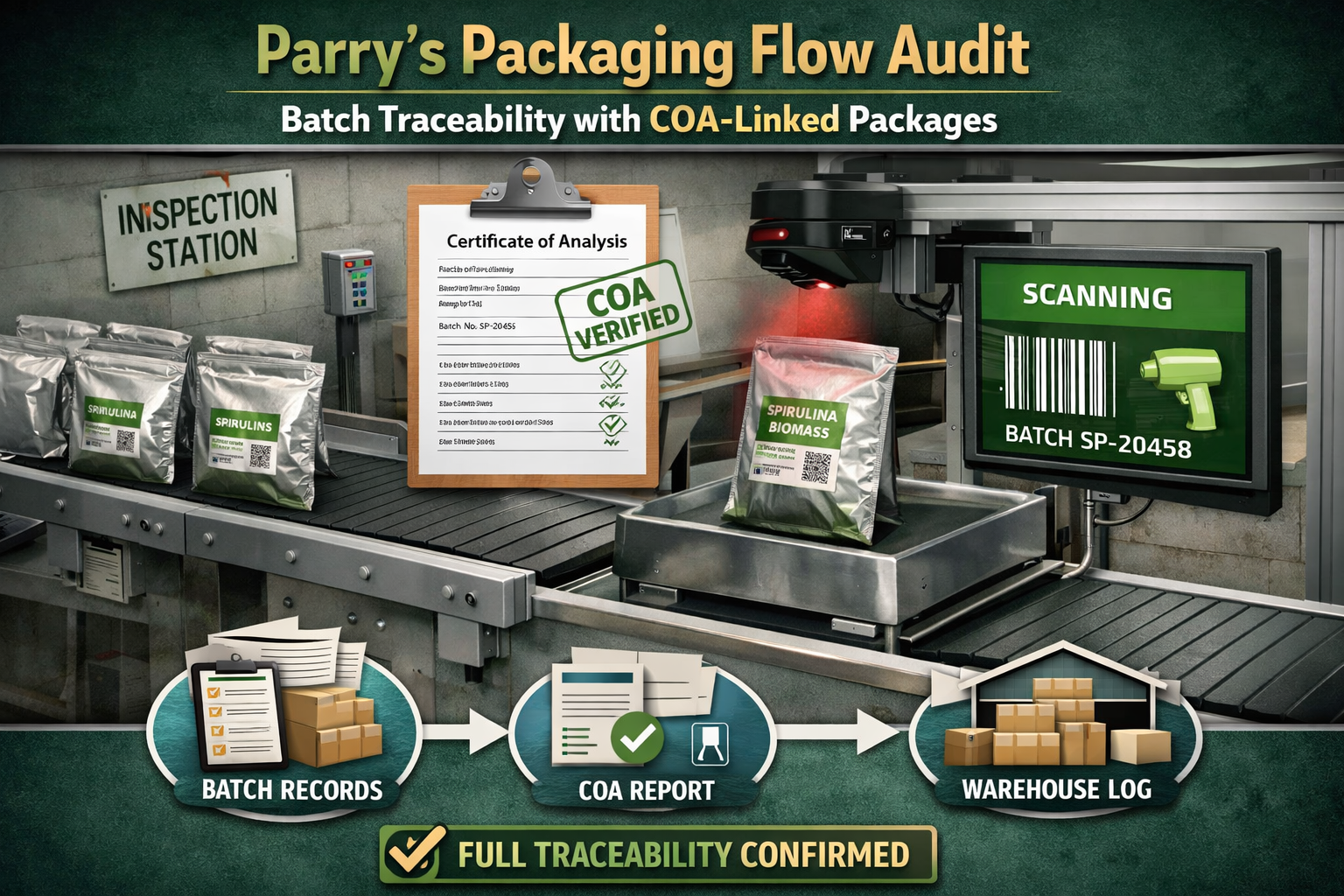
At industrial scale, traceability is not a documentation exercise – it is an operational capability. For large spirulina producers, packaging flow determines whether batch-level accountability is reliable or merely assumed. The Parry Nutraceuticals project illustrates how structured packaging audits and downstream automation can convert traceability from a compliance burden into a built-in system feature.
This article examines how Greenbubble supported Parry Nutraceuticals in auditing and redesigning packaging flow to enable consistent batch traceability at one of the world’s largest spirulina production facilities.
Client Background: Industrial-Scale Spirulina Leadership
Parry Nutraceuticals Ltd, part of the Murugappa Group, is widely recognised as India’s largest spirulina producer and a globally established leader in microalgae. With decades of experience supplying international markets, Parry operates under stringent quality, sustainability, and scale expectations.
Its Tamil Nadu facility spans approximately 100 acres and integrates cultivation, processing, and packaging within a single industrial ecosystem dedicated to microalgae.
Why Packaging Flow Becomes Critical at Scale
In small facilities, batch traceability is often managed through manual records and operator familiarity. At Parry’s scale, however, multiple parallel processing lines and high throughput volumes make informal controls insufficient.
Packaging flow – the sequence by which material moves from dewatering and drying into final packing – became the focal point for ensuring that each batch could be traced accurately across time, operators, and systems.
Scope of the Flow Audit
Greenbubble’s engagement focused on downstream processing rather than cultivation. The objective was to audit existing material movement, identify traceability risk points, and design automation that embedded batch integrity into daily operations.
Key audit questions included:
- Where do batches merge or split?
- How is batch identity preserved across process transitions?
- Which steps rely on manual intervention?
- How can automation reduce ambiguity?
Trial-Based Validation Before Full Deployment
Rather than implementing automation at full scale immediately, a 20 KLPH downstream trial system was installed and operated across all seasons for one year. This extended validation period ensured that packaging flow logic held under variable production conditions.
The trial phase allowed real-world stress testing of batch tracking, operator workflows, and system reliability before committing to full deployment.
Automation as a Traceability Enabler
Following successful trials, Greenbubble implemented a fully automated downstream system capable of handling commercial volumes with zero manual intervention. SCADA-based control enabled single-operator oversight of dewatering, discharge, and packaging coordination.
Custom auto-discharge dewatering systems ensured that material movement followed predictable, auditable pathways – reducing the risk of batch mixing or loss of identity.
Relevant automation components were aligned with advanced packing systems to ensure that batch traceability extended seamlessly into final packaging.
Packaging Flow Redesign: From Linear to Controlled
The redesigned flow replaced linear, operator-dependent movement with controlled transitions governed by automation logic. Each batch progressed through defined stages with clear handoff points, enabling reliable linkage between production data and packaged output.
This structure reduced dependence on post-process reconciliation and strengthened real-time traceability.
Operational Impact and Long-Term Stability
The upgraded packaging flow delivered measurable operational benefits:
- Reduced manpower requirements
- Improved process stability across seasons
- Consistent batch-level traceability
- Lower operational ambiguity during audits
Most importantly, the system has been operating reliably for several years, validating the durability of the design.
Greenbubble’s Role in Industrial-Scale Execution
Working with a producer of Parry’s scale required precision, patience, and deep process understanding. Greenbubble’s role extended from audit and design through installation, commissioning, and long-term stabilisation.
By combining trial-based validation with turnkey downstream execution, Greenbubble demonstrated its ability to support large, established nutraceutical manufacturers without disrupting ongoing operations.
What Large Spirulina Producers Can Learn
Key takeaways from the Parry Nutraceuticals project include:
- Traceability must be designed into packaging flow
- Trial systems reduce risk in high-volume environments
- Automation simplifies compliance at scale
- Downstream clarity protects upstream excellence
Batch traceability is strongest when it is enforced by systems, not memory.
FAQs
Q1. Why is batch traceability harder at large scale?
High throughput and parallel processes increase the risk of batch mixing without structured flow control.
Q2. What role does automation play in traceability?
Automation standardises material movement and reduces manual ambiguity.
Q3. Why was a year-long trial necessary?
Extended trials ensure reliability across seasonal and operational variations.
Q4. Does packaging flow affect audit outcomes?
Yes. Clear, controlled flow simplifies audit verification and reduces compliance risk.
Q5. Can existing plants retrofit such systems?
Yes. With proper auditing, downstream automation can be integrated into existing facilities.
Conclusion: Traceability Is a System Outcome
The Parry Nutraceuticals project shows that batch traceability is not achieved through paperwork alone. At industrial scale, it emerges from disciplined packaging flow design, automation, and validation. By auditing and restructuring downstream processes, Greenbubble helped Parry embed traceability directly into operations – ensuring that quality, compliance, and scale remain aligned over the long term.
Table Of Contents