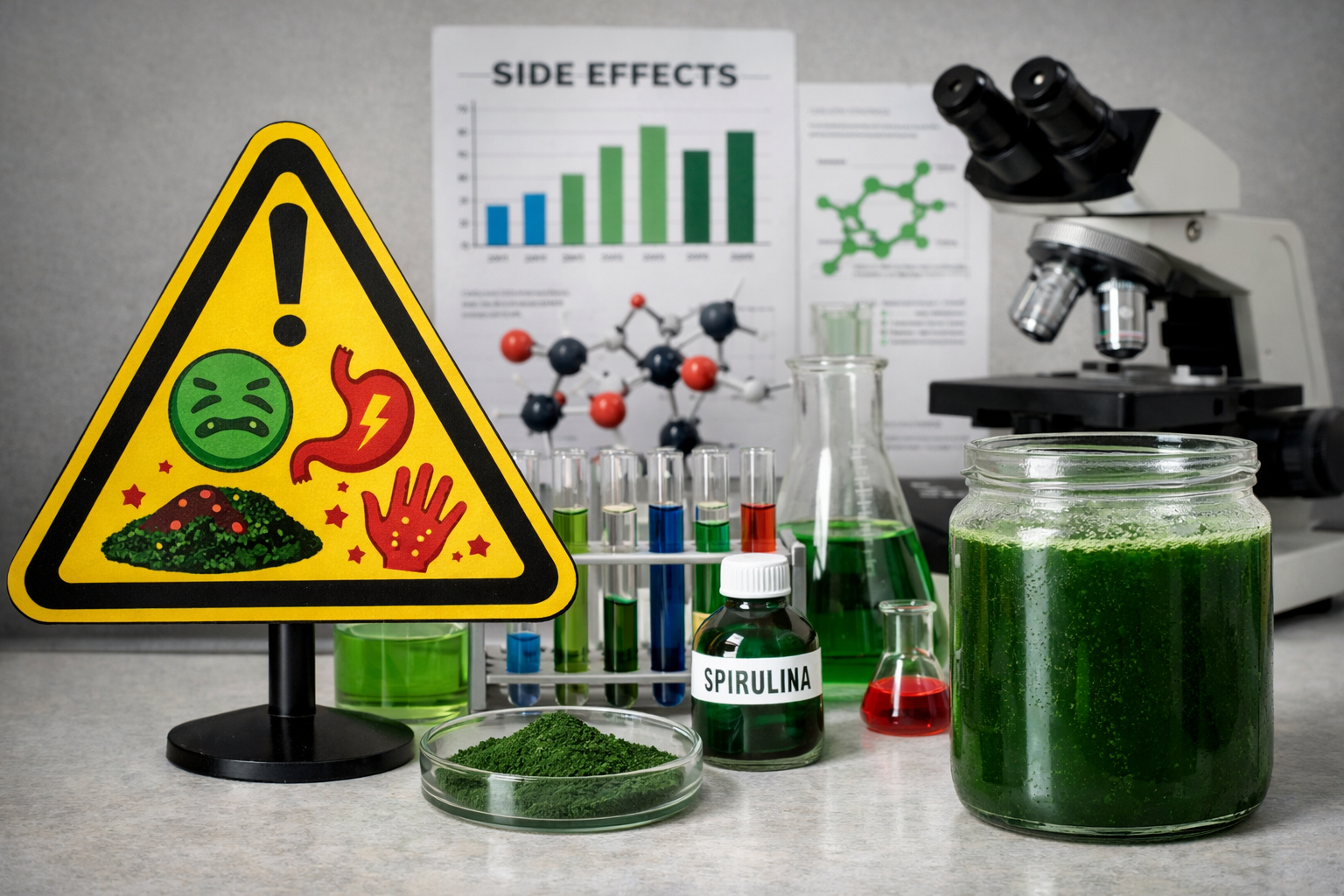
Yes, spirulina can cause side effects – but the honest answer requires nuance that most articles skip. The side effects that occur fall into two distinct categories: normal, mild, and temporary responses that resolve on their own, and signals of an underlying quality problem with the specific product consumed. Understanding which category applies matters more than simply knowing that side effects are possible.
The Common, Mild Side Effects
Digestive Discomfort
The most frequently reported side effect is gastrointestinal – mild nausea, bloating, or loose stools, typically in the first one to two weeks of use. This is a dose-and-adjustment issue, not a toxicity signal. Spirulina is a concentrated source of protein and minerals at 55–70% protein by dry weight, a density most digestive systems are not accustomed to processing in supplement form.
The fix: Start at 1–2 grams daily rather than the full 4.5-gram recommended dose, and increase gradually over one to two weeks. Taking spirulina with food rather than on an empty stomach further reduces the likelihood of nausea. Most people who experience this find it resolves completely as the body adjusts.
Green-Tinted Stool or Urine
Spirulina’s high chlorophyll content can produce green discolouration in waste. This is cosmetic and harmless – a direct, expected consequence of chlorophyll passing through the digestive tract, not a sign of anything wrong.
Mild Headache in the First Few Days
Some users report mild headaches when starting spirulina. This is commonly linked to chlorophyll’s heavy metal-binding activity in the gut, which can temporarily mobilise trace compounds before elimination. Adequate hydration minimises this, and it typically resolves within the first week.
Side Effects That Signal a Quality Problem
This distinction is the one most content on this topic fails to make clearly – and it is the most important one.
Symptoms Consistent With Heavy Metal Exposure
Persistent fatigue, neurological symptoms, or digestive distress that does not resolve after the initial adjustment period can indicate heavy metal contamination – lead, arsenic, cadmium, or mercury – in spirulina sourced from poorly controlled water. Spirulina is a bioaccumulator; it absorbs whatever is present in its growing environment. This is precisely why water quality is treated as a foundational production variable, not an afterthought.
A properly tested product carries a batch-specific COA confirming lead ≤0.20 µg/g, arsenic ≤0.50 µg/g, cadmium ≤0.20 µg/g, and mercury ≤0.025 µg/g. Symptoms beyond normal adjustment warrant checking this documentation – or discontinuing the product if it does not exist. The guide on avoiding heavy metals and contamination explains how serious producers prevent this at the source.
Microbial Illness Symptoms
Nausea, vomiting, or diarrhoea that is more severe than mild digestive adjustment can indicate microbial contamination – elevated bacterial counts or pathogen presence from inadequate HACCP-compliant production. Quality spirulina should test below 50,000 cfu/g total aerobic microbial count, with E. coli, Salmonella, and Staphylococcus confirmed absent per batch.
Allergic Reactions
Rash, itching, or swelling in individuals with algae or seafood sensitivities is a genuine, if rare, allergic response – not a quality issue, but a population-specific risk that warrants caution and medical guidance.
Populations Requiring Extra Caution
| Population | Why |
| Autoimmune conditions | Spirulina stimulates immune activity, which may worsen overactive immune states |
| Anticoagulant medication users | Spirulina has mild blood-thinning properties |
| PKU diagnosis | Cannot metabolise spirulina’s phenylalanine content |
| Gout or high uric acid | Spirulina’s nucleic acids metabolise to uric acid |
| Pregnant or breastfeeding | Heavy metal risk is disproportionate; verified COA essential |
What the Science Actually Concludes
Clinical research on spirulina consistently finds a strong safety profile, with mild gastrointestinal effects being the most commonly reported and most easily managed side effect category. Studies examining doses far above typical supplementation – up to 800mg per kilogram of body weight – have not established a toxicity threshold at realistic intakes.
What the science does not support is the assumption that all spirulina products are equivalent. The compounds responsible for both the benefits and the rare adverse effects – phycocyanin, chlorophyll, heavy metals if present, microbial load if present – depend entirely on how the spirulina was cultivated, harvested, and dried. A properly produced batch and a poorly produced batch can carry an identical label while delivering very different safety realities.
The Practical Takeaway
Mild, temporary digestive discomfort in the first two weeks is normal and expected. Anything beyond that – persistent symptoms, neurological signs, or severe gastrointestinal illness – warrants checking the product’s Certificate of Analysis rather than assuming it is simply “how spirulina affects me.”
Greenbubble’s production systems – which supply more than 90% of India’s spirulina output across operations in more than 10 countries – are built around per-batch lab verification precisely because the difference between a normal side effect and a genuine safety problem usually comes down to one thing: whether the product was tested before it reached you.
Table Of Contents