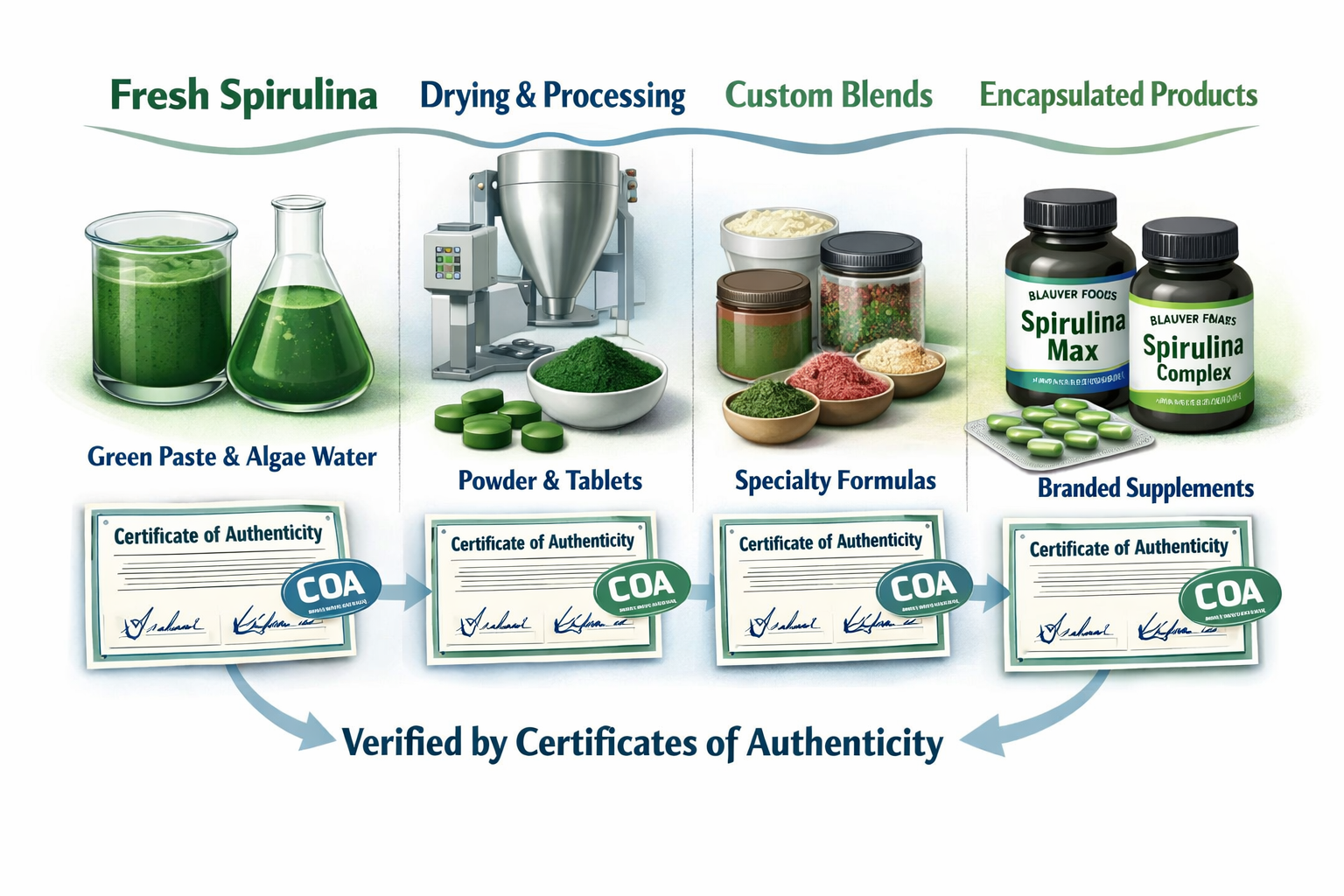
Retail success in the spirulina category depends on more than cultivation quality. Brands operating in mature consumer markets must bridge the gap between farm-level integrity and product formats that fit everyday lifestyles. The Blauver Foods project illustrates how sustainable spirulina cultivation can be paired with a diversified retail strategy built around custom blends, capsules, and direct consumer engagement.
This article explores how Blauver Foods’ retail approach shaped its spirulina production philosophy – and how Greenbubble supported the underlying farming systems that made this strategy viable.
Client Background: A Consumer-First Spirulina Brand
Blauver Foods Pvt Ltd is a Spain-based spirulina food company with a strong emphasis on ecological cultivation, minimal processing, and nutrient preservation. Unlike producers focused solely on bulk powder, Blauver Foods positions spirulina as a daily wellness ingredient, accessible through multiple consumer-friendly formats.
The brand’s portfolio includes fresh spirulina, custom blends, and capsule-based products – each requiring a consistent, high-quality raw material foundation.
Retail-Led Thinking: Why Format Diversity Matters
European wellness consumers engage with spirulina in varied ways. Capsules appeal to convenience-driven users, while blends target functional nutrition and taste integration. Blauver Foods recognised early that retail growth would depend on offering multiple formats without compromising nutritional integrity.
This retail-led mindset influenced upstream decisions, ensuring that spirulina cultivation prioritised purity, consistency, and gentle handling – qualities essential for downstream formulation.
Custom Blends as a Differentiation Strategy
Rather than offering a single commodity product, Blauver Foods developed multiple spirulina blends tailored to specific wellness use cases. This approach requires tighter batch control and predictable nutrient profiles, as variations become more visible when ingredients are combined.
Custom blending also places greater emphasis on traceability and reproducibility, linking retail formulation choices directly back to farming discipline.
Capsules: Convenience Without Compromise
Capsules represent one of the most widely adopted spirulina formats in retail markets. However, encapsulation amplifies quality expectations – odour, texture, and stability must remain consistent across large production runs.
For Blauver Foods, capsule production reinforced the need for spirulina cultivation systems that minimise contamination risk and preserve nutritional density, supporting long shelf life and consumer trust.
Direct Consumer Engagement Through Demonstrations
Beyond product formats, Blauver Foods invests in consumer education through demonstrations in apartment complexes, wellness events, and community spaces. These interactions allow consumers to understand product origins, usage, and benefits.
Such transparency increases accountability at the production level, as retail-facing narratives must align with actual farming practices.
Farming Systems Designed for Retail Consistency
To support its retail strategy, Blauver Foods partnered with Greenbubble Algalworks to implement spirulina farming systems aligned with ecological and quality-driven values.
Greenbubble’s role focused on designing cultivation infrastructure that delivered consistent output suitable for multiple retail formats. Engineered raceway pond systems and controlled harvesting practices ensured that spirulina entering the retail pipeline met predictable quality benchmarks.
Sustainability as a Brand and Production Requirement
Sustainability is not an optional attribute for Blauver Foods – it is central to brand identity. Chemical-free cultivation, controlled growing environments, and minimal processing ensure that nutritional value is retained from farm to final product.
Greenbubble’s farming methodologies aligned closely with this philosophy, enabling the project to maintain ecological integrity while supporting commercial retail needs.
Greenbubble’s Role in an International Context
The Blauver Foods project highlights Greenbubble’s ability to adapt spirulina farming systems to international contexts. Working in Spain required alignment with local regulations, climate conditions, and operational expectations distinct from Indian projects.
By supporting Blauver Foods’ cultivation goals, Greenbubble demonstrated the scalability and adaptability of its spirulina farming approach across geographies.
Strategic Significance: From Farm to Shelf
This collaboration underscores an important insight for spirulina producers: retail success begins at the farm. Custom blends and capsules magnify inconsistencies that might go unnoticed in bulk sales.
By aligning cultivation systems with retail strategy, Blauver Foods built a supply chain where sustainability, quality, and consumer trust reinforce each other.
What Other Spirulina Brands Can Learn
Key lessons from the Blauver Foods project include:
- Retail formats should influence farming decisions early
- Custom blends demand higher consistency than single products
- Capsules require exceptional hygiene and stability
- Consumer education strengthens supply chain accountability
Retail-ready spirulina is designed, not reformulated later.
FAQs
Q1. Why does retail strategy matter in spirulina farming?
Retail formats place specific demands on consistency, hygiene, and nutrient stability that influence upstream cultivation.
Q2. Are custom blends harder to manage than single products?
Yes. Blends amplify variability, making consistent raw material quality critical.
Q3. Do capsules require different spirulina quality standards?
Capsules heighten sensitivity to odour, texture, and stability, requiring tighter production control.
Q4. How does sustainability influence retail trust?
Consumers increasingly expect ecological practices to align with health claims, especially in nutraceuticals.
Q5. Can farming systems adapt to international retail markets?
Yes. With the right design approach, spirulina farming systems can meet diverse regulatory and consumer expectations.
Conclusion: Retail Strategy Shapes the Farm
The Blauver Foods project demonstrates that successful spirulina retail brands are built upstream. By aligning sustainable farming practices with a diversified retail strategy encompassing custom blends, capsules, and consumer engagement, Blauver Foods created a coherent farm-to-shelf model. With Greenbubble’s support, the project stands as an example of how spirulina farming systems can serve sophisticated retail ambitions without compromising ecological values.
Table Of Contents