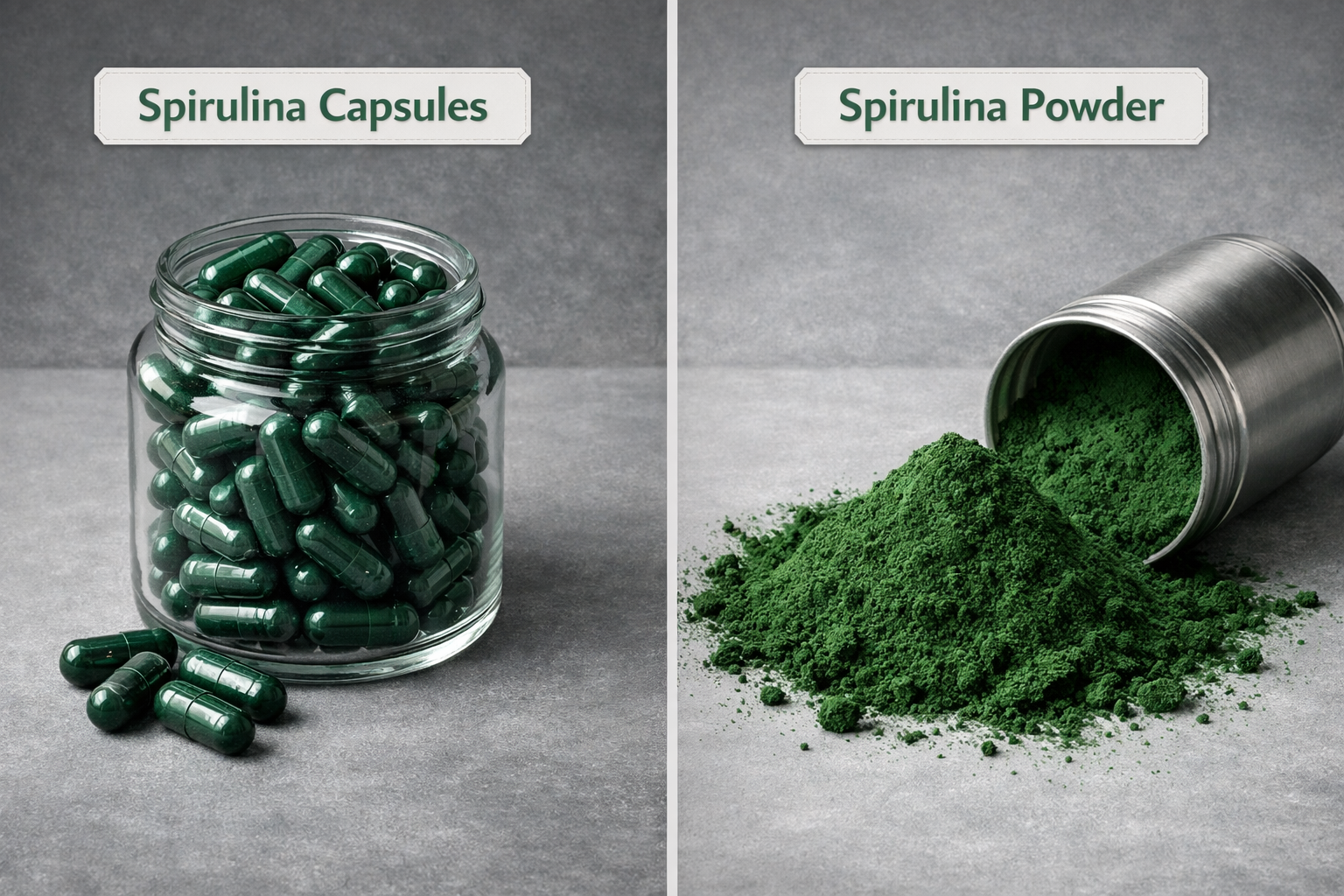
The spirulina inside a capsule and the spirulina in a powder jar are, at their core, the same thing – dried, ground Arthrospira platensis biomass. The organism is identical. The nutritional composition, assuming equivalent production quality, is identical. What differs is everything around the spirulina: how it is delivered, how it is stored, how quickly the body accesses it, how easy it is to use consistently, and how transparently the manufacturer communicates what is actually inside.
Those differences are meaningful enough to make one form clearly better for some people and clearly worse for others. Here is the full comparison.
Head-to-Head: The Complete Comparison
| Factor | Spirulina Powder | Spirulina Capsules |
| Bioavailability | Slightly higher – no capsule shell to dissolve first | Marginally slower onset – shell dissolves before absorption begins |
| Dose flexibility | Full control – measure any amount | Fixed per capsule (typically 500mg-1g per capsule) |
| Taste | Strong, oceanic – noticeable in water, masked by smoothies | None – capsule completely eliminates taste |
| Ease of daily use | Requires measuring and mixing | Swallow and done – maximum convenience |
| Onset of absorption | Immediate upon consumption | 15-30 minutes for capsule shell dissolution |
| Typical daily dose | ~4.5g (approximately 1 level teaspoon) | ~4.5g = 5-9 capsules depending on capsule size |
| Cost per gram | Lower – no encapsulation cost | Higher – encapsulation adds manufacturing overhead |
| Shelf life | 24 months vacuum-sealed; degrades faster once opened | 24 months; individual capsules limit air exposure per dose |
| Phycocyanin preservation | Dependent on storage conditions post-opening | Capsule shell offers modest additional protection per unit |
| Portability | Requires jar, scoop, and mixing liquid | Highly portable – pre-measured, no equipment |
| Quality verification | COA directly reflects what you are consuming | COA must also account for capsule shell ingredients |
| Mixing versatility | Blends into smoothies, juices, food – natural colourant | Cannot be incorporated into food without opening capsules |
| Risk of adulteration | Visible colour and odour are quality indicators | Contents not visible without opening – harder to assess |
| GMP compliance requirement | Standard for both – but encapsulation adds one more step requiring clean room conditions | Encapsulation environment must meet GMP standards separately from powder production |
| Best for | Daily users, smoothie drinkers, food applications, higher doses | Travel, taste-sensitive users, fixed-dose supplementation, beginners |
Bioavailability: Does the Capsule Slow Things Down?
The difference in absorption speed between powder and capsules is real but modest. Powder consumed in a smoothie or dissolved in water begins contact with digestive enzymes immediately. A capsule – whether gelatin or vegetarian HPMC – requires 15 to 30 minutes to dissolve in stomach acid before the spirulina inside becomes accessible.
For most supplementation purposes, this difference is clinically insignificant. Spirulina’s benefits accumulate over weeks of consistent use, not minutes after each dose. The 20-minute difference in onset is irrelevant to outcomes measured over months.
Where it does matter slightly is in the context of pre-exercise consumption. If taking spirulina for its antioxidant or amino acid contribution around a training session with a tight timing window, powder consumed 30-45 minutes before activity begins absorption faster than a capsule taken at the same time.
Dose: The Practical Reality of Capsule Counts
The recommended daily amount of approximately 4.5 grams sounds straightforward. In powder form it is one level teaspoon. In capsule form, it requires doing the arithmetic on the capsule size your product uses.
| Capsule Size | Spirulina per Capsule | Capsules Needed for 4.5g Daily |
| Standard 00 capsule | ~500mg (0.5g) | 9 capsules |
| Large 000 capsule | ~750mg (0.75g) | 6 capsules |
| Tablet (compressed) | ~1,000mg (1g) | 5 tablets |
Nine capsules per day is a meaningful daily commitment. Many people who start spirulina in capsule form either under-dose because the full amount feels like a lot of capsules, or switch to powder when they realise the cost per gram is considerably higher at equivalent doses. Understanding this before purchasing avoids both outcomes.
Cost: What the Price Difference Actually Reflects
Capsules cost more per gram of spirulina delivered. The premium reflects legitimate manufacturing costs – encapsulation equipment, capsule shell material, cleanroom handling, and the additional quality control step of verifying the capsule shell ingredients separately from the spirulina content.
| Format | Approximate Cost per Gram (certified organic, quality grade) |
| Bulk powder (1kg+) | ₹800-₹1,500/kg = ₹0.80-₹1.50/g |
| Retail powder (100-250g) | ₹1,500-₹3,000/kg equivalent |
| Capsules (500mg, retail) | ₹2,500-₹5,000/kg equivalent |
The capsule premium is real and consistent. For daily long-term supplementation at the recommended 4.5g dose, powder is significantly more economical. For occasional use, travel, or users for whom taste is a hard barrier, the capsule premium is a reasonable exchange.
Quality Indicators: What Each Form Reveals
This is where the two formats diverge in an underappreciated way. Powder gives you direct sensory access to the spirulina itself. A deep forest-green colour, a fresh oceanic odour, and a smooth texture are all indicators of properly dried, well-stored spirulina. Pale, yellowish, or brownish powder signals heat damage – phycocyanin and chlorophyll degradation visible to the naked eye. A stale or chemical odour signals storage or contamination issues.
Capsules remove these indicators entirely. You are trusting the manufacturer’s documentation rather than any property of the product you can assess yourself. This makes the COA – Certificate of Analysis – even more critical for capsule products. A capsule-format spirulina without a batch-specific COA declaring protein percentage, phycocyanin content, and heavy metal results is asking for more trust than it has earned.
The encapsulation process itself is also a quality variable. Capsules produced in non-GMP-compliant environments introduce contamination risk at the filling stage – a risk that does not exist in bulk powder sold directly from the drying line. Reputable producers – those whose cultivation and processing systems are built to the standard that organisations like Greenbubble have developed across commercial spirulina farms in more than 10 countries – apply the same rigour to encapsulation as to cultivation. Not all capsule products on the market can say the same.
The Verdict
Neither format is universally superior. The decision is practical.
Choose powder if: you already have a daily smoothie or juice routine, you want maximum dose flexibility, you are supplementing at the full 4.5g daily dose long-term, or you want direct sensory access to the product’s quality indicators.
Choose capsules if: taste is a genuine barrier to consistency, you travel frequently, you are new to spirulina and want to start without committing to a flavour, or you prefer the simplicity of a fixed daily count.
The spirulina that matters is the one you actually take every day. Format is the variable that determines consistency – and consistency is what produces results.
Table Of Contents